Department of Tropical Medicine and Infectious Diseases, Center of Internal Medicine II, Rostock University Medical Center, Rostock, Germany.
Institute of Immunology, University of Rostock, Rostock, Germany.
Front Cell Infect Microbiol. 2022 Jul 5;12:893632. doi: 10.3389/fcimb.2022.893632. eCollection 2022.
Schistosomiasis is a severe parasitic disease that is primarily driven by the host's immune response to schistosome eggs trapped in tissue and by the granulomatous inflammatory and fibrotic reaction they cause. Despite significant progress in understanding the complex immunological processes involved in the relationship between schistosomes and their host, neither an effective vaccine against the infection nor anti-fibrotic drugs currently exists, making the search for new targets for schistosome drugs and vaccine candidates even more important. In order to identify new molecular targets for defense against or elimination of the parasite, we investigate herein the interplay between the host and male or female schistosomes, clearly separating this from the action of the parasite eggs.
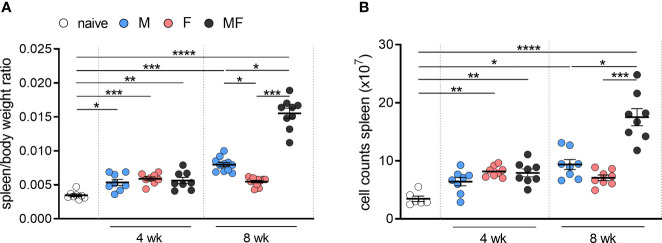
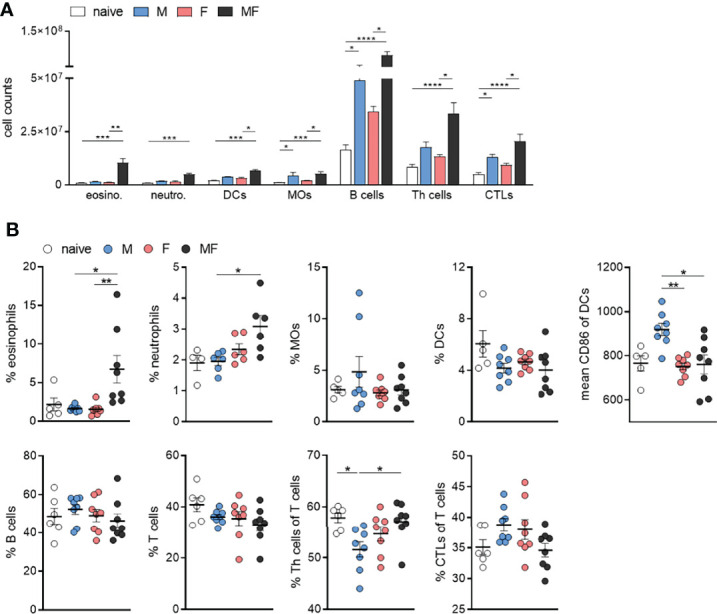
For this purpose, we infected 6-8-week-old female NMRI mice with 100 male (M), female (F), or both (MF) cercariae and performed a comparative transcriptomic and flow cytometric analysis of their spleens.
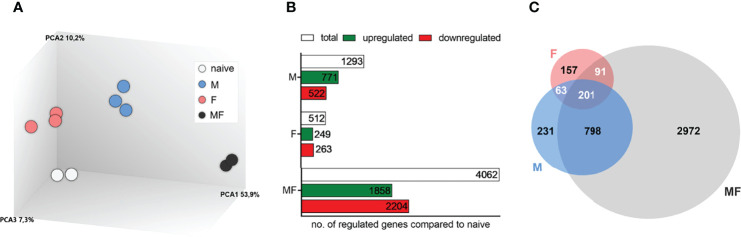
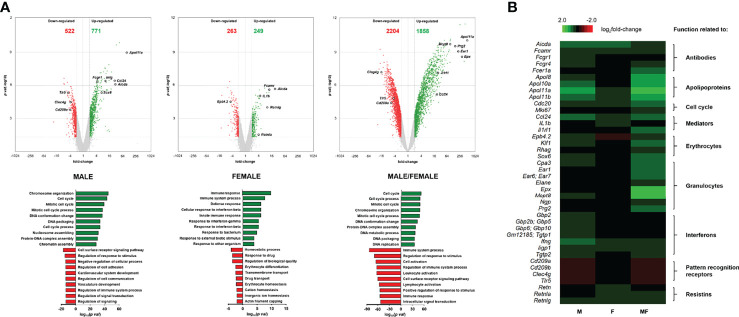
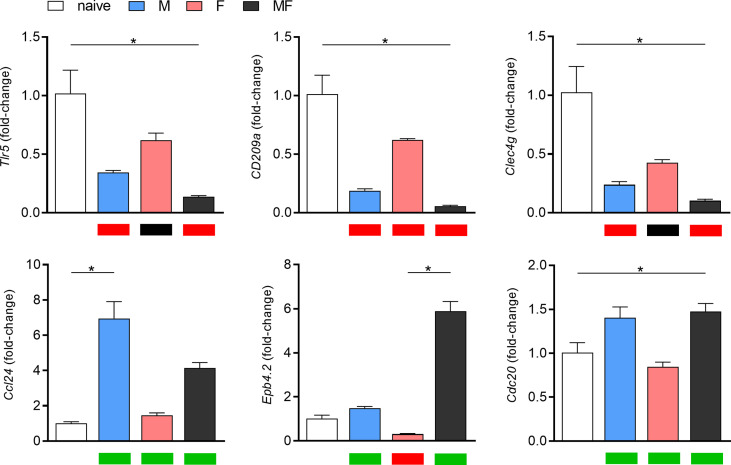
Principal component analysis of a total of 22,207 transcripts showed a clear clustering of the experimental groups. We identified a total of 1,293 genes in group M, 512 genes in group F, and 4,062 genes in group MF that were differentially expressed compared to naive controls. The highest percentage of regulated genes (2,972; 65.9%) was found in group MF alone, but there was a large overlap between groups M and MF (798; 17.7%) and a small overlap between groups F and MF (91; 2.0%). Only 4.5% of genes (201) were revealed to be regulated in all experimental groups (M/F/MF). In addition, we were able to show that both worm sexes trigger immune responses in an egg-independent manner (non-polarized Th1 and Th2 response), with female worms exerting less regulatory influence than males.
Our data show that adult schistosomes trigger sex-specific, egg-independent immune responses. The lists of genes regulated by adult female or male worms presented here may be useful in deciphering host-parasite interactions to identify targets for schistosome elimination.
血吸虫病是一种严重的寄生虫病,主要由宿主对被困在组织中的血吸虫卵的免疫反应以及由此引起的肉芽肿性炎症和纤维化反应驱动。尽管在理解血吸虫与宿主之间复杂的免疫过程方面取得了重大进展,但目前既没有有效的感染疫苗,也没有抗纤维化药物,因此寻找血吸虫药物和疫苗候选物的新靶点变得更加重要。为了确定针对寄生虫防御或消除的新分子靶标,我们在此研究了宿主与雄性或雌性血吸虫之间的相互作用,明确将其与寄生虫卵的作用区分开来。
为此,我们用 100 只雄性(M)、雌性(F)或雌雄混合(MF)尾蚴感染 6-8 周龄的 NMRI 雌性小鼠,并对其脾脏进行比较转录组学和流式细胞术分析。
总共 22,207 个转录本的主成分分析显示实验分组明显聚类。与对照组相比,我们在 M 组中总共鉴定出 1,293 个基因,在 F 组中鉴定出 512 个基因,在 MF 组中鉴定出 4,062 个基因差异表达。调节基因的最高百分比(2,972;65.9%)仅在 MF 组中发现,但 M 组和 MF 组之间有很大的重叠(798;17.7%),F 组和 MF 组之间的重叠很小(91;2.0%)。仅 4.5%的基因(201)在所有实验组(M/F/MF)中被调控。此外,我们还能够证明雌雄两性蠕虫都以卵非依赖性方式触发免疫反应(非极化 Th1 和 Th2 反应),雌性蠕虫的调节影响小于雄性。
我们的数据表明,成年血吸虫触发性别特异性、卵非依赖性免疫反应。本文介绍的由成年雌性或雄性蠕虫调节的基因列表可能有助于解析宿主-寄生虫相互作用,以确定血吸虫消除的靶标。