Department of Medicine, Division of Infectious Diseases, College of Medicine, Rush University, Chicago, IL, United States.
Division of Epidemiology and Biostatistics, School of Public Health, University of Illinois, Chicago, IL, United States.
Front Cell Infect Microbiol. 2022 Jul 5;12:916437. doi: 10.3389/fcimb.2022.916437. eCollection 2022.
Penile microbiome composition has been associated with HSV-2 and HIV in men and with bacterial vaginosis (BV) and HSV-2 in female sex partners. This study sought to 1) characterize penile microbiome composition over a 1-year period and 2) identify factors associated with penile microbiome composition over time.
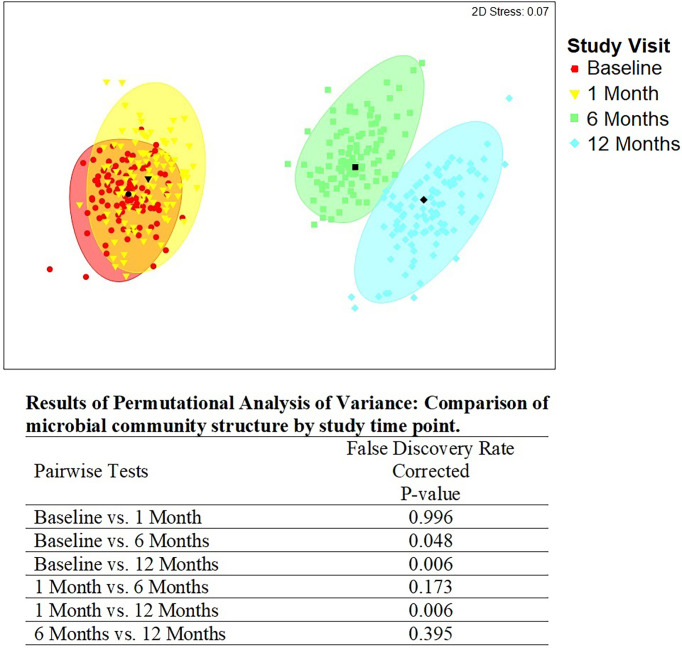
This prospective study of community-recruited heterosexual couples in Kenya measured penile and vaginal microbiomes 16S ribosomal RNA gene amplicon sequencing at 4 time points over 1 year (1, 6, and 12 months after baseline). We used longitudinal mixed-effects modeling to assess associated demographic, behavioral, and disease factors and changes in community type, meatal taxa with the highest mean relative abundance, and alpha and beta diversity measures. We estimated group-based trajectories to elucidate compositional trends.
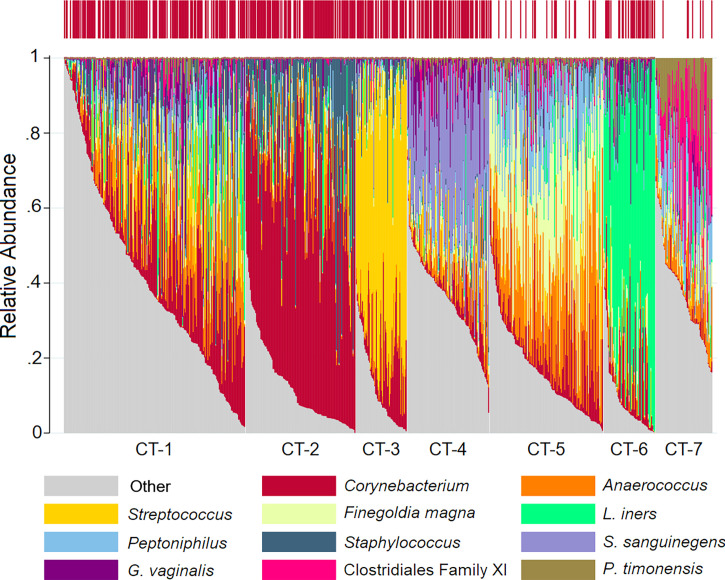
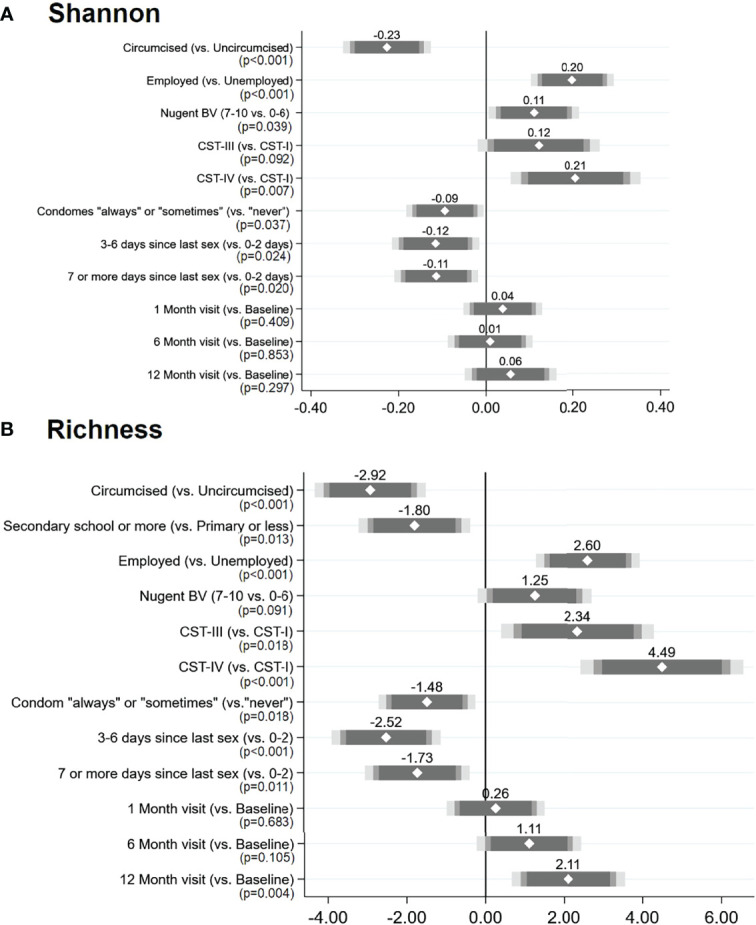
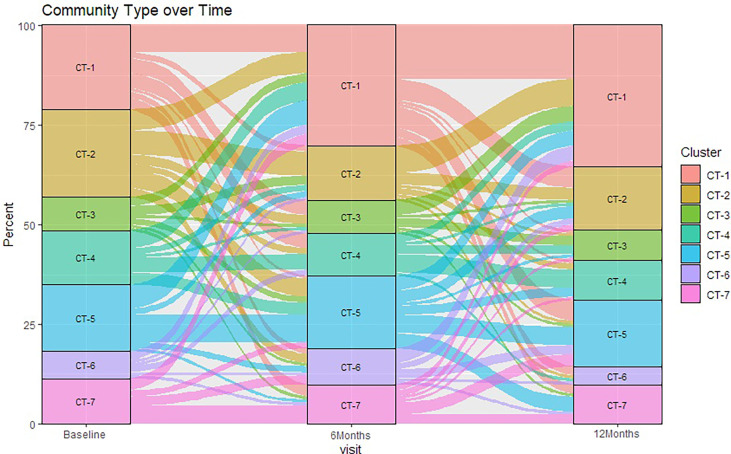
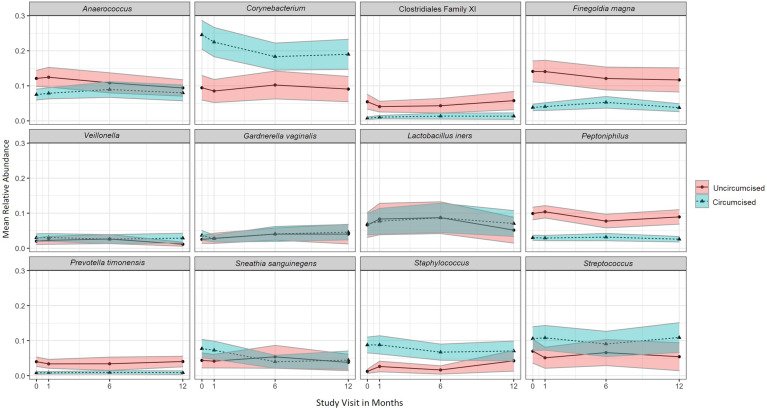
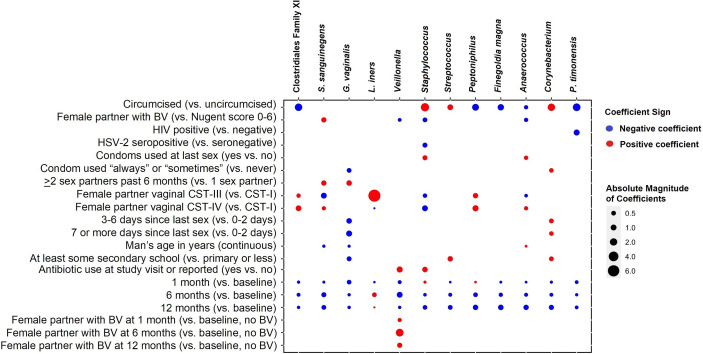
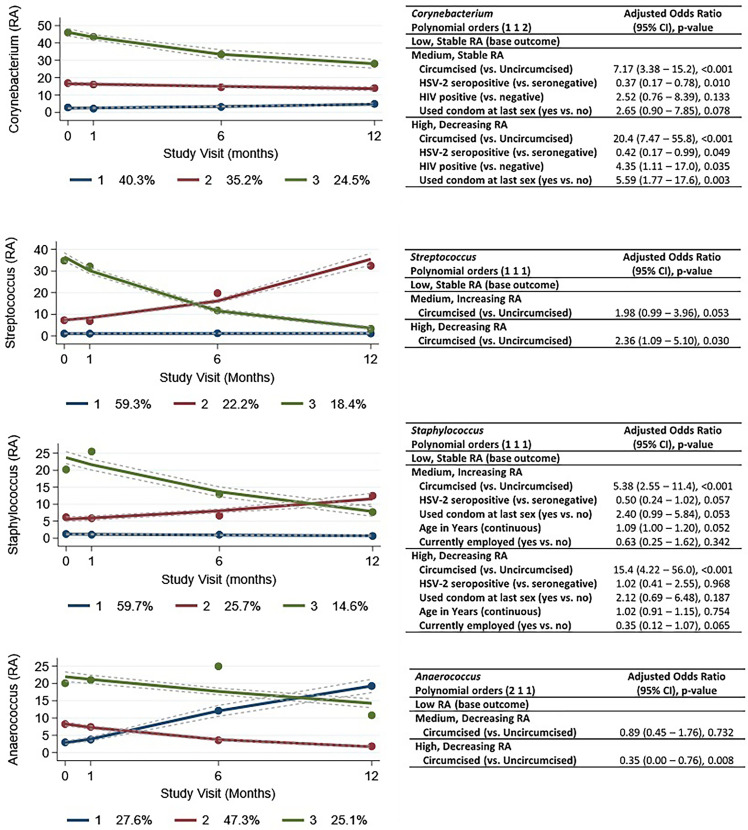
Among 218 men with 740 observations, men had a median age of 26 years, 11.6% were living with HIV, and 46.1% were HSV-2 seropositive. We identified 7 penile community types that varied with circumcision status, female partner vaginal microbiome community state type (CST), condom use, and penile washing. Across varying analytic approaches, 50%-60% of men had stable penile microbiome compositions. Alpha diversity measures were lower for circumcised men and those who reported condom use; they were stable over time but higher if female partners had diverse CSTs or BV. BV was positively associated with the relative abundance of numerous individual penile taxa. The decreased Bray-Curtis similarity was more common for men with HSV-2, and HSV-2 was also associated with a lower relative abundance of and .
Over a 1-year period, penile microbiome composition was stable for a substantial proportion of men and was influenced by men's circumcision status, sexual practices, female partner's vaginal CST and BV status, and men's HSV-2 status. In the female genital tract, a diverse CST is often associated with poorer health outcomes. Our results contribute toward understanding whether this framework extends to the penile microbiome and whether diversity and the associated penile microbiome compositions influence susceptibility or resilience to poorer health outcomes in men. Focusing on understanding how these factors influence the penile microbiome may lead to therapeutic avenues for reduced HSV-2 and BV infections in men and their female sex partners.
阴茎微生物组的组成与男性中的 HSV-2 和 HIV 以及女性性伴侣中的细菌性阴道病 (BV) 和 HSV-2 有关。本研究旨在 1) 描述阴茎微生物组在 1 年内的组成,2) 确定随时间推移与阴茎微生物组组成相关的因素。
本研究是肯尼亚社区招募的异性恋夫妇的前瞻性研究,在 1 年的 4 个时间点(基线后 1、6 和 12 个月)通过 16S 核糖体 RNA 基因扩增子测序测量阴茎和阴道微生物组。我们使用纵向混合效应模型评估相关的人口统计学、行为和疾病因素以及群落类型、具有最高平均相对丰度的尿道口分类群以及 alpha 和 beta 多样性测量值的变化。我们估计基于群组的轨迹以阐明组成趋势。
在 218 名男性中,有 740 次观察,男性的中位年龄为 26 岁,11.6% 携带 HIV,46.1% 为 HSV-2 血清阳性。我们鉴定了 7 种阴茎群落类型,这些类型与包皮环切状态、女性性伴侣阴道微生物群落状态类型 (CST)、避孕套使用和阴茎清洗有关。在不同的分析方法中,50%-60%的男性阴茎微生物组组成稳定。包皮环切男性和报告使用避孕套的男性的 alpha 多样性测量值较低;它们随时间保持稳定,但如果女性伴侣的 CST 多样或 BV 丰富,则更高。BV 与许多个体阴茎分类群的相对丰度呈正相关。对于 HSV-2 阳性男性,Bray-Curtis 相似性降低更为常见,并且 HSV-2 也与相对丰度较低相关。
在 1 年期间,相当一部分男性的阴茎微生物组组成稳定,受男性包皮环切状态、性行为、女性性伴侣阴道 CST 和 BV 状态以及男性 HSV-2 状态的影响。在女性生殖道中,多样化的 CST 通常与较差的健康结果相关。我们的结果有助于了解该框架是否扩展到阴茎微生物组,以及多样性和相关的阴茎微生物组组成是否影响男性对较差健康结果的易感性或抵抗力。关注于了解这些因素如何影响阴茎微生物组可能为减少男性及其女性性伴侣中的 HSV-2 和 BV 感染提供治疗途径。