Nigeria Field Epidemiology and Laboratory Training Program, Abuja, Nigeria.
Department of Community Medicine, Alex Ekwueme Federal University Teaching Hospital Abakaliki, Ebonyi State, Nigeria.
Pan Afr Med J. 2022 Apr 20;41:317. doi: 10.11604/pamj.2022.41.317.34307. eCollection 2022.
identifying risk factors for SARS-CoV-2 infection and disease severity is critical to developing measures to protect vulnerable groups. We aimed to identify risk factors for SARS-CoV-2 infection and severe disease.
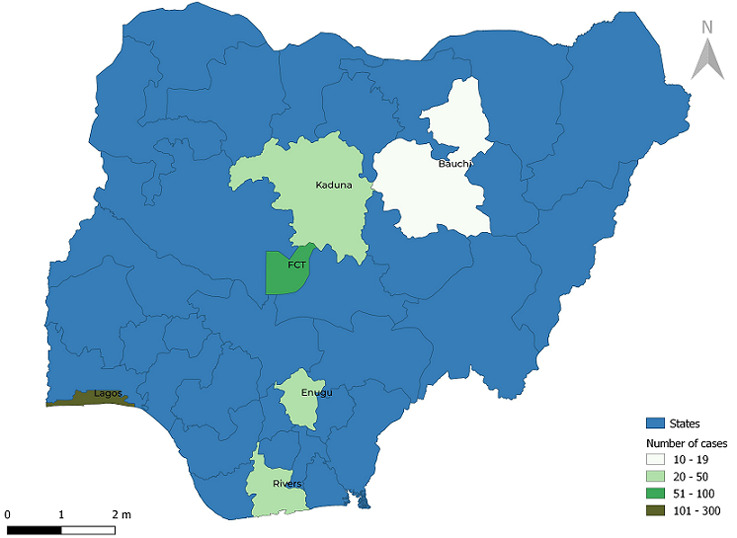
this was an unmatched case-control study that recruited participants in the country from April to July 2020. Cases tested positive on Reverse-Transcription Polymerase Chain Reaction (RT-PCR), while controls tested negative on RT-PCR. Data were collected by trained research assistants using an interviewer-administered questionnaire. Cases were categorized into severe and non-severe to identify risk factors for severe disease.
there were 497 cases and 997 controls recruited. Contact with a symptomatic confirmed case adjusted odds ratio (aOR) 1.91 (95% CI: 1.30-2.80) and attendance of mass gatherings aOR 1.74 (95% CI: 1.10-2.74) were associated with SARS-CoV-2 infection, while the use of private transportation aOR 0.56 (95% CI: 0.37-0.85) and use of a face mask aOR 0.43 (95% CI: 0.19-0.95) were associated with lower odds of infection. We identified 38 (7.7%) severe cases and 459 (92.3%) non-severe cases. Multivariate analysis identified age ≥ 50 years aOR 4.54 (95% CI: 1.86-11.08), male sex aOR 2.95 (95% CI: 1.07-8.11), hypertension aOR 3.52 (95% CI: 1.46-8.50), and diabetes aOR 5.76 (95% CI: 2.01-16.50) as risk factors for severe disease, while Hausa ethnicity aOR 0.15 (95% CI: 0.04-0.62) lowered the odds of severe disease.
our findings highlight the importance of exposure history, mass gatherings, private transportation, and the use of face masks. Being over 50 years, male and having comorbidities indicate a worse prognosis.
确定 SARS-CoV-2 感染和疾病严重程度的危险因素对于制定保护弱势群体的措施至关重要。本研究旨在确定 SARS-CoV-2 感染和严重疾病的危险因素。
这是一项在 2020 年 4 月至 7 月期间在该国招募参与者的非匹配病例对照研究。病例经逆转录聚合酶链反应(RT-PCR)检测呈阳性,而对照组经 RT-PCR 检测呈阴性。数据由经过培训的研究助理使用访谈者管理的问卷收集。病例被分为重症和非重症,以确定重症的危险因素。
共招募了 497 例病例和 997 例对照。与症状性确诊病例接触的调整后的比值比(aOR)为 1.91(95%CI:1.30-2.80),参加群众集会的 aOR 为 1.74(95%CI:1.10-2.74)与 SARS-CoV-2 感染相关,而使用私人交通工具的 aOR 为 0.56(95%CI:0.37-0.85)和使用口罩的 aOR 为 0.43(95%CI:0.19-0.95)与较低的感染几率相关。我们发现 38 例(7.7%)重症病例和 459 例(92.3%)非重症病例。多变量分析确定年龄≥50 岁 aOR 为 4.54(95%CI:1.86-11.08),男性 aOR 为 2.95(95%CI:1.07-8.11),高血压 aOR 为 3.52(95%CI:1.46-8.50),糖尿病 aOR 为 5.76(95%CI:2.01-16.50)为重症的危险因素,而豪萨族裔 aOR 为 0.15(95%CI:0.04-0.62)降低了重症的几率。
我们的研究结果强调了接触史、群众集会、私人交通工具和口罩使用的重要性。50 岁以上、男性和合并症表明预后更差。