Department of Clinical and Experimental Epilepsy, UCL Queen Square Institute of Neurology, London, UK.
The Chalfont Centre for Epilepsy, Chalfont St. Peter, UK.
Hum Brain Mapp. 2022 Dec 15;43(18):5465-5477. doi: 10.1002/hbm.26022. Epub 2022 Jul 21.
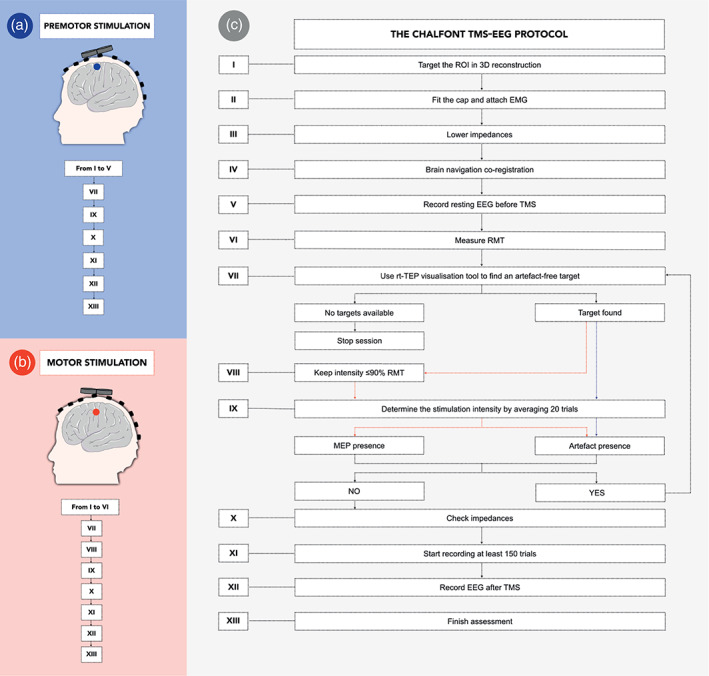
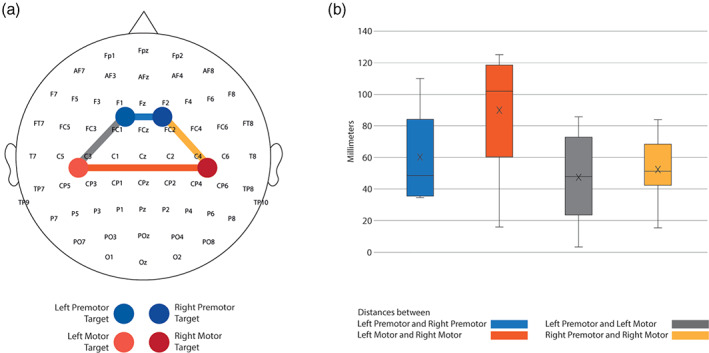
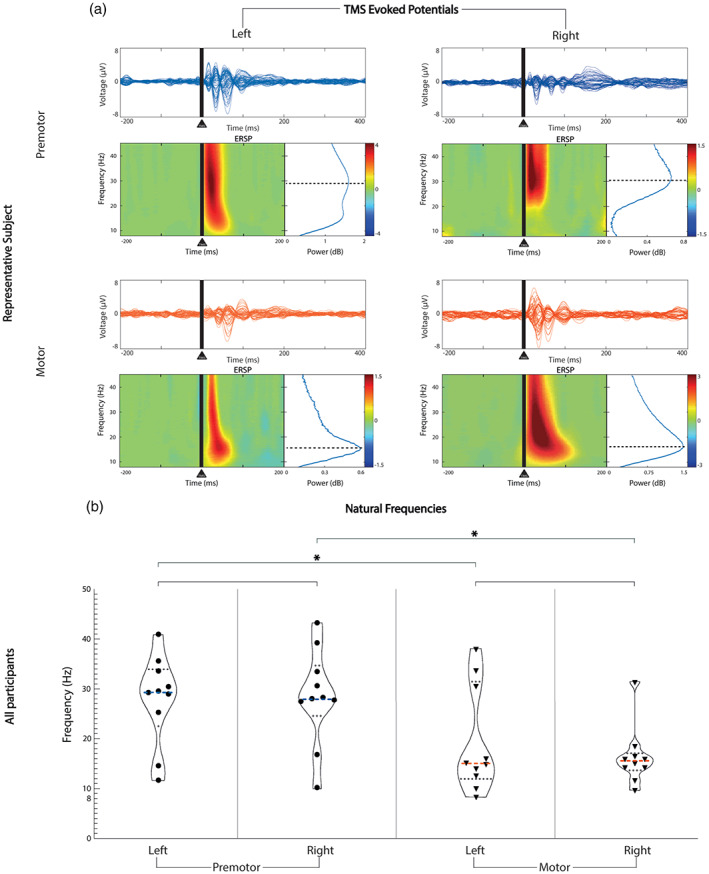
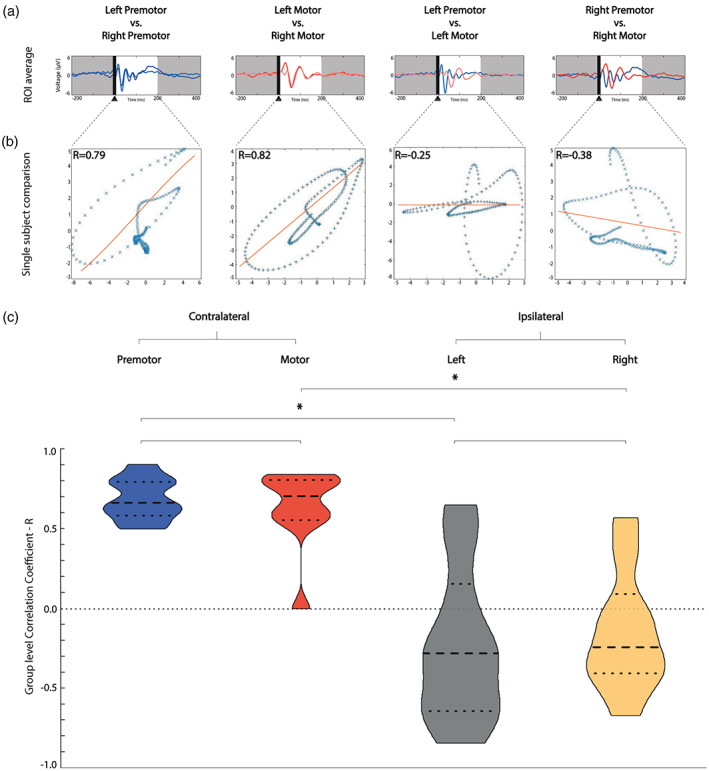
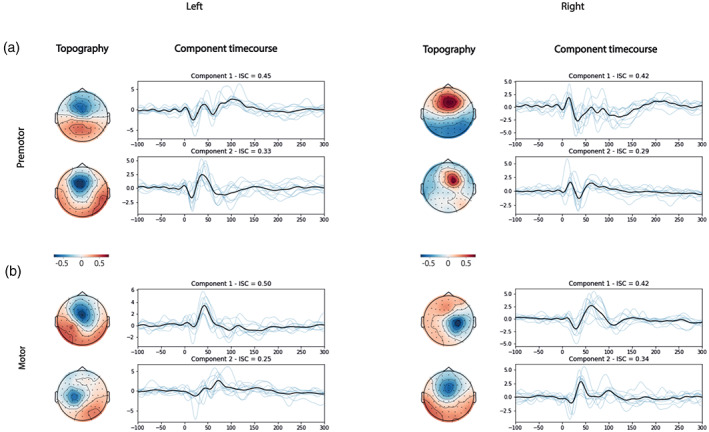
Transcranial magnetic stimulation (TMS)-evoked EEG potentials (TEPs) have been used to study the excitability of different cortical areas (CAs) in humans. Characterising the interhemispheric symmetry of TMS-EEG may provide further understanding of structure-function association in physiological and pathological conditions. We hypothesise that, in keeping with the underlying cytoarchitectonics, TEPs in contralateral homologous CAs share similar, symmetric spectral features, whilst ipsilateral TEPs from different CAs diverge in their waveshape and frequency content. We performed single-pulse (<1 Hz) navigated monophasic TMS, combined with high-density EEG with active electrodes, in 10 healthy participants. We targeted two bilateral CAs: premotor and motor. We compared frequency power bands, computed Pearson correlation coefficient (R) and Correlated Component Analysis (CorrCA) to detect divergences, as well as common components across TEPs. The main frequency of TEPs was faster in premotor than in motor CAs (p < .05) across all participants. Frequencies were not different between contralateral homologous CAs, whilst, despite closer proximity, there was a significant difference between ipsilateral premotor and motor CAs (p > .5), with frequency decreasing from anterior to posterior CAs. Correlation was high between contralateral homologous CAs and low between ipsilateral CAs. When applying CorrCA, specific components were shared by contralateral homologous TEPs. We show physiological symmetry of TEP spectral features between contralateral homologous CAs, whilst ipsilateral premotor and motor TEPs differ despite lower geometrical distance. Our findings support the role of TEPs as biomarker of local cortical properties and provide a first reference dataset for TMS-EEG studies in asymmetric brain disorders.
经颅磁刺激(TMS)诱发的脑电图(TEP)已被用于研究人类不同皮质区(CA)的兴奋性。描述 TMS-EEG 的半球间对称性可能会进一步了解生理和病理条件下的结构-功能关联。我们假设,与潜在的细胞构筑学一致,对侧同源 CA 的 TEP 具有相似的、对称的频谱特征,而来自不同 CA 的同侧 TEP 在波形和频率内容上则存在差异。我们在 10 名健康参与者中进行了单脉冲(<1 Hz)导航单相 TMS 联合主动电极高密度 EEG。我们以两个双侧 CA 为目标:运动前皮质和运动皮质。我们比较了频率功率带,计算了 Pearson 相关系数(R)和相关成分分析(CorrCA)以检测差异以及 TEP 之间的共同成分。所有参与者的运动前皮质的 TEP 主要频率均快于运动皮质(p < 0.05)。尽管距离更近,但对侧同源 CA 的频率没有差异,而同侧运动前皮质和运动皮质之间则存在显著差异(p > 0.5),频率从前到后 CA 逐渐降低。对侧同源 CA 之间的相关性很高,而同侧 CA 之间的相关性很低。应用 CorrCA 时,对侧同源 TEP 共享特定成分。我们显示了 TEP 频谱特征在对侧同源 CA 之间的生理对称性,而同侧运动前皮质和运动皮质 TEP 尽管距离更近,但存在差异。我们的发现支持 TEP 作为局部皮质特性生物标志物的作用,并为不对称性脑疾病的 TMS-EEG 研究提供了第一个参考数据集。