Department of Health Sciences, Magna Græcia University, 88100, Catanzaro, Italy.
Department of Oral and Maxillofacial Sciences, Sapienza University of Rome, 00161, Rome, Italy.
Int J Implant Dent. 2022 Jul 22;8(1):32. doi: 10.1186/s40729-022-00431-5.
To investigate clinical and radiographic outcomes of transcrestal maxillary sinus floor elevation performed with an injectable xenograft in gel form, analyzing general, local and surgical variables possibly influencing the results.
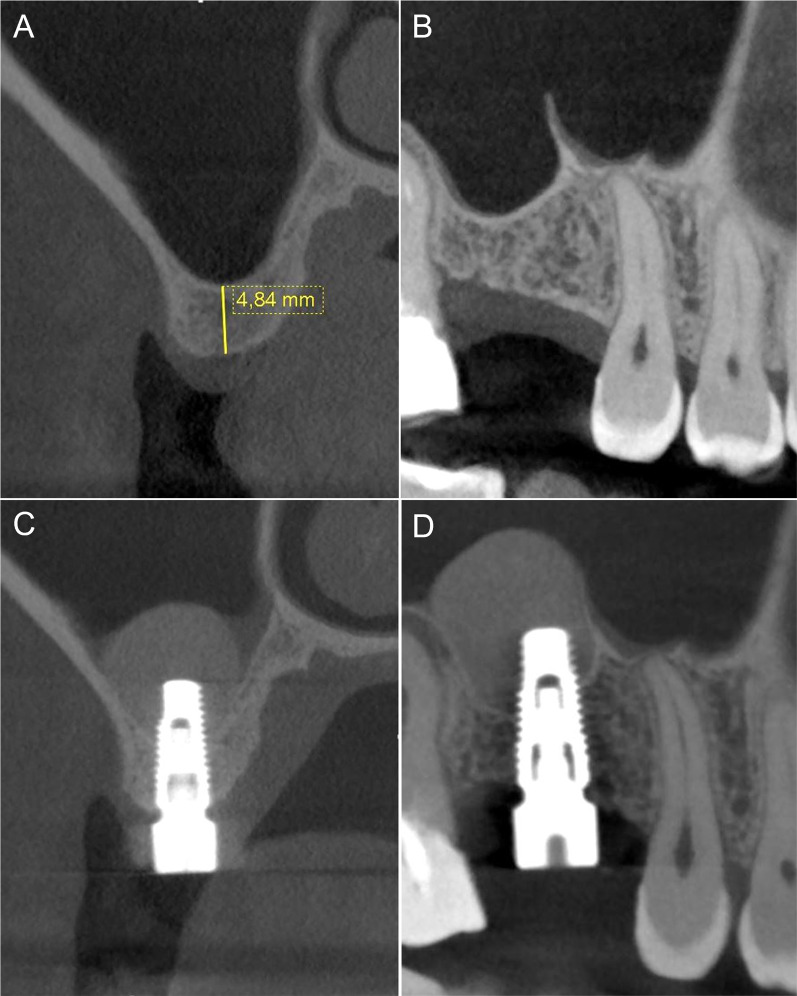
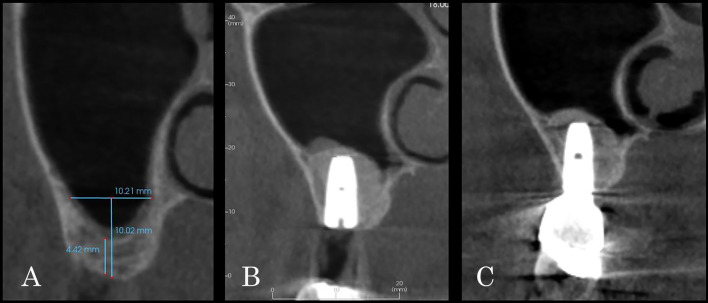
Patients with residual crestal height < 5 mm underwent transcrestal sinus floor elevation with xenograft in gel form to allow the placement of a single implant. Simultaneous implant placement was performed when primary stability was ≥ 15 Ncm. Graft height was measured immediately after surgery (T0) and after 6 months of healing (T1). Univariate and multivariate regression models were built to assess associations between clinical variables with implant survival and graft height at T1.
71 patients underwent transcrestal sinus floor elevation and 54 implants were simultaneously placed. Delayed implant placement (at T1) was possible in 5 cases out of 17 (29.4%), whereas in 12 patients (70.6%) implant insertion was not possible or required additional sinus grafting. Implant survival rate, with a follow-up varying from 12 to 32 months after loading, was 100%. Mean pre-operative bone height was 3.8 ± 1.0 mm, at T0 was 13.9 ± 2.2 mm and at T1 was 9.9 ± 2.8 mm. Bone height at T1 was negatively influenced by membrane perforation at surgery (p = 0.004) and positively influenced by immediate implant insertion (p < 0.001).
Transcrestal sinus floor elevation performed with injectable xenograft gel resulted in 100% implant survival rate. However, immediate implant insertion seems a crucial factor to preserve vertical bone gain: one-stage technique seems to be the most predictable approach to optimize clinical outcomes with this approach. Trial registration clinicaltrials.gov, NCT05305521. Registered 31 March 2022-Retrospectively registered, https://clinicaltrials.gov/ct2/show/NCT05305521 .
研究凝胶形式的可注射异种移植物行经牙槽嵴顶上颌窦底提升的临床和影像学结果,分析可能影响结果的一般、局部和手术变量。
牙槽嵴顶剩余高度<5mm 的患者接受凝胶形式的经牙槽嵴顶窦底提升,以允许植入单个种植体。当初级稳定性≥15 Ncm 时,同时进行植入物放置。在手术后即刻(T0)和愈合后 6 个月(T1)测量移植物高度。建立单变量和多变量回归模型,以评估临床变量与 T1 时种植体存活率和移植物高度之间的关联。
71 例患者行经牙槽嵴顶窦底提升,同时放置 54 枚种植体。17 例中有 5 例(29.4%)延迟至 T1 时放置植入物,12 例(70.6%)患者无法植入或需要额外的窦底植骨。植入物存活率在负荷后 12 至 32 个月的随访中为 100%。术前骨高度平均为 3.8±1.0mm,T0 时为 13.9±2.2mm,T1 时为 9.9±2.8mm。T1 时的骨高度受手术时的膜穿孔(p=0.004)的负面影响和即时植入物插入(p<0.001)的正面影响。
用可注射异种移植物凝胶行经牙槽嵴顶窦底提升,种植体存活率为 100%。然而,即时植入物插入似乎是保持垂直骨量增加的关键因素:一期技术似乎是优化这种方法临床结果的最可靠方法。试验注册临床Trials.gov,NCT05305521。2022 年 3 月 31 日注册-回顾性注册,https://clinicaltrials.gov/ct2/show/NCT05305521。