Departments of Preclinical and Translational Pharmacokinetics and Pharmacodynamics, Research and Early Development, Genentech, Inc, South San Francisco, CA, USA.
Safety Assessment, Research and Early Development, Genentech, Inc, South San Francisco, CA, USA.
MAbs. 2022 Jan-Dec;14(1):2085535. doi: 10.1080/19420862.2022.2085535.
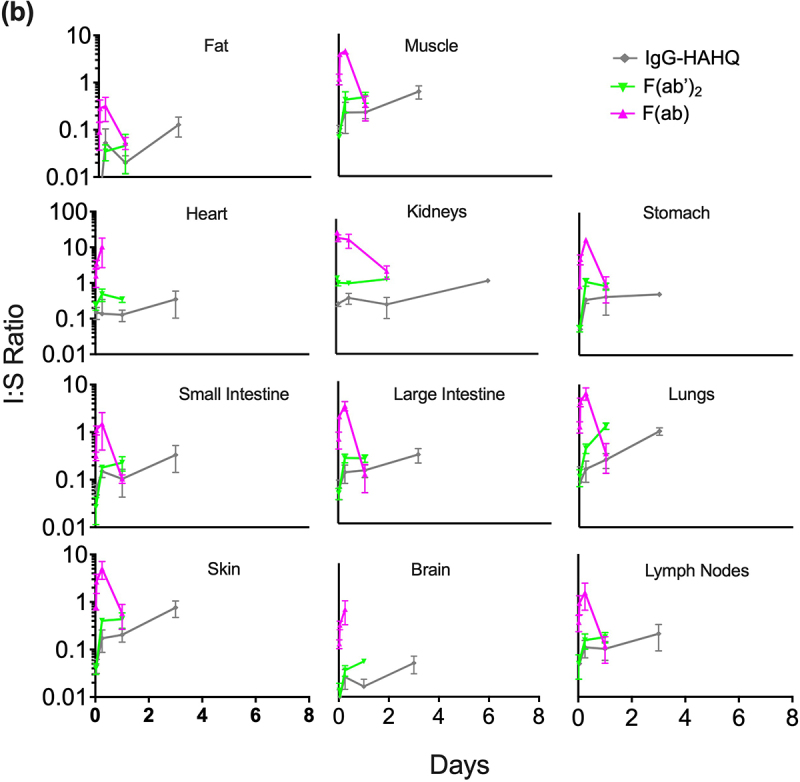
Advances in antibody engineering have enabled the construction of novel molecular formats in diverse shapes and sizes, providing new opportunities for biologic therapies and expanding the need to understand how various structural aspects affect their distribution properties. To assess the effect of antibody size on systemic pharmacokinetics (PK) and tissue distribution with or without neonatal Fc receptor (FcRn) binding, we evaluated a series of non-mouse-binding anti-glycoprotein D monoclonal antibody formats, including IgG [150 kDa], one-armed IgG [100 kDa], IgG-HAHQ (attenuated FcRn binding) [150 kDa], F(ab') [100 kDa], and F(ab) [~50 kDa]. Tissue-specific concentration-time profiles were corrected for blood content based on vascular volumes and normalized based on interstitial volumes to allow estimation of interstitial concentrations and interstitial:serum concentration ratios. Blood correction demonstrated that the contribution of circulating antibody on total uptake was greatest at early time points and for highly vascularized tissues. Tissue interstitial PK largely mirrored serum exposure profiles. Similar interstitial:serum ratios were obtained for the two FcRn-binding molecules, IgG and one-armed IgG, which reached pseudo-steady-state kinetics in most tissues. For non-FcRn-binding molecules, interstitial:serum ratios changed over time, suggesting that these molecules did not reach steady-state kinetics during the study. Furthermore, concentration-time profiles of both intact and catabolized molecule were measured by a dual tracer approach, enabling quantification of tissue catabolism and demonstrating that catabolism levels were highest for IgG-HAHQ. Overall, these data sets provide insight into factors affecting preclinical distribution and may be useful in estimating interstitial concentrations and/or catabolism in human tissues.
抗体工程的进展使得构建各种形状和大小的新型分子结构成为可能,为生物疗法提供了新的机会,并扩大了对理解各种结构方面如何影响其分布特性的需求。为了评估抗体大小对系统药代动力学(PK)和组织分布的影响,无论是否与新生儿 Fc 受体(FcRn)结合,我们评估了一系列非结合小鼠的抗糖蛋白 D 单克隆抗体形式,包括 IgG [150 kDa]、单臂 IgG [100 kDa]、IgG-HAHQ(减弱 FcRn 结合)[150 kDa]、F(ab') [100 kDa] 和 F(ab) [~50 kDa]。根据血管体积和间质体积对组织特异性浓度-时间曲线进行血液校正,以允许估计间质浓度和间质:血清浓度比。血液校正表明,在早期时间点和高血管化组织中,循环抗体对总摄取的贡献最大。组织间质 PK 很大程度上反映了血清暴露曲线。两种 FcRn 结合分子 IgG 和单臂 IgG 获得了相似的间质:血清比值,它们在大多数组织中达到了准稳态动力学。对于非 FcRn 结合分子,间质:血清比值随时间变化,表明这些分子在研究期间未达到稳态动力学。此外,通过双示踪剂方法测量了完整和代谢产物分子的浓度-时间曲线,从而能够定量组织代谢,并证明 IgG-HAHQ 的代谢水平最高。总体而言,这些数据集提供了对影响临床前分布的因素的深入了解,并可用于估计人组织中的间质浓度和/或代谢。