Translational Genomics Research Institute, Phoenix, Arizona, United States of America.
Charles River Laboratories, Wilmington, MA, United States of America.
PLoS One. 2022 Jul 22;17(7):e0264986. doi: 10.1371/journal.pone.0264986. eCollection 2022.
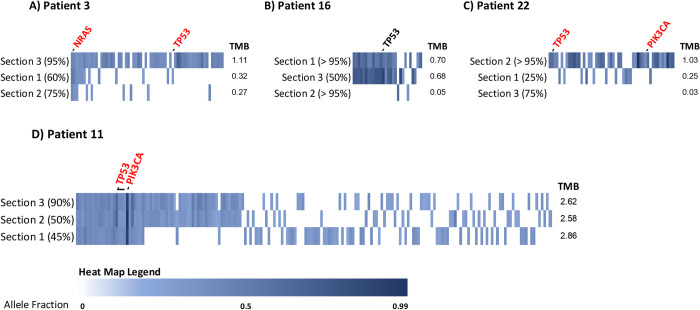
Cancer genomic heterogeneity presents significant challenges for understanding oncogenic processes and for cancer's clinical management. Variation in driver mutation frequency between patients with the same tumor type as well as within an individual patients' cancer can shape the use of mutations as diagnostic, prognostic, and predictive biomarkers. We have characterized genomic heterogeneity between and within canine splenic hemangiosarcoma (HSA), a common naturally occurring cancer in pet dogs that is similar to human angiosarcoma (AS). HSA is a clinically, physiologically, and genomically complex canine cancer that may serve as a valuable model for understanding the origin and clinical impact of cancer heterogeneity. We conducted a prospective collection of 52 splenic masses from 43 dogs (27 HSA, 15 benign masses, and 1 stromal sarcoma) presenting for emergency care with hemoperitoneum secondary to a ruptured splenic mass. Multi-platform genomic analysis included matched tumor/normal targeted sequencing panel and exome sequencing. We found candidate somatic cancer driver mutations in 14/27 (52%) HSAs. Among recurrent candidate driver mutations, TP53 was most commonly mutated (30%) followed by PIK3CA (15%), AKT1 (11%), and CDKN2AIP (11%). We also identified significant intratumoral genomic heterogeneity, consistent with a branched evolution model, through multi-region exome sequencing of three distinct tumor regions from selected primary splenic tumors. These data provide new perspectives on the genomic landscape of this veterinary cancer and suggest a cross-species value for using HSA in pet dogs as a naturally occurring model of intratumoral heterogeneity.
癌症基因组异质性给人们理解致癌过程和癌症临床管理带来了巨大挑战。同一肿瘤类型的患者之间以及个体患者的癌症内部驱动突变频率的变化会影响突变作为诊断、预后和预测生物标志物的应用。我们已经描述了犬脾血管肉瘤(HSA)之间和内部的基因组异质性,HSA 是宠物犬中常见的自然发生的癌症,类似于人类血管肉瘤(AS)。HSA 是一种临床上、生理学上和基因组上都很复杂的犬科癌症,可能是了解癌症异质性的起源和临床影响的有价值的模型。我们进行了一项前瞻性研究,收集了 43 只因脾破裂导致腹腔内出血而紧急就诊的犬的 52 个脾脏肿块,其中 27 个为 HSA,15 个为良性肿块,1 个为间质肉瘤。多平台基因组分析包括匹配的肿瘤/正常靶向测序面板和外显子组测序。我们在 27 个 HSA 中有 14 个(52%)发现了候选体细胞癌驱动突变。在反复出现的候选驱动突变中,TP53 突变最为常见(30%),其次是 PIK3CA(15%)、AKT1(11%)和 CDKN2AIP(11%)。我们还通过对三个选定的原发性脾肿瘤的三个不同肿瘤区域进行多区域外显子组测序,发现了明显的肿瘤内基因组异质性,与分支进化模型一致。这些数据为兽医癌症的基因组图谱提供了新的视角,并表明在宠物犬中使用 HSA 作为肿瘤内异质性的自然发生模型具有跨物种的价值。