Broad Institute of Harvard and MIT, Cambridge, Massachusetts.
Science for Life Laboratory, Department of Medical Biochemistry and Microbiology, Uppsala University, Uppsala, Sweden.
Mol Cancer Res. 2019 Dec;17(12):2410-2421. doi: 10.1158/1541-7786.MCR-19-0221. Epub 2019 Sep 30.
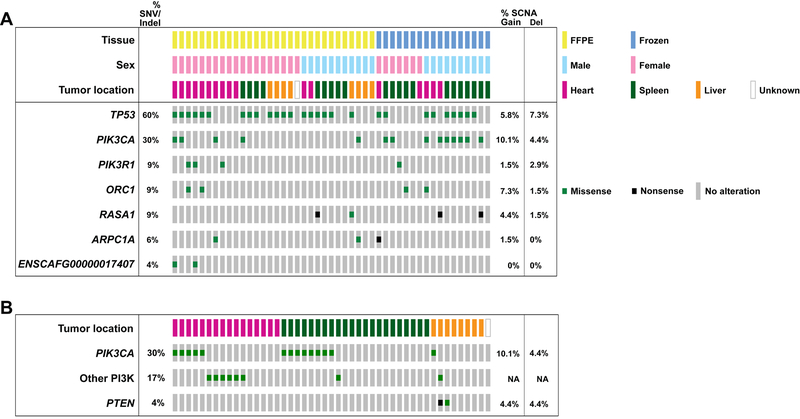
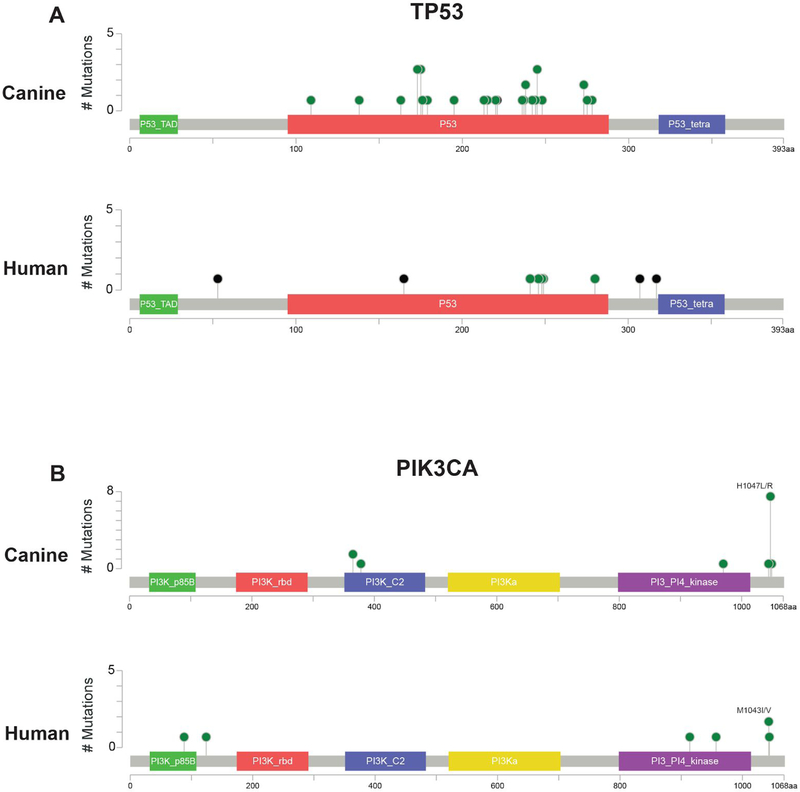
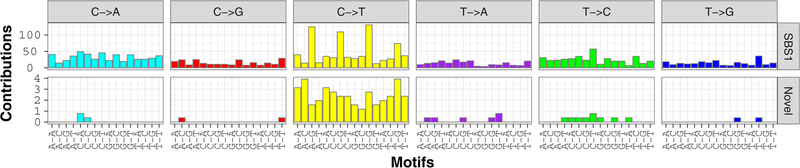
Angiosarcoma is a highly aggressive cancer of blood vessel-forming cells with few effective treatment options and high patient mortality. It is both rare and heterogenous, making large, well-powered genomic studies nearly impossible. Dogs commonly suffer from a similar cancer, called hemangiosarcoma, with breeds like the golden retriever carrying heritable genetic factors that put them at high risk. If the clinical similarity of canine hemangiosarcoma and human angiosarcoma reflects shared genomic etiology, dogs could be a critically needed model for advancing angiosarcoma research. We assessed the genomic landscape of canine hemangiosarcoma via whole-exome sequencing (47 golden retriever hemangiosarcomas) and RNA sequencing (74 hemangiosarcomas from multiple breeds). Somatic coding mutations occurred most frequently in the tumor suppressor (59.6% of cases) as well as two genes in the PI3K pathway: the oncogene (29.8%) and its regulatory subunit (8.5%). The predominant mutational signature was the age-associated deamination of cytosine to thymine. As reported in human angiosarcoma, was recurrently deleted and , and recurrently gained. We compared the canine data to human data recently released by The Angiosarcoma Project, and found many of the same genes and pathways significantly enriched for somatic mutations, particularly in breast and visceral angiosarcomas. Canine hemangiosarcoma closely models the genomic landscape of human angiosarcoma of the breast and viscera, and is a powerful tool for investigating the pathogenesis of this devastating disease. IMPLICATIONS: We characterize the genomic landscape of canine hemangiosarcoma and demonstrate its similarity to human angiosarcoma.
血管肉瘤是一种高度侵袭性的血管生成细胞癌,治疗选择有限,患者死亡率高。它既罕见又具有异质性,使得进行大规模、强有力的基因组研究几乎不可能。狗通常患有一种类似的癌症,称为血管肉瘤,金毛猎犬等品种携带遗传因素,使它们面临高风险。如果犬血管肉瘤与人类血管肉瘤的临床相似性反映了共同的基因组病因,那么狗可能是推进血管肉瘤研究的急需模型。我们通过全外显子组测序(47 例金毛猎犬血管肉瘤)和 RNA 测序(来自多个品种的 74 例血管肉瘤)评估了犬血管肉瘤的基因组景观。体细胞编码突变最常发生在肿瘤抑制基因 (59.6%的病例)以及 PI3K 途径中的两个基因:致癌基因 (29.8%)及其调节亚基 (8.5%)。主要的突变特征是与年龄相关的胞嘧啶脱氨酶致胸腺嘧啶。正如在人类血管肉瘤中报道的那样, 经常缺失, 和 经常获得。我们将犬的数据与最近由血管肉瘤项目发布的人类数据进行了比较,发现许多相同的基因和途径在体细胞突变中显著富集,特别是在乳腺和内脏血管肉瘤中。犬血管肉瘤非常类似于人类乳腺和内脏血管肉瘤的基因组景观,是研究这种毁灭性疾病发病机制的有力工具。 意义:我们描述了犬血管肉瘤的基因组景观,并证明其与人类血管肉瘤相似。