National Key Laboratory of Plant Molecular Genetics, Chinese Academy of Sciences Center for Excellence in Molecular Plant Sciences, Institute of Plant Physiology and Ecology, Shanghai Institutes for Biological Sciences, Chinese Academy of Sciences, Shanghai, China.
University of Chinese Academy of Sciences, Beijing, China.
Plant Biotechnol J. 2022 Nov;20(11):2159-2173. doi: 10.1111/pbi.13896. Epub 2022 Aug 27.
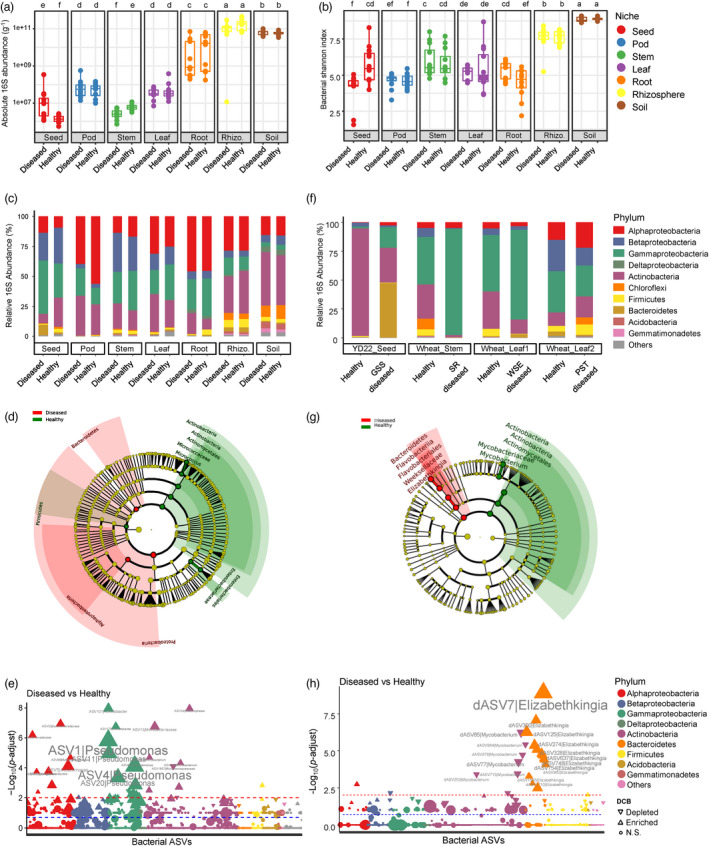
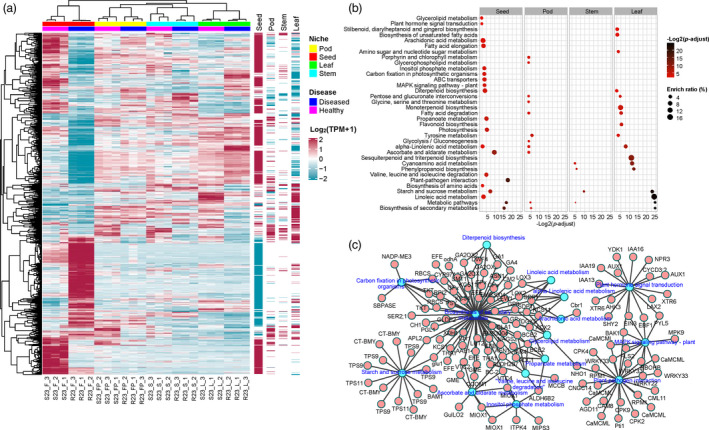
Microbiota colonize every accessible plant tissue and play fundamental roles in plant growth and health. Soybean stay-green syndrome (SGS), a condition that causes delayed leaf senescence (stay-green), flat pods and abnormal seeds of soybean, has become the most serious disease of soybean in China. However, the direct cause of SGS is highly debated, and little is known about how SGS affect soybean microbiome dynamics, particularly the seed microbiome. We studied the bacterial, fungal, and viral communities associated with different soybean tissues with and without SGS using a multi-omics approach, and investigated the possible pathogenic agents associated with SGS and how SGS affects the assembly and functions of plant-associated microbiomes. We obtained a comprehensive view of the composition, function, loads, diversity, and dynamics of soybean microbiomes in the rhizosphere, root, stem, leaf, pod, and seed compartments, and discovered that soybean SGS was associated with dramatically increased microbial loads and dysbiosis of the bacterial microbiota in seeds. Furthermore, we identified a novel geminivirus that was strongly associated with soybean SGS, regardless of plant cultivar, sampling location, or harvest year. This whole-plant microbiome profiling of soybean provides the first demonstration of geminivirus infection associated with microbiota dysbiosis, which might represent a general microbiological symptom of plant diseases.
微生物定植于所有可及的植物组织,并在植物生长和健康中发挥基本作用。大豆持绿综合征(SGS)是一种导致叶片衰老延迟(持绿)、豆荚扁平以及大豆种子异常的病症,已成为中国大豆最严重的病害。然而,SGS 的直接原因尚存在高度争议,并且对于 SGS 如何影响大豆微生物组动态,尤其是种子微生物组,人们知之甚少。我们使用多组学方法研究了具有和不具有 SGS 的不同大豆组织中与细菌、真菌和病毒群落相关的情况,并调查了与 SGS 相关的可能病原体以及 SGS 如何影响植物相关微生物组的组装和功能。我们全面了解了根际、根、茎、叶、荚和种子等部位的大豆微生物组的组成、功能、负荷、多样性和动态,发现大豆 SGS 与种子中微生物负荷的显著增加和细菌微生物组的失调有关。此外,我们还鉴定出一种与大豆 SGS 强烈相关的新型双生病毒,而不论植物品种、采样地点或收获年份如何。这项对大豆全株微生物组的研究首次证明了双生病毒感染与微生物失调有关,这可能代表了植物疾病的一般微生物学症状。