Department of Psychology, Marquette University, Milwaukee, WI, USA.
Semel Institute for Neuroscience and Human Behavior, University of California, Los Angeles, CA, USA.
J Autism Dev Disord. 2022 Dec;52(12):5491-5499. doi: 10.1007/s10803-022-05666-0. Epub 2022 Jul 23.
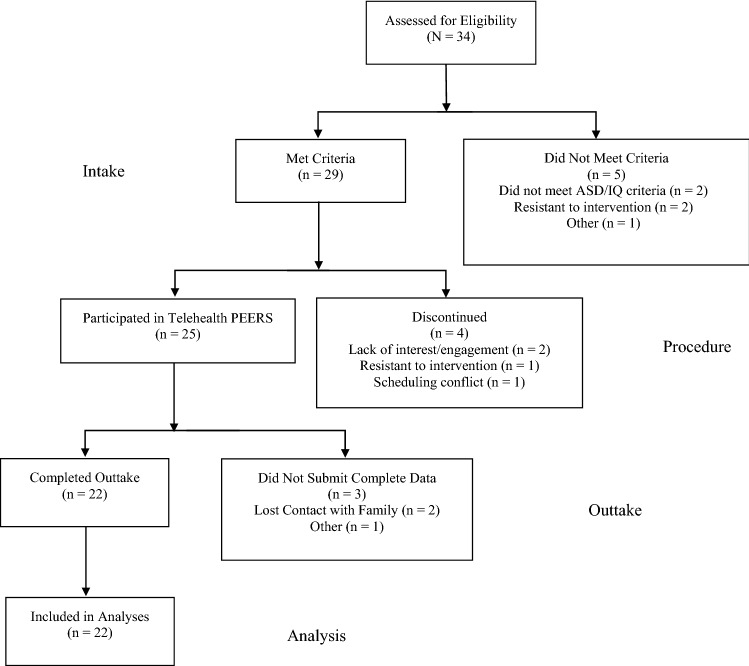
The COVID-19 pandemic sparked a worldwide transition to providing online services overnight, highlighting the urgent need for empirically supported telehealth interventions. The current study examined the effects of PEERS® for Adolescents Telehealth, an adaptation from the original social skills intervention developed for in-person provision, among 22 autistic adolescents and their caregivers. To evaluate the intervention, caregivers completed questionnaires assessing core autistic features and frequency of get-togethers. Adolescents completed questionnaires measuring social knowledge and frequency of get-togethers. Improvements in social skills knowledge, increased get-togethers, and decreased core autistic symptoms were evident. Preliminary results suggest PEERS® for Adolescents Telehealth improves social competence, as found for the in-person version. Further research exploring the equivalence of telehealth to in-person social skills intervention is recommended.
新冠疫情促使全球在一夜之间向在线服务转变,凸显了对有实证支持的远程医疗干预措施的迫切需求。本研究调查了 PEERS® for Adolescents Telehealth 的效果,这是对原有的专为面对面提供而开发的社交技能干预措施的改编,研究对象为 22 名自闭症青少年及其照顾者。为了评估该干预措施,照顾者完成了评估核心自闭症特征和聚会频率的问卷。青少年则完成了评估社交知识和聚会频率的问卷。社交技能知识的提高、聚会次数的增加和核心自闭症症状的减少都很明显。初步结果表明,PEERS® for Adolescents Telehealth 提高了社交能力,与面对面版本的效果一致。建议进一步研究远程医疗与面对面社交技能干预的等效性。