School of Psychological Science, University of Bristol, Bristol, UK.
MRC Integrative Epidemiology Unit (IEU), University of Bristol, Bristol, UK.
Harm Reduct J. 2022 Jul 24;19(1):81. doi: 10.1186/s12954-022-00662-0.
Alongside a recent revival in the use of psychedelics in clinical settings, there have been increases in the prevalence of recreational use, with many using psychedelics to deal with difficult emotions or to improve well-being. While clinical research is conducted in carefully controlled settings, this is not necessarily the case for recreational use. In this mixed methods online survey study, we aimed to develop an understanding of frequently used psychedelic harm reduction practices in recreational settings and how their use relates to the psychedelic experience. We also aimed to characterise users' first and most recent psychedelic trips to understand how harm reduction changes with experience.
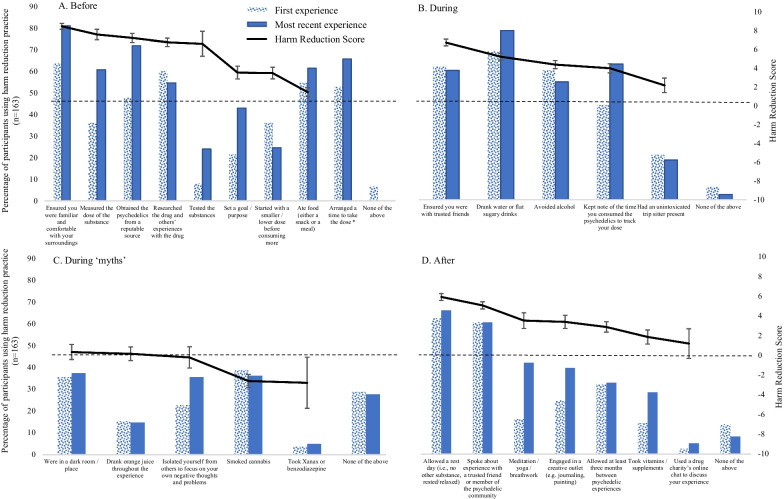
Participants (n = 163) recounted their first and most recent psychedelic experience by providing details about the harm reduction practices they employed and completing the Challenging Experience Questionnaire (CEQ) and Emotional Breakthrough Inventory (EBI). We also asked open-ended questions for a more in-depth qualitative understanding of their views on psychedelic harm reduction.
Using ANOVA, we observe greater use of harm reduction practices for participants' most recent versus first psychedelic experience and that use of these practices is positively associated with EBI scores and negatively associated with CEQ scores (particularly for the first experience). Participants engaged in a wide range of harm reduction practices and we provide details of those which are most commonly used and those which are deemed most important by experienced users. Our qualitative analysis indicated that participants were largely positive about psychedelics and many recounted profound positive experiences. While specifics of the drug they were taking was important for aspects of harm reduction, participants largely focused on the importance of ensuring a good "set and setting" for enhancing positive effects.
Our research helps us understand how engagement in harm reduction may increase with experience. Our mixed methods data shed light on the perceived importance of different harm reduction practices and examine their association with the psychedelic experience itself. Together, our research has important implications for the development of psychedelic harm reduction advice and provides opportunities for future research to explore the importance of these different practices in more detail.
随着迷幻剂在临床环境中的应用最近重新兴起,娱乐性使用的流行度也有所增加,许多人使用迷幻剂来应对情绪困扰或改善幸福感。虽然临床研究是在精心控制的环境中进行的,但娱乐性使用并非如此。在这项混合方法的在线调查研究中,我们旨在了解娱乐性使用迷幻剂时常用的减少伤害的实践方法,以及它们的使用与迷幻体验之间的关系。我们还旨在描述用户的首次和最近一次迷幻之旅,以了解随着经验的增加,减少伤害的方式如何变化。
参与者(n=163)通过提供他们使用的减少伤害的实践细节,并完成挑战性体验问卷(CEQ)和情感突破量表(EBI),讲述了他们的首次和最近一次迷幻体验。我们还提出了开放性问题,以更深入地了解他们对迷幻剂减少伤害的看法。
通过方差分析,我们观察到参与者最近一次迷幻体验中使用减少伤害的实践方法比首次使用更多,并且这些实践方法的使用与 EBI 分数呈正相关,与 CEQ 分数呈负相关(特别是首次体验)。参与者采用了广泛的减少伤害的实践方法,我们详细介绍了那些最常用的和那些被经验丰富的用户认为最重要的方法。我们的定性分析表明,参与者对迷幻剂的看法基本是积极的,许多人讲述了深刻的积极体验。虽然他们所服用的药物的具体细节对减少伤害的某些方面很重要,但参与者主要关注的是确保良好的“设定和环境”以增强积极效果的重要性。
我们的研究帮助我们了解随着经验的增加,减少伤害的参与度可能会增加。我们的混合方法数据阐明了不同减少伤害的实践方法的感知重要性,并研究了它们与迷幻体验本身的关系。总的来说,我们的研究对迷幻剂减少伤害的建议的发展具有重要意义,并为未来的研究提供了机会,以更详细地探讨这些不同实践方法的重要性。