Qi Jia-Long, He Jin-Rong, Liu Cun-Bao, Jin Shu-Mei, Yang Xu, Bai Hong-Mei, Ma Yan-Bing
Institute of Medical Biology, Chinese Academy of Medical Sciences and Peking Union Medical College, Kunming, Yunnan 530102, PR China.
Kunming Medical University, Institute of Medical Biology, Kunming, Yunnan 650500, PR China.
Genes Dis. 2021 Apr 20;9(5):1332-1344. doi: 10.1016/j.gendis.2021.03.008. eCollection 2022 Sep.
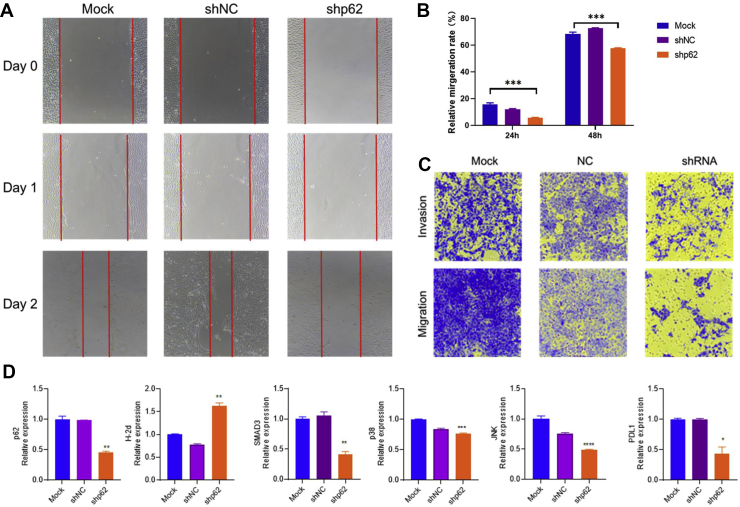
The autophagy adaptor protein SQSTM1/p62 is overexpressed in breast cancer and has been identified as a metastasis-related protein. However, the mechanism by which SQSTM1/p62 contributes to breast cancer progression and tumor microenvironment remains unclear. This study revealed that silencing expression suppressed breast cancer progression via regulating cell proliferation and reshaping the tumor microenvironment (TME). Here, we found that SQSTM1/62 was overexpressed in multiple human cancer tissue types and that was correlated with poor patient overall survival (OS) and disease-free survival (DFS). Moreover, we found that short-hairpin RNA (shRNA)-mediated knockdown of expression significantly inhibited cell proliferation, migration, and invasion, and promoted cell death , as well as suppressed breast cancer growth and lung metastasis . In addition, flow cytometry analysis of splenocytes and tumor infiltrating lymphocytes (TILs) indicated that the numbers of CD8α interferon (IFN)-γ cells (CTLs) and CD4IFN-γ (Th1) cells were increased while those of CD4IL-4 (Th2) cells, tumor-associated macrophages (TAMs) and myeloid-derived suppressor cells (MDSCs) were decreased. RT-PCR analyses showed that the gene expression of Th1/Th2 cytokines changed in the tumor microenvironment. Silencing /62 suppressed tumor cell lung metastasis. Together, our results provide strong evidence that silencing tumor cell /62 inhibited tumor growth and metastasis through cell cycle arrest and TME regulation. This finding provides a novel molecular therapeutic strategy for breast cancer progression and metastasis treatment.
自噬衔接蛋白SQSTM1/p62在乳腺癌中过表达,已被确定为一种与转移相关的蛋白。然而,SQSTM1/p62促进乳腺癌进展和肿瘤微环境的机制仍不清楚。本研究表明,沉默其表达可通过调节细胞增殖和重塑肿瘤微环境(TME)来抑制乳腺癌进展。在此,我们发现SQSTM1/62在多种人类癌症组织类型中过表达,且与患者较差的总生存期(OS)和无病生存期(DFS)相关。此外,我们发现短发夹RNA(shRNA)介导的其表达敲低显著抑制细胞增殖、迁移和侵袭,并促进细胞死亡,以及抑制乳腺癌生长和肺转移。此外,对脾细胞和肿瘤浸润淋巴细胞(TILs)的流式细胞术分析表明,CD8α干扰素(IFN)-γ细胞(CTLs)和CD4IFN-γ(Th1)细胞数量增加,而CD4IL-4(Th2)细胞、肿瘤相关巨噬细胞(TAMs)和髓系来源抑制细胞(MDSCs)数量减少。RT-PCR分析表明,肿瘤微环境中Th1/Th2细胞因子的基因表达发生了变化。沉默/62可抑制肿瘤细胞肺转移。总之,我们的结果提供了强有力的证据,表明沉默肿瘤细胞/62通过细胞周期阻滞和TME调节抑制肿瘤生长和转移。这一发现为乳腺癌进展和转移治疗提供了一种新的分子治疗策略。