Wen Shubo, Song Yang, Lv Xiangyu, Meng Xiaogang, Liu Kai, Yang Jingfeng, Diao Fengying, He Jinfei, Huo Xiaowei, Chen Zeliang, Zhai Jingbo
Preventive Veterinary Laboratory, College of Animal Science and Technology, Inner Mongolia Minzu University, Tongliao, China.
Brucellosis Prevention and Treatment Technology Research Center, Inner Mongolia Autonomous Region, Tongliao, China.
Front Vet Sci. 2022 Jul 6;9:930123. doi: 10.3389/fvets.2022.930123. eCollection 2022.
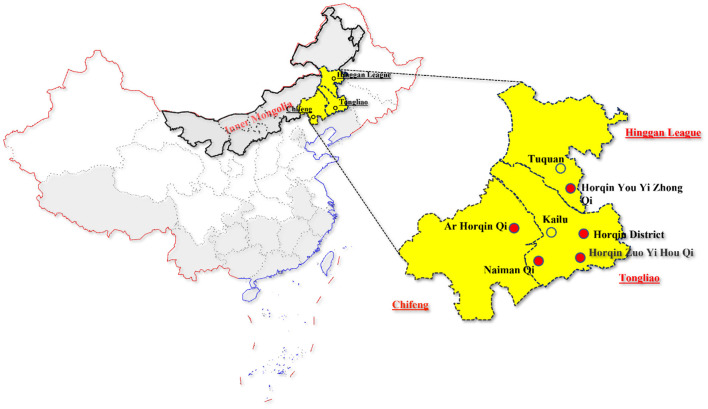
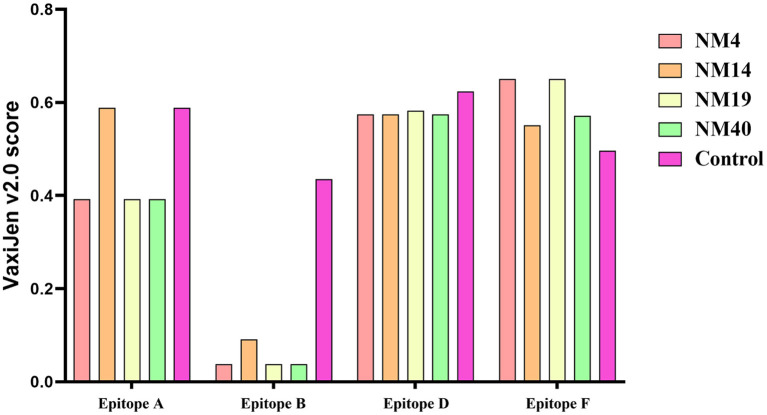
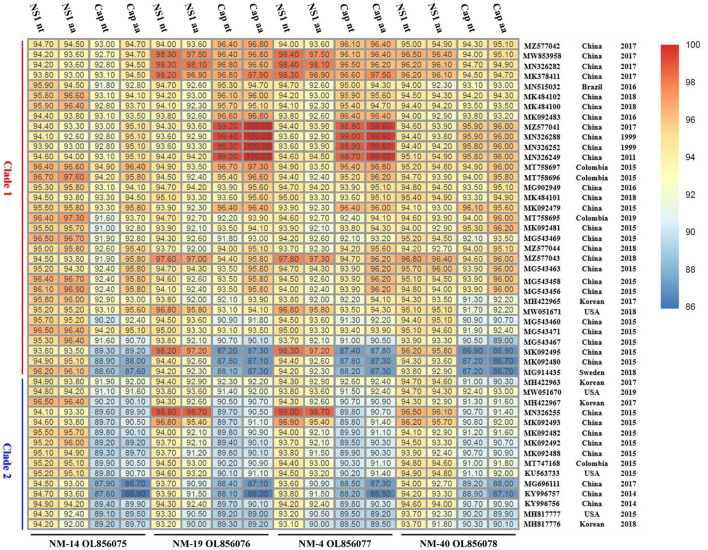
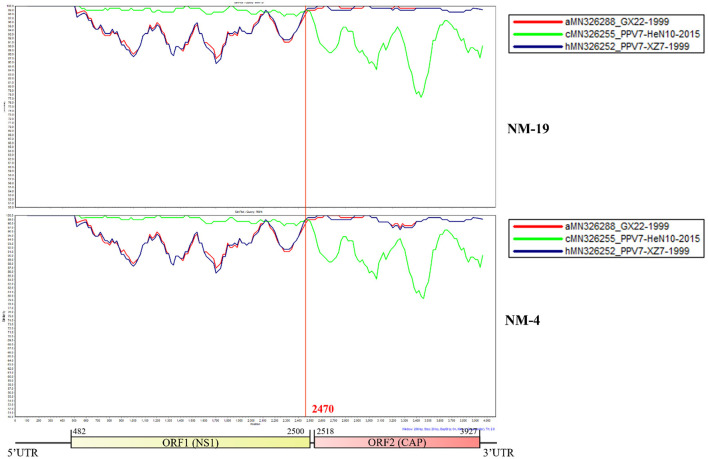
Porcine parvoviruses (PPV) and porcine circoviruses type 2 (PCV2) are widespread in the pig population. Recently, it was suggested that PPV7 may stimulate PCV2 and PCV3 replication. The present study aimed to make detection and molecular characterization of PPV7 for the first time in eastern Inner Mongolia Autonomous Region, China. Twenty-seven of ninety-four samples (28.72%) and five in eight pig farms were PPV7 positive. Further detection showed that the co-infection rate of PPV7 and PCV2 was 20.21% (19/94), and 9.59% (9/94) for PPV7 and PCV3. In addition, the positive rate of PPV7 in PCV2 positive samples was higher than that in PCV2 negative samples, supporting that PCV2 could act as a co-factor for PPV7 infection. In total, four PPV7 strains were sequenced and designated as NM-14, NM-19, NM-4, and NM-40. The amplified genome sequence of NM-14 and NM-40 were 3,999nt in length, while NM-19 and NM-4 were 3,996nt with a three nucleotides deletion at 3,097-3,099, resulting in an amino acid deletion in the Cap protein. Phylogenetic analysis based on the capsid amino acid (aa) sequences showed that 52 PPV7 strains were divided into two clades, and the four PPV7 strains in this study were all clustered in clade 1. The genome and capsid amino acid sequence of the four PPV7 strains identified in this study shared 80.0-96.9% and 85.9-100% similarity with that of 48 PPV7 reference strains selected in NCBI. Simplot analysis revealed that NM-19 and NM-4 strains were probably produced by recombination of two PPV7 strains from China. The amino acid sequence alignment analysis of capsid revealed that the four PPV7 strains detected in Inner Mongolia had multiple amino acid mutations in the 6 B cell linear epitopes compared with the reference strains, suggesting that the four PPV7 strains may have different characteristics in receptor binding and immunogenicity. In summary, this paper reported the PPV7 infection and molecular characterization in the eastern of Inner Mongolia Autonomous Region for the first time, which is helpful to understand the molecular epidemic characteristics of PPV7.
猪细小病毒(PPV)和猪圆环病毒2型(PCV2)在猪群中广泛存在。最近,有人提出PPV7可能刺激PCV2和PCV3的复制。本研究旨在首次对中国内蒙古自治区东部的PPV7进行检测和分子特征分析。94份样本中有27份(28.72%)呈PPV7阳性,8个猪场中有5个猪场的样本呈阳性。进一步检测表明,PPV7与PCV2的共感染率为20.21%(19/94),PPV7与PCV3的共感染率为9.59%(9/94)。此外,PCV2阳性样本中PPV7的阳性率高于PCV2阴性样本,这支持了PCV2可能是PPV7感染的一个辅助因素。总共对4株PPV7毒株进行了测序,分别命名为NM-14、NM-19、NM-4和NM-40。NM-14和NM-40的扩增基因组序列长度为3999nt,而NM-19和NM-4的长度为3996nt,在3097-3099位有3个核苷酸缺失,导致Cap蛋白中一个氨基酸缺失。基于衣壳氨基酸(aa)序列的系统发育分析表明,52株PPV7毒株分为两个进化枝,本研究中的4株PPV7毒株均聚集在进化枝1中。本研究鉴定的4株PPV7毒株的基因组和衣壳氨基酸序列与NCBI中选择的48株PPV7参考毒株的相似性分别为80.0-96.9%和85.9-100%。Simplot分析表明,NM-19和NM-4毒株可能是由中国的两株PPV7毒株重组产生的。衣壳氨基酸序列比对分析表明,内蒙古检测到的4株PPV7毒株与参考毒株相比,在6个B细胞线性表位中有多个氨基酸突变,这表明这4株PPV7毒株在受体结合和免疫原性方面可能具有不同的特性。综上所述,本文首次报道了内蒙古自治区东部的PPV7感染情况及分子特征,有助于了解PPV7的分子流行特征。