Huang Wenhao, Chen Jiayi, Zheng Yadan, Zhang Jin, Li Xin, Su Liujie, Li Yinying, Dou Zulin
Department of Rehabilitation Medicine, The Third Affiliated Hospital of Sun Yat-sen University, Guangzhou, China.
Guangzhou University of Chinese Medicine, Guangzhou, China.
Front Neurol. 2022 Jul 6;13:896651. doi: 10.3389/fneur.2022.896651. eCollection 2022.
Upper limb impairments are one of the most common health problems of stroke, affecting both motor function and independence in daily life. It has been demonstrated that intermittent theta burst stimulation (iTBS) increases brain excitability and improves upper limb function. Our study sought to determine the role of iTBS in stroke recovery.
The purpose of this study was to determine the efficacy of iTBS in individuals with upper limb impairments following stroke.
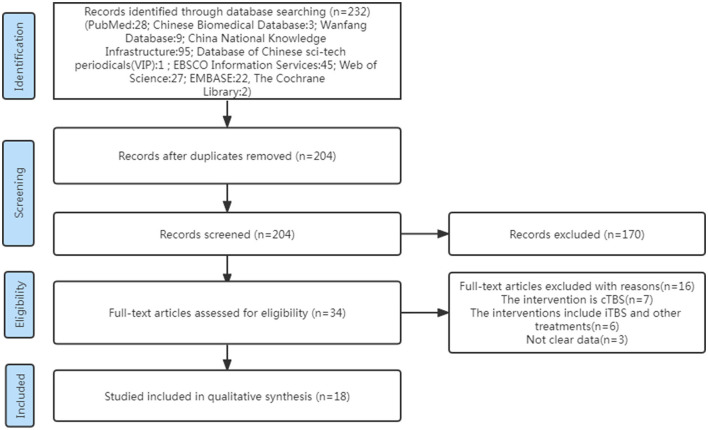
The databases used included Cumulative Index to PubMed, EMBASE, ESCBOhost, The Cochrane Library, Chinese Biomedical Database, Web of Science, China Biology Medicine (CBM), China National Knowledge Infrastructure (CNKI), Technology Periodical Database (VIP), and WanFang Database. Studies published before November 2021 were included. Each participant received an iTBS-based intervention aimed at improving activity levels or impairment, which was compared to usual care, a sham intervention, or another intervention. The primary outcome measure was a change in upper limb function assessment. Secondary outcomes included impairment, participation, and quality of life measures.
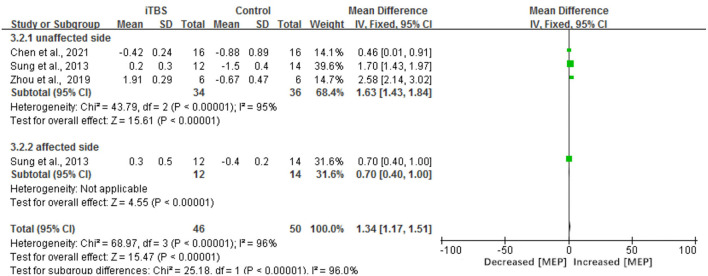
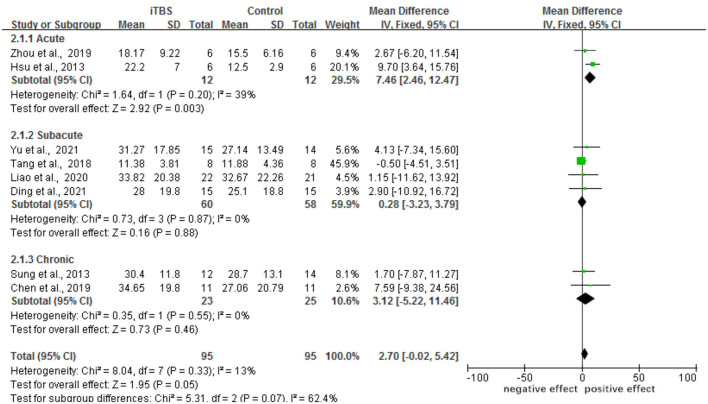
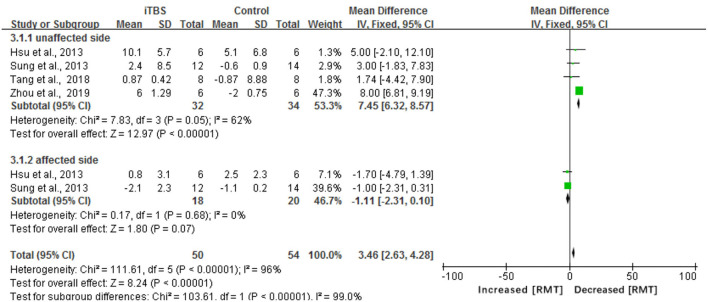
A total of 18 studies ( = 401 participants) that met the inclusion criteria were included in this study. There was a slight change in the upper limb function of the iTBS group compared with the control group, as measured by the Fugl-Meyer Assessment-Upper Extremity (FMA-UE) score (mean difference 2.70, 95% CI -0.02 to 5.42, = 0.05). Significant improvement in resting motor threshold (RMT) and motor-evoked potential (MEP) was also observed in the meta-analysis of iTBS (MD 3.46, 95% CI 2.63 to 4.28, < 0.00001); (MD 1.34, 95% CI 1.17 to 1.51, < 0.00001). In addition, we got similar results when the studies were using the Modified Barthel Index (MBI) assessment (mean difference of 7.34, 95% CI 0.47 to 14.21, = 0.04).
Our study established the efficacy of iTBS in improving motor cortical plasticity, motor function, and daily functioning in stroke patients. However, the review requires evidence from additional randomized controlled trials and high-quality research.
上肢功能障碍是中风最常见的健康问题之一,会影响运动功能和日常生活独立性。已有研究表明,间歇性θ波爆发刺激(iTBS)可增强大脑兴奋性并改善上肢功能。我们的研究旨在确定iTBS在中风恢复中的作用。
本研究的目的是确定iTBS对中风后上肢功能障碍患者的疗效。
使用的数据库包括PubMed累积索引、EMBASE、ESCBOhost、Cochrane图书馆、中国生物医学数据库、科学网、中国生物医学文献数据库(CBM)、中国知网、维普资讯网和万方数据库。纳入2021年11月之前发表的研究。每位参与者接受了一项基于iTBS的干预措施,旨在提高活动水平或减轻功能障碍,并与常规护理、假干预或其他干预措施进行比较。主要结局指标是上肢功能评估的变化。次要结局包括功能障碍、参与度和生活质量指标。
本研究共纳入18项符合纳入标准的研究(n = 401名参与者)。根据Fugl-Meyer上肢评估量表(FMA-UE)评分,iTBS组的上肢功能与对照组相比有轻微变化(平均差异2.70,95%CI -0.02至5.42,P = 0.05)。在iTBS的荟萃分析中,静息运动阈值(RMT)和运动诱发电位(MEP)也有显著改善(MD 3.46,95%CI 2.63至4.28,P < 0.00001);(MD 1.34,95%CI 1.17至1.51,P < 0.00001)。此外,当研究使用改良Barthel指数(MBI)评估时,我们得到了类似的结果(平均差异7.34,95%CI 0.47至14.21,P = 0.04)。
我们的研究证实了iTBS在改善中风患者运动皮质可塑性、运动功能和日常功能方面的疗效。然而,该综述需要更多随机对照试验和高质量研究的证据。