Chen Songbin, Zhang Shunxi, Yang Wenqing, Chen Yujie, Wang Bingshui, Chen Jixiang, Li Xiaotong, Xie Lanfang, Huang Huangjie, Zeng Yangkang, Tian Lingling, Ji Wenxue, Wei Xijun, Lan Yue, Li Hai
Department of Rehabilitation Medicine, Shenzhen Hospital, Southern Medical University, Shenzhen, China.
Department of Rehabilitation Medicine, Guangzhou First People's Hospital, School of Medicine, South China University of Technology, Guangzhou, China.
Front Neurosci. 2023 Oct 12;17:1272003. doi: 10.3389/fnins.2023.1272003. eCollection 2023.
Intermittent theta burst stimulation (iTBS) is a promising noninvasive therapy to restore the excitability of the cortex, and subsequently improve the function of the upper extremities. Several studies have demonstrated the effectiveness of iTBS in restoring upper limb function and modulating cortical excitability. We aimed to evaluate the effects of iTBS on upper limb motor recovery after stroke.
The purpose of this article is to evaluate the influence of intermittent theta-burst stimulation on upper limb motor recovery and improve the quality of life.
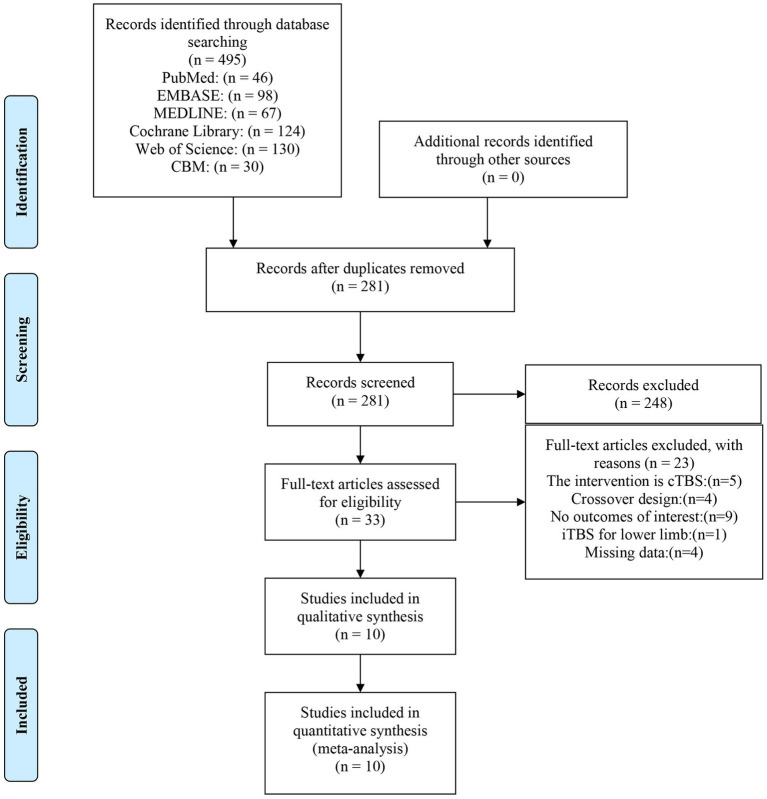
A literature search was conducted using PubMed, EMBASE, MEDLINE, The Cochrane Library, Web of Science, and CBM, including only English studies, to identify studies that investigated the effects of iTBS on upper limb recovery, compared with sham iTBS used in control groups. Effect size was reported as standardized mean difference (SMD) or weighted mean difference (WMD).
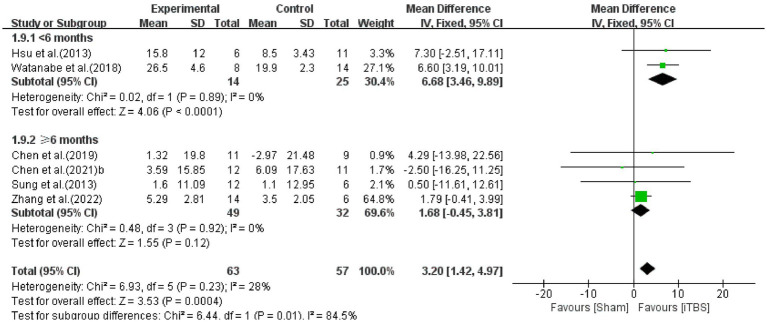
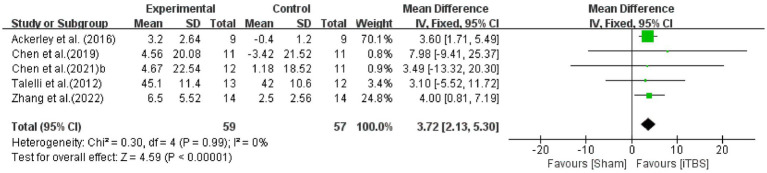
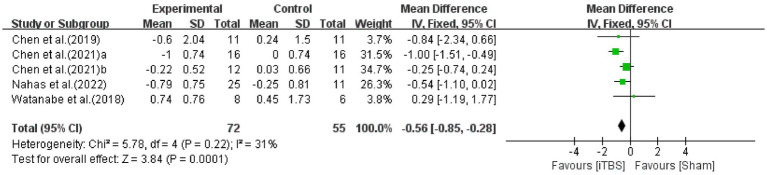
Ten studies were included in the meta-analysis. The results of the meta-analysis indicated that when compared to the control group, the iTBS group had a significant difference in the Fugl-Meyer Assessment (FMA) and Action Research Arm Test (ARAT) (WMD: 3.20, 95% CI: 1.42 to 4.97; WMD: 3.72, 95% CI: 2.13 to 5.30, respectively). In addition, there was also a significant improvement in the modified Ashworth scale (MAS) compared to the sham group (WMD: -0.56; 95% CI: -0.85 to -0.28). More evidence is still needed to confirm the effect of Barthel Index (BI) scores after interventions. However, no significant effect was found for the assessment of Motor Evoked Potential (MEP) amplitude and MEP latency (SMD: 0.35; 95% CI: -0.21 to 0.90; SMD: 0.35, 95% CI: -0.18 to 0.87; SMD: 0.03, 95% CI: -0.49 to 0.55; respectively).
Our results showed that iTBS significantly improved motor impairment, functional activities, and reduced muscle tone of upper limbs, thereby increasing the ability to perform Activities of Daily Living (ADL) in stroke patients, while there were no significant differences in MEPs. In conclusion, iTBS is a promising non-invasive brain stimulation as an adjunct to therapy and enhances the therapeutic effect of conventional physical therapy. In the future, more randomized controlled trials with large sample sizes, high quality, and follow-up are necessary to explore the neurophysiological effects.
https://www.crd.york.ac.uk/PROSPERO/, identifier CRD42023392739.
间歇性θ波爆发刺激(iTBS)是一种很有前景的非侵入性疗法,可恢复皮质兴奋性,进而改善上肢功能。多项研究已证实iTBS在恢复上肢功能和调节皮质兴奋性方面的有效性。我们旨在评估iTBS对中风后上肢运动恢复的影响。
本文旨在评估间歇性θ波爆发刺激对上肢运动恢复的影响,并提高生活质量。
使用PubMed、EMBASE、MEDLINE、Cochrane图书馆、Web of Science和CBM进行文献检索,仅纳入英文研究,以确定研究iTBS对上肢恢复影响的研究,并与对照组使用的假iTBS进行比较。效应量报告为标准化均数差(SMD)或加权均数差(WMD)。
荟萃分析纳入了10项研究。荟萃分析结果表明,与对照组相比,iTBS组在Fugl-Meyer评估(FMA)和动作研究上肢测试(ARAT)方面有显著差异(WMD:3.20,95%CI:1.42至4.97;WMD:3.72,95%CI:2.13至5.30)。此外,与假刺激组相比,改良Ashworth量表(MAS)也有显著改善(WMD:-0.56;95%CI:-0.85至-0.28)。仍需要更多证据来证实干预后Barthel指数(BI)评分的效果。然而,在运动诱发电位(MEP)幅度和MEP潜伏期评估中未发现显著影响(SMD:0.35;95%CI:-0.21至0.90;SMD:0.35,95%CI:-0.18至0.87;SMD:0.03,95%CI:-0.49至0.55)。
我们的结果表明,iTBS显著改善了运动障碍、功能活动,并降低了上肢肌张力,从而提高了中风患者进行日常生活活动(ADL)的能力,而MEP方面无显著差异。总之,iTBS作为一种辅助治疗的有前景的非侵入性脑刺激方法,可增强传统物理治疗的疗效。未来,需要更多大样本、高质量且有随访的随机对照试验来探索其神经生理效应。