
在莲花丝装置上修饰二维二硫化钼纳米片以增强疏水性和抗菌活性。
Embellishing 2-D MoS Nanosheets on Lotus Thread Devices for Enhanced Hydrophobicity and Antimicrobial Activity.
作者信息
Selvam Govarthini Seerangan, Dheivasigamani Thangaraju, Prabhu Anusha, Mani Naresh Kumar
机构信息
Nano-crystal Design and Application Lab (n-DAL), Department of Physics, PSG Institute of Technology and Applied Research, Coimbatore-641062, Tamil Nadu India.
Microfluidics, Sensors and Diagnostics Laboratory (μSenD), Department of Biotechnology, Manipal Institute of Technology, Manipal Academy of Higher Education, Manipal 576104, Karnataka India.
出版信息
ACS Omega. 2022 Jul 6;7(28):24606-24613. doi: 10.1021/acsomega.2c02337. eCollection 2022 Jul 19.
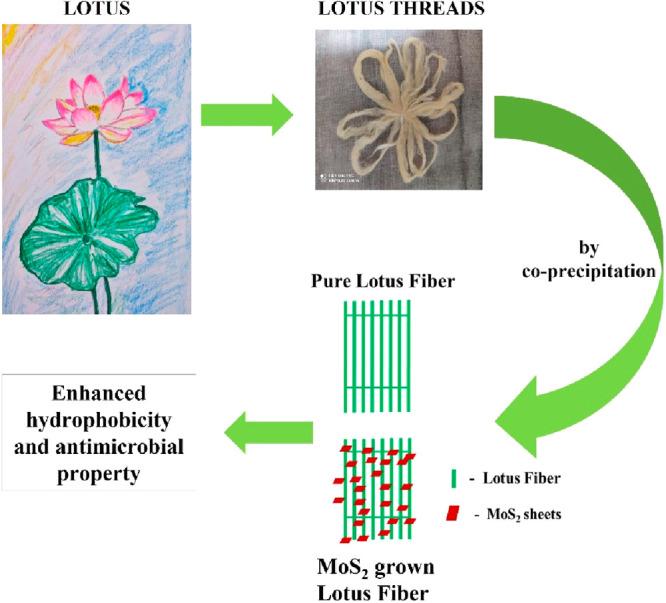
Herein, we report cellulose-based threads from Indian sacred Lotus () of the Nymphaceae family embellished with MoS nanosheets for its enhanced hydrophobic and antimicrobial properties. MoS nanosheets synthesized by a coprecipitation method using sodium molybdate dihydrate (NaMoO·2HO) and thioacetamide (CHCSNH) were used as a sourse for MoS particle growth with cellulose threads extracted from lotus peduncles. The size, crystallinity, and morphology of pure and MoS-coated fibers were studied using X-ray diffractometry (XRD) and scanning electron microscopy (SEM). the XRD pattern of pure lotus threads showed a semicrystalline nature, and the threads@MoS composite showed more crystallinity than the pure threads. SEM depicts that pure lotus threads possess a smooth surface, and the MoS nanosheets growth can be easily identified on the threads@MoS. Further, the presence of MoS nanosheets on threads was confirmed with EDX elemental analysis. Antimicrobial studies with and reveal that threads@MoS have better resistance than its counterpart, i.e., pure threads. MoS sheets play a predominant role in restricting the wicking capability of the pure threads due to their enhanced hydrophobic property. The water absorbency assay denotes the absorption rate of threads@MoS to 80%, and threads@MoS shows no penetration for the observed 60 min, thus confirming its wicking restriction. The contact angle for threads@MoS is 128°, indicating its improved hydrophobicity.
在此,我们报道了来自睡莲科印度神圣莲花()的纤维素基纤维丝,其装饰有二硫化钼纳米片以增强其疏水和抗菌性能。通过使用二水合钼酸钠(NaMoO·2HO)和硫代乙酰胺(CHCSNH)的共沉淀法合成的二硫化钼纳米片,被用作与从莲梗中提取的纤维素纤维丝一起生长二硫化钼颗粒的来源。使用X射线衍射仪(XRD)和扫描电子显微镜(SEM)研究了纯纤维丝和二硫化钼涂层纤维丝的尺寸、结晶度和形态。纯莲花纤维丝的XRD图谱显示出半结晶性质,并且纤维丝@二硫化钼复合材料比纯纤维丝表现出更高的结晶度。SEM描绘出纯莲花纤维丝具有光滑的表面,并且在纤维丝@二硫化钼上可以容易地识别出二硫化钼纳米片的生长。此外,通过能谱元素分析证实了纤维丝上存在二硫化钼纳米片。对大肠杆菌和金黄色葡萄球菌的抗菌研究表明,纤维丝@二硫化钼比其对应物即纯纤维丝具有更好的抗性。由于其增强的疏水性质,二硫化钼片在限制纯纤维丝的芯吸能力方面起主要作用。吸水性测定表明纤维丝@二硫化钼的吸水率为80%,并且在观察的60分钟内纤维丝@二硫化钼没有渗透,从而证实了其芯吸限制。纤维丝@二硫化钼的接触角为128°,表明其疏水性得到改善。



 Zotero 插件