Andersson Per A, Tinghög Gustav, Västfjäll Daniel
Department of Behavioural Sciences and Learning, Linkoping university, Linkoping, Sweden.
Department of Management and Engineering, Linkoping university, Linkoping, Sweden.
Humanit Soc Sci Commun. 2022;9(1):243. doi: 10.1057/s41599-022-01257-7. Epub 2022 Jul 18.
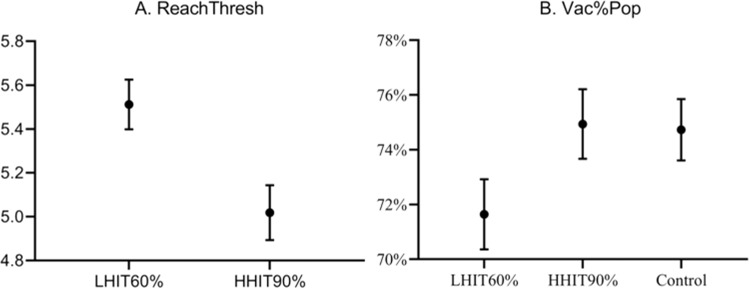
Throughout the COVID-19 pandemic, media and policymakers openly speculated about the number of immune citizens needed to reach a herd immunity threshold. What are the effects of such numerical goals on the willingness to vaccinate? In a large representative sample ( = 1540) of unvaccinated Swedish citizens, we find that giving a low (60%) compared to a high (90%) threshold has direct effects on beliefs about reaching herd immunity and beliefs about how many others that will get vaccinated. Presenting the high threshold makes people believe that herd immunity is harder to reach (on average about half a step on a seven-point scale), compared to the low threshold. Yet at the same time, people also believe that a higher number of the population will get vaccinated (on average about 3.3% more of the population). Since these beliefs affect willingness to vaccinate in opposite directions, some individuals are encouraged and others discouraged depending on the threshold presented. Specifically, in mediation analysis, the high threshold indirectly increases vaccination willingness through the belief that many others will get vaccinated ( = 0.027, = 0.003). At the same time, the high threshold also decreases vaccination willingness through the belief that the threshold goal is less attainable ( = -0.053, < 0.001) compared to the low threshold condition. This has consequences for ongoing COVID-19 vaccination and future vaccination campaigns. One message may not fit all, as different groups can be encouraged or discouraged from vaccination.
在整个新冠疫情期间,媒体和政策制定者公开猜测达到群体免疫阈值所需的免疫公民数量。这些数字目标对疫苗接种意愿有何影响?在一个由未接种疫苗的瑞典公民组成的大型代表性样本(n = 1540)中,我们发现,与高阈值(90%)相比,给出低阈值(60%)会直接影响人们对实现群体免疫的信念以及对其他人接种疫苗数量的信念。与低阈值相比,呈现高阈值会让人们认为群体免疫更难实现(在七点量表上平均约低半分)。然而与此同时,人们也认为会有更高比例的人口接种疫苗(平均比人口比例多约3.3%)。由于这些信念对疫苗接种意愿的影响方向相反,根据所呈现的阈值不同,一些人受到鼓励,而另一些人则受到抑制。具体而言,在中介分析中,高阈值通过许多其他人会接种疫苗这一信念间接提高了疫苗接种意愿(β = 0.027,p = 0.003)。与此同时,与低阈值条件相比,高阈值也通过认为阈值目标更难实现这一信念降低了疫苗接种意愿(β = -0.053,p < 0.001)。这对正在进行的新冠疫苗接种和未来的疫苗接种运动都有影响。由于不同群体可能会受到鼓励或抑制而不接种疫苗,因此单一信息可能并不适用于所有人。