Chaves Antonio, Arnáez Sandra, Castilla Diana, Roncero María, García-Soriano Gemma
Departamento de Personalidad, Evaluación y Tratamientos Psicológicos, Universitat de València, Avda. Blasco Ibáñez, 21, 46010 Valencia, Spain.
Departamento de Psicología de la Personalidad, Evaluación y Tratamientos Psicológicos, Universidad Nacional de Educación a Distancia (UNED), C. de Juan del Rosal, 14, 28040 Madrid, Spain.
Internet Interv. 2022 Jul 13;29:100560. doi: 10.1016/j.invent.2022.100560. eCollection 2022 Sep.
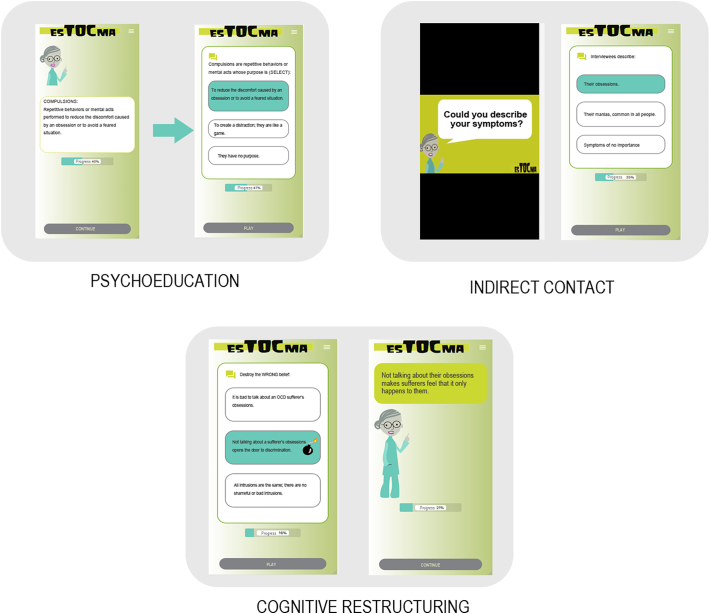
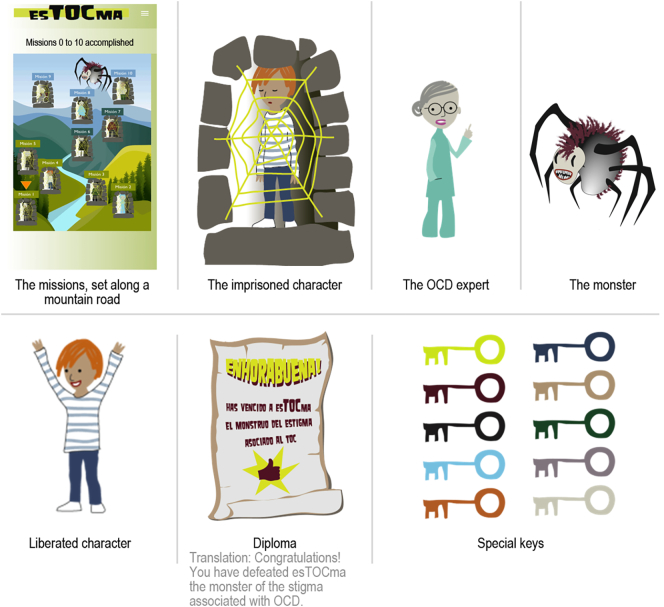
Obsessive-compulsive disorder (OCD) is a disabling disorder that can be successfully treated. However, individuals with OCD do not seek or delay seeking treatment. This delay may be explained by poor mental health literacy and stigmatizing attitudes toward OCD in community. In order to work on these variables, a gamified mental health mobile application (app) called esTOCma has been developed. The purpose of this study is to describe the protocol for a study to test the efficacy of esTOCma, increasing mental health literacy and help-seeking intention, reducing the stigmatizing attitudes and social distance suffered by people with OCD, as well as the distress associated with obsessive-compulsive symptoms.
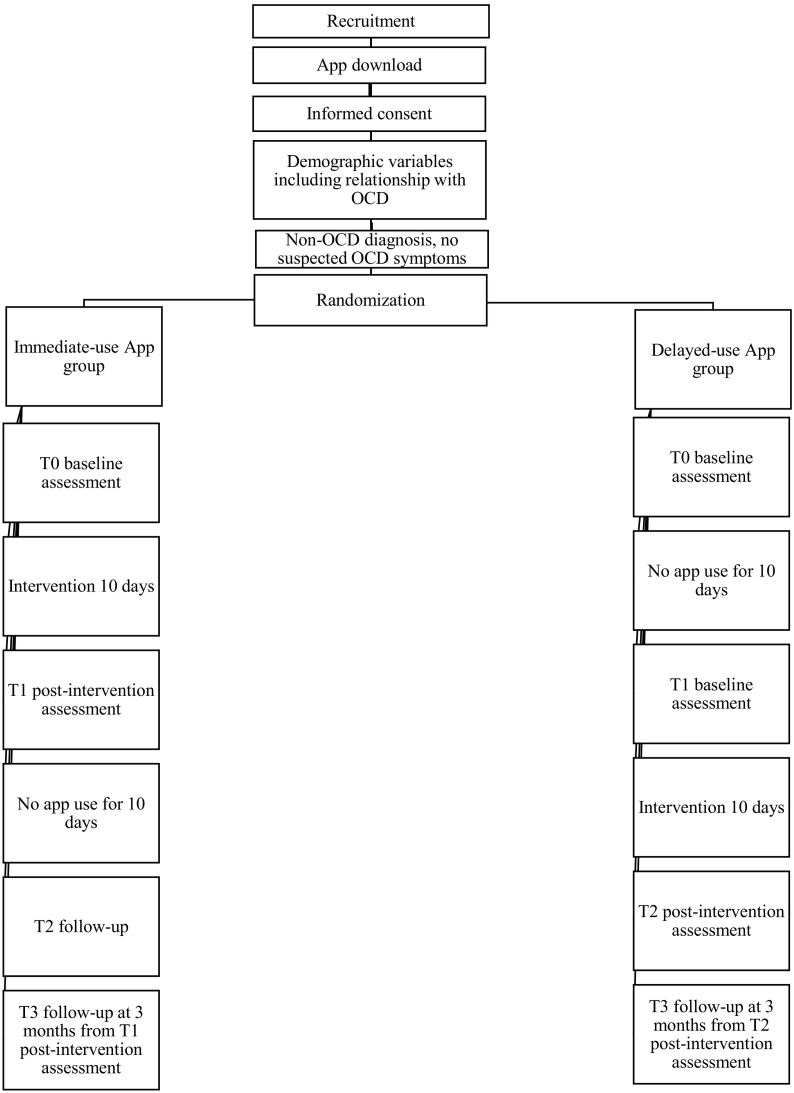
A randomized controlled trial with a crossover design with two conditions (immediate-use App group versus delayed-use App group) will be conducted on a non-clinical adult sample of the community of a minimum size of 200 participants. Participants in the immediate-use App group will start using the app at baseline until completion (10 days); whereas participants in the delayed-use App group will wait 10 days, and then start using the app until completion (10 days). The outcomes will be measured at four assessment points (baseline; 10 days from baseline; and 20 days from baseline; and after 3 months). The following instruments will be administered: Attribution Questionnaire, General Help-Seeking Questionnaire, Social Distance Scale, Mental Health Literacy, Psychoeducation Questionnaire, Social Desirability Scale, Single-Item Self-esteem Scale, and Obsessive-Compulsive Inventory-Revised.
This protocol presents the first study to describe a randomized control trial of a mental health app focused on changing mental health literacy, stigmatizing attitudes, social distance and help-seeking intention associated with OCD. An app intervention of these characteristics is especially relevant nowadays as the COVID-19 pandemic has increased obsessive-compulsive symptoms and severity. An improvement in general knowledge about OCD and a reduction in stigma could be associated with earlier OCD detection and an increase in help-seeking intention, which could result in greater wellbeing. Moreover, normalizing intrusions and knowledge about the cognitive OCD model could serve as a protective variable in vulnerable individuals.
ClinicalTrials.gov identifier: NCT04777292. Registered February 23, 2021, https://clinicaltrials.gov/ct2/show/NCT04777292.
强迫症(OCD)是一种可成功治疗的致残性疾病。然而,强迫症患者不寻求治疗或延迟寻求治疗。这种延迟可能是由于心理健康素养低下以及社区对强迫症的污名化态度所致。为了解决这些变量问题,已开发出一款名为esTOCma的游戏化心理健康移动应用程序(应用)。本研究的目的是描述一项研究方案,以测试esTOCma的疗效,提高心理健康素养和求助意愿,减少强迫症患者所遭受的污名化态度和社会距离,以及与强迫症状相关的痛苦。
将对一个至少有200名参与者的社区非临床成人样本进行一项采用交叉设计的随机对照试验,设有两种条件(立即使用应用组与延迟使用应用组)。立即使用应用组的参与者将在基线时开始使用应用直至完成(10天);而延迟使用应用组的参与者将等待10天,然后开始使用应用直至完成(10天)。将在四个评估点(基线;基线后10天;基线后20天;以及3个月后)测量结果。将使用以下工具:归因问卷、一般求助问卷、社会距离量表、心理健康素养、心理教育问卷、社会期望量表、单项自尊量表和修订后的强迫观念及强迫行为量表。
本方案介绍了第一项描述针对一款心理健康应用程序的随机对照试验的研究,该应用程序旨在改变与强迫症相关的心理健康素养、污名化态度、社会距离和求助意愿。如今,随着新冠疫情增加了强迫症状和严重程度,具有这些特征的应用程序干预尤为重要。对强迫症常识的改善以及污名的减少可能与更早发现强迫症和求助意愿的增加相关,这可能会带来更大的幸福感。此外,对侵入观念和关于强迫症认知模型的知识进行正常化处理,可能对易受影响的个体起到保护作用。
ClinicalTrials.gov标识符:NCT04777292。于2021年2月23日注册,https://clinicaltrials.gov/ct2/show/NCT04777292 。