Shi Yue, Chen Tingli, Shaw Peter, Wang Peng-Yuan
Oujiang Laboratory, Key Laboratory of Alzheimer's Disease of Zhejiang Province, Institute of Aging, Wenzhou Medical University, Wenzhou, China.
Shenzhen Key Laboratory of Biomimetic Materials and Cellular Immunomodulation, Shenzhen Institute of Advanced Technology, Chinese Academy of Sciences, Shenzhen, China.
Front Microbiol. 2022 Jul 7;13:844997. doi: 10.3389/fmicb.2022.844997. eCollection 2022.
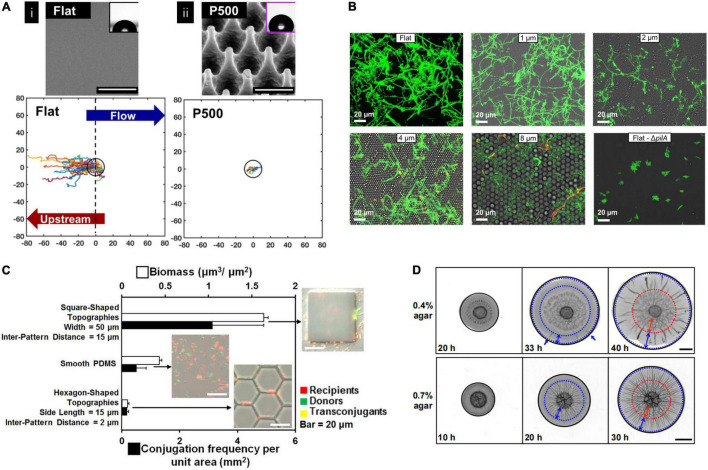
Bacteria form biofilms on material surfaces within hours. Biofilms are often considered problematic substances in the fields such as biomedical devices and the food industry; however, they are beneficial in other fields such as fermentation, water remediation, and civil engineering. Biofilm properties depend on their genome and the extracellular environment, including pH, shear stress, and matrices topography, stiffness, wettability, and charges during biofilm formation. These surface properties have feedback effects on biofilm formation at different stages. Due to emerging technology such as synthetic biology and genome editing, many studies have focused on functionalizing biofilm for specific applications. Nevertheless, few studies combine these two approaches to produce or modify biofilms. This review summarizes up-to-date materials science and synthetic biology approaches to controlling biofilms. The review proposed a potential research direction in the future that can gain better control of bacteria and biofilms.
细菌在数小时内就能在材料表面形成生物膜。在生物医学设备和食品工业等领域,生物膜通常被视为有问题的物质;然而,它们在发酵、水修复和土木工程等其他领域却是有益的。生物膜的特性取决于其基因组和细胞外环境,包括生物膜形成过程中的pH值、剪切应力以及基质的形貌、硬度、润湿性和电荷。这些表面特性在不同阶段对生物膜的形成具有反馈作用。由于合成生物学和基因组编辑等新兴技术的出现,许多研究都集中在使生物膜功能化以用于特定应用。然而,很少有研究将这两种方法结合起来生产或修饰生物膜。本综述总结了控制生物膜的最新材料科学和合成生物学方法。该综述提出了一个未来潜在的研究方向,有望更好地控制细菌和生物膜。