Mental Health Research Center, School of Behavioural Sciences and Mental Health, Iran University of Medical Sciences, Tehran, Iran.
Department of Psychiatry, Sunnybrook Health Sciences Centre, University of Toronto, Toronto, ON, Canada.
Can J Psychiatry. 2023 Jul;68(7):479-494. doi: 10.1177/07067437221115029. Epub 2022 Jul 25.
Obsessive-compulsive disorder (OCD) is a major mental health condition with a lifetime prevalence rate of 1.3% among adults. While placebo effects are well described for conditions such as depressive and anxiety disorders, they have not been systematically characterized in OCD.
We aimed to determine the impact of placebos in improving different symptom domains in patients with OCD.
We systematically searched PubMed, EMBASE, Scopus, Web of Science, Ovid, the Cochrane Library, and Google Scholar databases/search engine from inception to January 2021 for randomized controlled trials of treatments for OCD with a placebo arm. A modified Cohen's effect size (ES) was calculated using change in baseline to endpoint scores for different measurement scales within placebo arms to estimate placebo effects and to investigate their correlates by random-effects model meta-analyses.
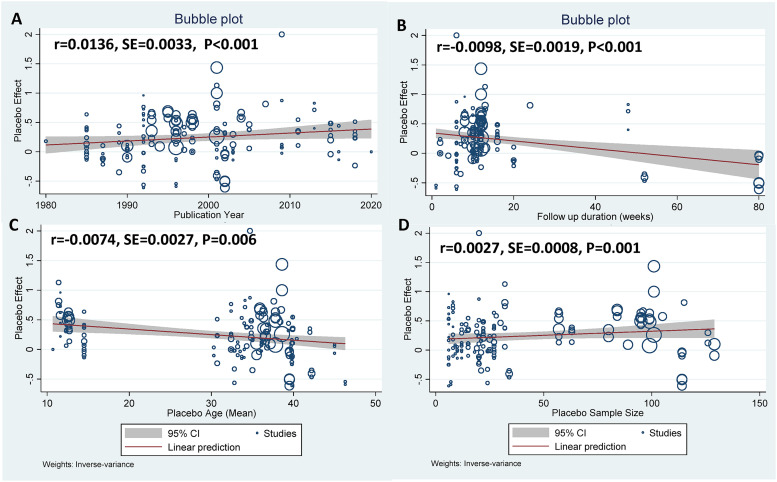
Forty-nine clinical trials (placebo group = 1993), reporting 80 OCD specific (153 measures in general) were included in the analysis. Overall placebo ES (95% confidence interval [CI]) was 0.32 (0.22-0.41) on OCD symptoms, with substantial heterogeneity (I-square = 96.1%). Among secondary outcomes, general scales, ES: 0.27 (95%CI: 0.14-0.41), demonstrated higher ES than anxiety and depression scales, ES: 0.14 (95%CI: -0.4 to 0.32) and 0.05 (95%CI: -0.05 to 0.14), respectively. Clinician-rated scales, ES: 0.27(95%CI: 0.20-0.34), had a higher ES than self-reported scales, ES: 0.07 (95%CI: -0.08 to 0.22). More recent publication year, larger placebo group sample size, shorter follow-up duration, and younger age of participants were all associated with larger placebo ES. Egger's test reflected possible small-study effect publication bias ( = 0.029).
Placebo effects are modest in OCD trials and are larger in clinician ratings, for younger patients, and early in the treatment course. These findings underscore the need for clinicians and scientists to be mindful of placebo effects when formulating treatments or research trials for OCD.
PROSPERO CRD42019125979.
强迫症(OCD)是一种主要的精神健康疾病,成年人的终身患病率为 1.3%。虽然安慰剂效应在抑郁和焦虑障碍等疾病中已有很好的描述,但在 OCD 中尚未系统地描述。
我们旨在确定安慰剂在改善 OCD 患者不同症状领域的作用。
我们系统地检索了 PubMed、EMBASE、Scopus、Web of Science、Ovid、Cochrane 图书馆和 Google Scholar 数据库/搜索引擎,从建库到 2021 年 1 月,以寻找 OCD 治疗的随机对照试验,其中包含安慰剂组。使用安慰剂组内不同测量量表的基线至终点评分变化计算改良 Cohen 效应量(ES),以估计安慰剂效应,并通过随机效应模型荟萃分析研究其相关性。
共纳入 49 项临床试验(安慰剂组 = 1993 例),报告了 80 项 OCD 特异性(总体 153 项)测量指标。OCD 症状的总体安慰剂 ES(95%置信区间[CI])为 0.32(0.22-0.41),存在较大的异质性(I-square = 96.1%)。在次要结局中,一般量表的 ES 为 0.27(95%CI:0.14-0.41),高于焦虑和抑郁量表的 ES,分别为 0.14(95%CI:-0.4 至 0.32)和 0.05(95%CI:-0.05 至 0.14)。临床评定量表的 ES 为 0.27(95%CI:0.20-0.34),高于自我报告量表的 ES,分别为 0.07(95%CI:-0.08 至 0.22)。更近的发表年份、更大的安慰剂组样本量、更短的随访时间和参与者更年轻均与更大的安慰剂 ES 相关。Egger 检验反映可能存在小样本量研究的发表偏倚( = 0.029)。
在 OCD 试验中,安慰剂效应适度,在临床评定中更大,在年轻患者和治疗早期更大。这些发现强调了临床医生和科学家在制定 OCD 治疗或研究试验时需要注意安慰剂效应。
PROSPERO CRD42019125979。