NMR and Structure Analysis Unit, Ghent Universitygrid.5342.0, Department of Organic and Macromolecular Chemistry, Ghent, Belgium.
Organic and Biomimetic Chemistry Research Group, Ghent Universitygrid.5342.0, Department of Organic and Macromolecular Chemistry, Ghent, Belgium.
Microbiol Spectr. 2022 Aug 31;10(4):e0126122. doi: 10.1128/spectrum.01261-22. Epub 2022 Jul 25.
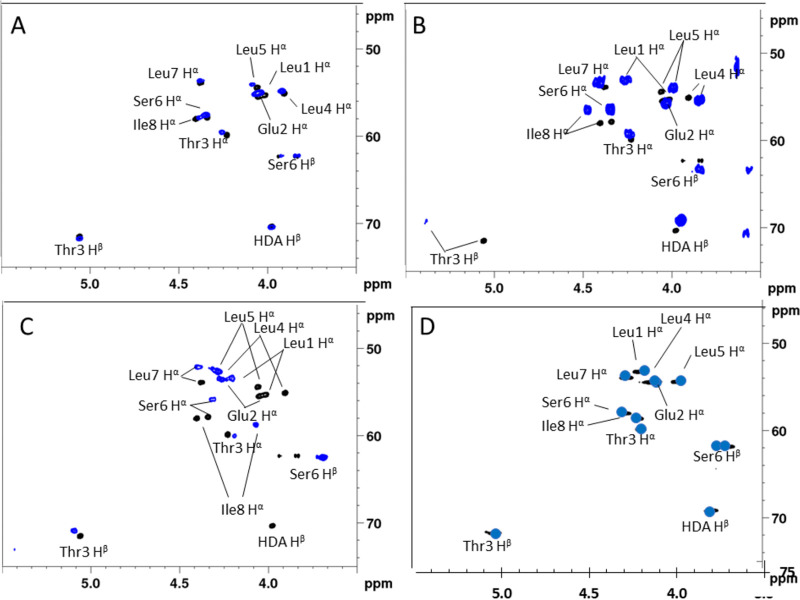
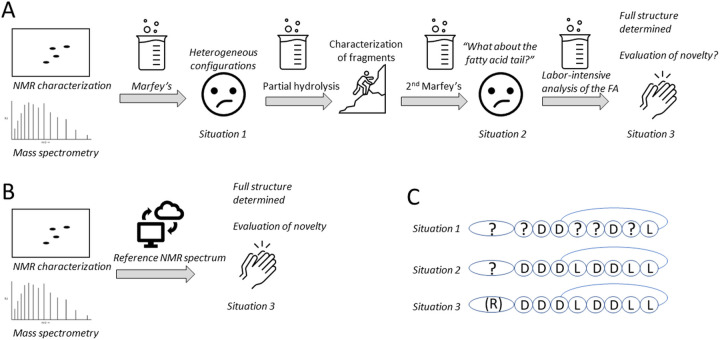
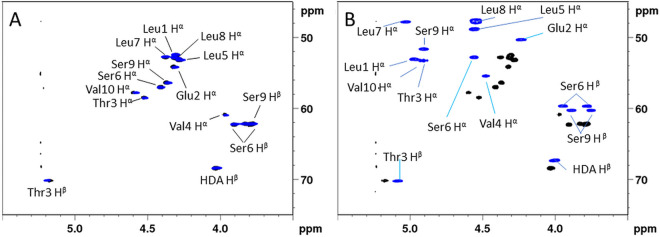
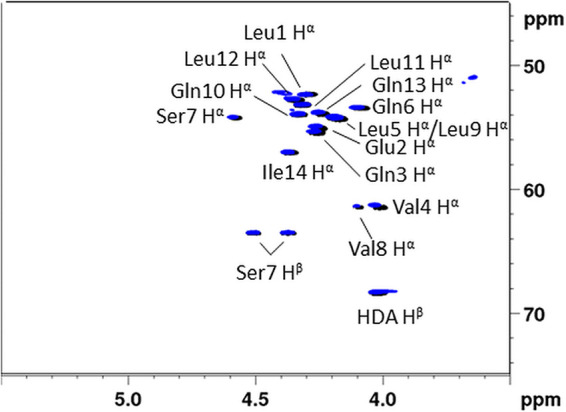
Cyclic lipopeptides (CLiPs) are secondary metabolites secreted by a range of bacterial phyla. CLiPs from Pseudomonas in particular, display diverse structural variations in terms of the number of amino acid residues, macrocycle size, amino acid identity, and stereochemistry (e.g., d- versus l-amino acids). Reports detailing the discovery of novel or already characterized CLiPs from new sources appear regularly in literature. Increasingly, however, the lack of detailed characterization threatens to cause considerable confusion, especially if configurational heterogeneity is present for one or more amino acids. Using Pseudomonas CLiPs from the Bananamide, Orfamide, and Xantholysin groups as test cases, we demonstrate and validate that the combined H and C Nuclear Magnetic Resonance (NMR) chemical shifts of CLiPs constitute a spectral fingerprint that is sufficiently sensitive to differentiate between possible diastereomers of a particular sequence even when they only differ in a single d/l configuration. Rapid screening, involving simple matching of the NMR fingerprint of a newly isolated CLiP with that of a reference CLiP of known stereochemistry, can then be applied to resolve dead-ends in configurational characterization and avoid the much more cumbersome chemical characterization protocols. Even when the stereochemistry of a particular reference CLiP remains to be established, its spectral fingerprint allows to quickly verify whether a newly isolated CLiP is novel or already present in the reference collection. We show NMR fingerprinting leads to a simple approach for early on dereplication which should become more effective as more fingerprints are collected. To benefit research involving CLiPs, we have made a publicly available data repository accompanied by a 'knowledge base' at https://www.rhizoclip.be, where we present an overview of published NMR fingerprint data of characterized CLiPs, together with literature data on the originally determined structures. Pseudomonas CLiPs are ubiquitous specialized metabolites, impacting the producer's lifestyle and interactions with the (a)biotic environment. Consequently, they generate interest for agricultural and clinical applications. Establishing structure-activity relationships as a premise to their development is hindered because full structural characterization including stereochemical information requires labor-intensive analyses, without guarantee for success. Moreover, increasing use of superficial comparison with previously characterized CLiPs introduces or propagates erroneous attributions, clouding further scientific progress. We provide a generally applicable characterization methodology based on matching NMR spectral fingerprints of newly isolated CLiPs to natural and synthetic reference compounds with (un)known stereochemistry. In addition, NMR fingerprinting is shown to provide a suitable basis for structural dereplication. A publicly available reference compound repository promises to facilitate participation of the lipopeptide research community in structural assessment and dereplication of newly isolated CLiPs, which should also support further developments in genome mining for novel CLiPs.
环状脂肽 (CLiPs) 是一类由多种细菌门分泌的次级代谢产物。特别是来自假单胞菌的 CLiPs,在氨基酸残基数、大环尺寸、氨基酸同一性和立体化学(例如,d-与 l-氨基酸)方面显示出多种结构变化。定期在文献中报道有关从新来源发现新型或已表征的 CLiPs 的报告。然而,越来越多的情况是,如果一个或多个氨基酸存在构型异质性,则缺乏详细的表征可能会导致相当大的混淆。我们使用 Bananamide、Orfamide 和 Xantholysin 群的假单胞菌 CLiPs 作为测试案例,证明和验证 CLiPs 的 H 和 C 核磁共振 (NMR) 化学位移组合构成了一个光谱指纹,即使它们仅在单个 d/l 构型上有所不同,也足以灵敏地区分特定序列的可能非对映异构体。然后,可以应用快速筛选,涉及将新分离的 CLiP 的 NMR 指纹与已知立体化学的参考 CLiP 的 NMR 指纹进行简单匹配,以解决构型表征中的死胡同并避免更繁琐的化学表征方案。即使特定参考 CLiP 的立体化学仍有待确定,其光谱指纹也可以快速验证新分离的 CLiP 是否为新型或已存在于参考集中。我们表明,NMR 指纹图谱可用于早期去重复,随着更多指纹图谱的收集,该方法应该会变得更加有效。为了使涉及 CLiPs 的研究受益,我们在 https://www.rhizoclip.be 上建立了一个公开可用的数据存储库,并附有“知识库”,其中我们展示了已发表的表征 CLiPs 的 NMR 指纹数据概述,以及最初确定的结构的文献数据。假单胞菌 CLiPs 是普遍存在的特殊代谢产物,影响着产生者的生活方式和与(非)生物环境的相互作用。因此,它们引起了农业和临床应用的兴趣。建立结构-活性关系是其发展的前提,但由于包括立体化学信息在内的全结构表征需要劳动密集型分析,并且不能保证成功,因此受到阻碍。此外,使用以前表征的 CLiPs 进行表面比较的增加引入或传播了错误的归因,进一步阻碍了科学的发展。我们提供了一种基于将新分离的 CLiP 的 NMR 光谱指纹与具有(未知)立体化学的天然和合成参考化合物进行匹配的一般适用性表征方法。此外,NMR 指纹图谱被证明是结构去重复的合适基础。一个公开可用的参考化合物存储库有望促进脂肽研究界参与新分离的 CLiPs 的结构评估和去重复,这也应该支持在新型 CLiPs 的基因组挖掘方面的进一步发展。