Liu Xinyao, Dai Guolin, He Qile, Ma Hao, Hu Hongpu
Institute of Medical Information/Medical Library, Chinese Academy of Medical Sciences & Peking Union Medical College, Beijing 100020, China.
J Cardiovasc Dev Dis. 2022 Jul 18;9(7):228. doi: 10.3390/jcdd9070228.
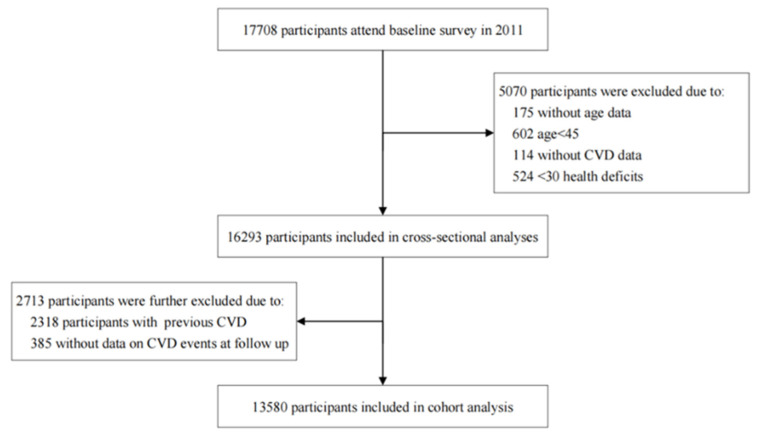
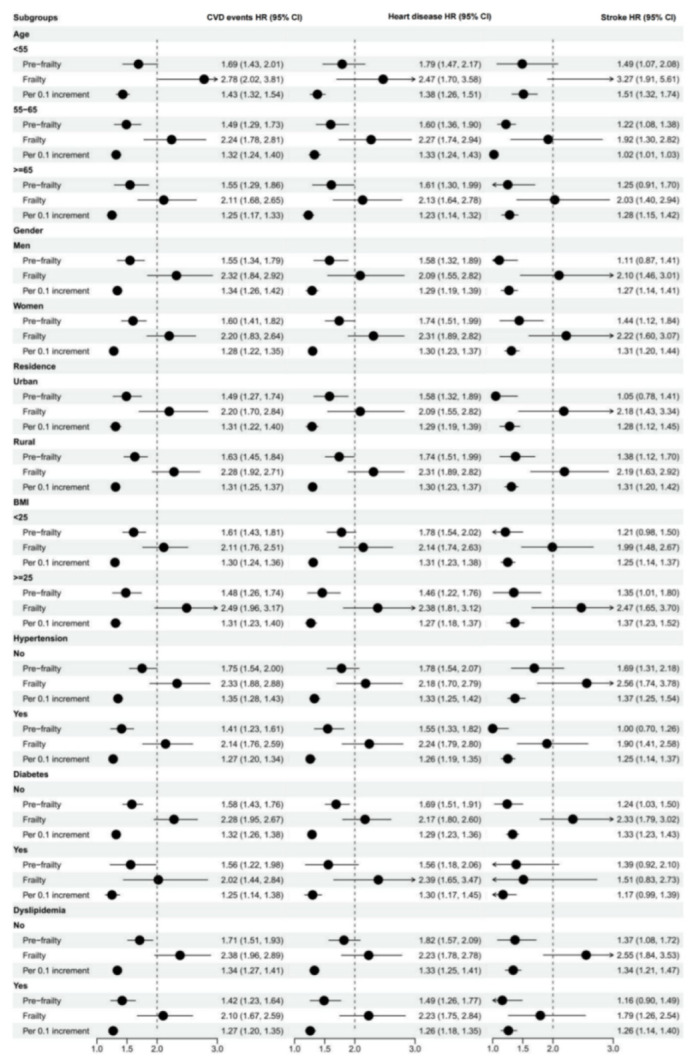
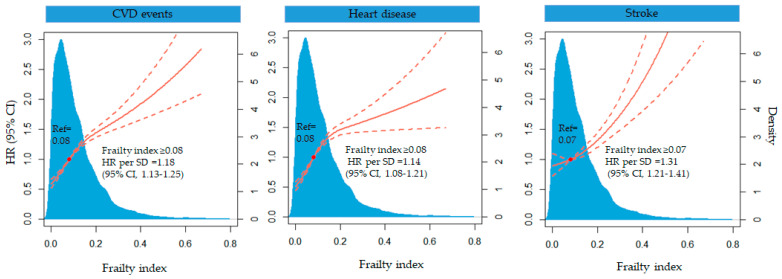
Evidence for the association between the frailty index and cardiovascular disease (CVD) is inconclusive, and this association has not been evaluated in Chinese adults. We aim to examine the association between the frailty index and CVD among middle-aged and older Chinese adults. We conducted cross-sectional and cohort analyses using nationally representative data from the China Health and Retirement Longitudinal Study (CHARLS). From 2011 to 2018, 17,708 participants aged 45 years and older were included in the CHARLS. The primary outcome was CVD events (composite of heart disease and stroke). Multivariable adjusted logistic regression and Cox proportional hazards models were used to estimate the association between the frailty index and CVD in cross-sectional and follow-up studies, respectively. A restricted cubic spline model was used to characterize dose−response relationships. A total of 16,293 and 13,580 participants aged 45 years and older were included in the cross-sectional and cohort analyses, respectively. In the cross-sectional study, the prevalence of CVD in robust, pre-frailty and frailty was 7.83%, 18.70% and 32.39%, respectively. After multivariable adjustment, pre-frailty and frailty were associated with CVD; ORs were 2.54 (95% confidence interval [CI], 2.28−2.84) and 4.76 (95% CI, 4.10−5.52), respectively. During the 7 years of follow-up, 2122 participants without previous CVD developed incident CVD; pre-frailty and frailty were associated with increased risk of CVD events; HRs were 1.53 (95% CI, 1.39−1.68) and 2.17 (95% CI, 1.88−2.50), respectively. Furthermore, a stronger association of the frailty index with CVD was observed in participants aged <55, men, rural community-dwellers, BMI ≥ 25, without hypertension, diabetes or dyslipidemia. A clear nonlinear dose−response pattern between the frailty index and CVD was widely observed (p < 0.001 for nonlinearity), the frailty index was above 0.08, and the hazard ratio per standard deviation was 1.18 (95% CI 1.13−1.25). We observed the association between the frailty index and CVD among middle-aged and elderly adults in China, independent of chronological age and other CVD risk factors. Our findings are important for prevention strategies aimed at reducing the growing burden of CVD in older adults.
衰弱指数与心血管疾病(CVD)之间关联的证据尚无定论,且这一关联尚未在中国成年人中得到评估。我们旨在研究中国中老年成年人中衰弱指数与CVD之间的关联。我们使用了来自中国健康与养老追踪调查(CHARLS)的具有全国代表性的数据进行横断面分析和队列分析。2011年至2018年期间,CHARLS纳入了17708名年龄在45岁及以上的参与者。主要结局是CVD事件(心脏病和中风的综合)。多变量调整逻辑回归和Cox比例风险模型分别用于横断面研究和随访研究中评估衰弱指数与CVD之间的关联。使用受限立方样条模型来描述剂量-反应关系。横断面分析和队列分析分别纳入了16293名和13580名年龄在45岁及以上的参与者。在横断面研究中,健康、前期衰弱和衰弱人群中CVD的患病率分别为7.83%、18.70%和32.39%。多变量调整后,前期衰弱和衰弱与CVD相关;比值比分别为2.54(95%置信区间[CI],2.28−2.84)和4.76(95%CI,4.10−5.52)。在7年的随访期间,2122名无既往CVD的参与者发生了新发CVD;前期衰弱和衰弱与CVD事件风险增加相关;风险比分别为1.53(95%CI,1.39−1.68)和2.17(95%CI,1.88−2.50)。此外,在年龄<55岁、男性、农村社区居民、BMI≥25、无高血压、糖尿病或血脂异常的参与者中,观察到衰弱指数与CVD之间的关联更强。在衰弱指数与CVD之间广泛观察到明显的非线性剂量-反应模式(非线性p<0.001),衰弱指数高于0.08,每标准差的风险比为1.18(95%CI 1.13−1.25)。我们观察到中国中老年成年人中衰弱指数与CVD之间的关联,独立于实际年龄和其他CVD危险因素。我们的研究结果对于旨在减轻老年人中不断增加的CVD负担的预防策略具有重要意义。