Channa Iftikhar Ahmed, Ashfaq Jaweria, Gilani Sadaf Jamal, Chandio Ali Dad, Yousuf Sumra, Makhdoom Muhammad Atif, Jumah May Nasser Bin
Thin Film Lab, Department of Metallurgical and Material Engineering, NED University of Engineering & Technology, Karachi 75270, Pakistan.
Department of Basic Health Sciences, Preparatory Year, Princess Nourah Bint Abdulrahman University, Riyadh 11671, Saudi Arabia.
Membranes (Basel). 2022 Jul 11;12(7):701. doi: 10.3390/membranes12070701.
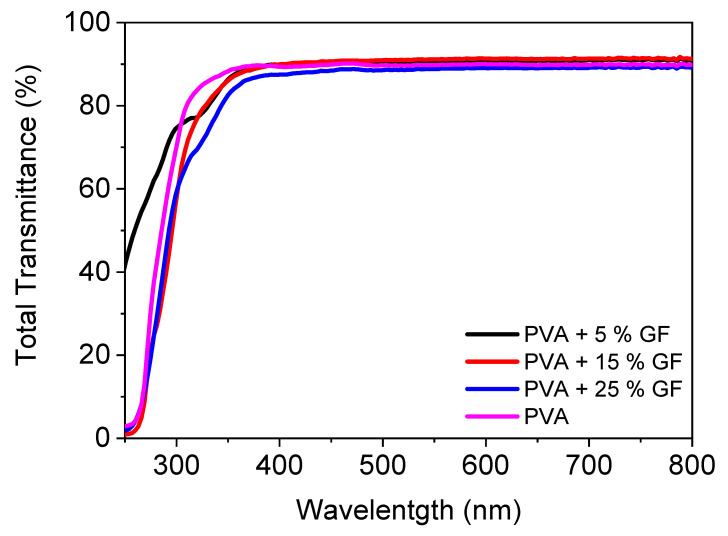
The majority of food packaging materials are petroleum-based polymers, which are neither easily recyclable nor ecologically friendly. Packaging films should preferably be transparent, light in weight, and easy to process, as well as mechanically flexible, and they should meet the criteria for food encapsulation. In this study, poly (vinyl alcohol) (PVA)-based films were developed by incorporating glass flakes into the films. The selection of PVA was based on its well-known biodegradability, whereas the selection of glass flakes was based on their natural impermeability to oxygen and moisture. The films were processed using the blade coating method and were characterized in terms of transparency, oxygen transmission rate, mechanical strength, and flexibility. We observed that the incorporation of glass flakes into the PVA matrix did not significantly change the transparency of the PVA films, and they exhibited a total transmittance of around 87% (at 550 nm). When the glass flakes were added to the PVA, a significant reduction in moisture permeation was observed. This reduction was also supported and proven by Bhardwaj’s permeability model. In addition, even after the addition of glass flakes to the PVA, the films remained flexible and showed no degradation in terms of the water vapor transmission rate (WVTR), even after bending cycles of 23,000. The PVA film with glass flakes had decent tensile characteristics, i.e., around >50 MPa. Increasing the concentration of glass flakes also increased the hardness of the films. Finally, a piece of bread was packaged in a well-characterized composite film. We observed that the bread packaged in the PVA film with glass flakes did not show any degradation at all, even after 10 days, whereas the bread piece packaged in a commercial polyethylene bag degraded completely. Based on these results, the developed packaging films are the perfect solution to replace commercial non-biodegradable films.
大多数食品包装材料是石油基聚合物,既不易回收利用,也不环保。包装薄膜最好是透明的、重量轻且易于加工,同时具有机械柔韧性,并且应符合食品封装标准。在本研究中,通过将玻璃鳞片掺入薄膜中来制备基于聚乙烯醇(PVA)的薄膜。选择PVA是基于其众所周知的生物降解性,而选择玻璃鳞片是基于它们对氧气和水分的天然不渗透性。这些薄膜采用刮刀法加工,并在透明度、氧气透过率、机械强度和柔韧性方面进行了表征。我们观察到,将玻璃鳞片掺入PVA基体中并没有显著改变PVA薄膜的透明度,它们在550nm处的总透光率约为87%。当向PVA中添加玻璃鳞片时,观察到水分渗透率显著降低。这种降低也得到了Bhardwaj渗透模型的支持和验证。此外,即使在向PVA中添加玻璃鳞片后,薄膜仍然保持柔韧性,并且即使在经过23000次弯曲循环后,其水蒸气透过率(WVTR)也没有下降。含有玻璃鳞片的PVA薄膜具有良好的拉伸特性,即约>50MPa。增加玻璃鳞片的浓度也会增加薄膜的硬度。最后,将一片面包包装在一种特性良好的复合薄膜中。我们观察到,用含有玻璃鳞片的PVA薄膜包装的面包即使在10天后也没有任何变质迹象,而用商用聚乙烯袋包装的面包片则完全变质了。基于这些结果,所开发的包装薄膜是替代商用不可生物降解薄膜的完美解决方案。