Jiang Tian, Zhang Yi, Dai Fang, Liu Chao, Hu Honglin, Zhang Qiu
Department of Endocrinology, The First Affiliated Hospital of Anhui Medical University, Hefei, 230022, Anhui, China.
Department of Maternal, Child and Adolescent Health, School of Public Health, Anhui Medical University, No 81 Meishan Road, Hefei, 230032, Anhui, China.
Diabetol Metab Syndr. 2022 Jul 25;14(1):104. doi: 10.1186/s13098-022-00873-2.
Diabetes is a global concern among adults. Previous studies have suggested an association between different screening methods and diabetes; however, increasing evidence has suggested the importance of early screening for diabetes mellitus (DM) and its influencing factors. In this study, we aimed to explore whether the non-invasive detection of advanced glycation end products (AGEs) in the early screening of DM in the Chinese community and whether body mass index (BMI) and metabolic indexes could moderate this relationship.
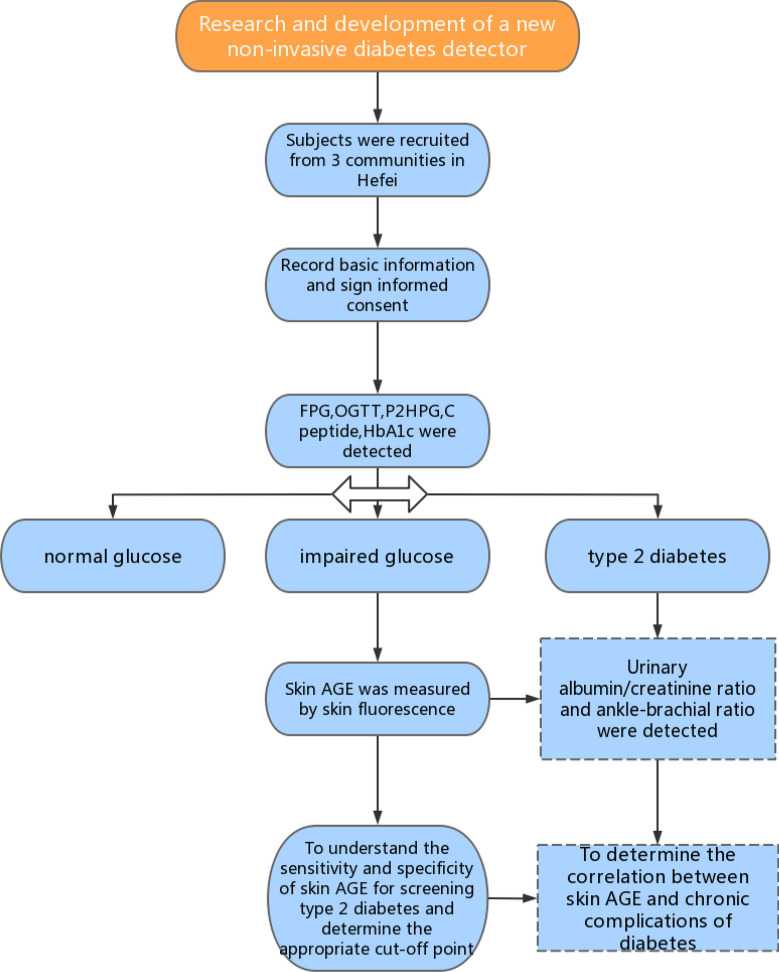
Three community health service centers in Hefei that signed the medical consortium agreement with the First Affiliated Hospital of Anhui Medical University were selected to screen the population aged 30-90 years in each community using a multi-stage cluster sampling method from January 2018 to January 2019. Univariate analysis of variance was used to compare the differences in general data, biochemical indexes, skin AGEs levels, and blood glucose among groups. In addition, a multivariable logistic regression analysis was performed.
A total of 912 patients with a community health physical examination and no history of diabetes were selected, excluding those with missing values > 5%. Finally, 906 samples were included in the study with an effective rate of 99.3%. The prevalence in the normal, impaired glucose tolerance, and DM groups were 79.8%, 10.0%, and 10.2%, respectively. By dividing AGE by quartile, AGE accumulation was classified as ≤ P25, P25-P50, P50-P75, and > P75. Higher AGE accumulation (χ = 37.95), BMI (χ = 12.20), systolic blood pressure (SBP) (χ = 8.46), triglyceride (TG) (χ = 6.23), and older age (χ = 20.11) were more likely to have a higher prevalence of fasting blood glucose (FBG). The analyses revealed significant correlations between AGE accumulation, BMI, TG, total cholesterol (TC), and FBG (P < 0.05).
As the findings indicate, priority should be given to the quality of metabolic-related indicators, such as BMI, TG, and TC, employed to effectively reduce the FBG of Chinese participants with high AGE accumulation. Skin autofluorescence may prove to be a rapid and non-invasive method for assessing the metabolic progression of all glucose level layers.
糖尿病是全球成年人关注的问题。先前的研究表明不同筛查方法与糖尿病之间存在关联;然而,越来越多的证据表明早期筛查糖尿病(DM)及其影响因素的重要性。在本研究中,我们旨在探讨在中国社区糖尿病早期筛查中先进糖基化终产物(AGEs)的非侵入性检测,以及体重指数(BMI)和代谢指标是否能调节这种关系。
选取与安徽医科大学第一附属医院签署医疗联合体协议的合肥3个社区卫生服务中心,于2018年1月至2019年1月采用多阶段整群抽样方法对各社区30 - 90岁人群进行筛查。采用单因素方差分析比较各组间一般资料、生化指标、皮肤AGEs水平和血糖的差异。此外,进行多变量逻辑回归分析。
共选取912例无糖尿病病史的社区健康体检患者,排除缺失值>5%的患者。最终,906个样本纳入研究,有效率为99.3%。正常、糖耐量受损和糖尿病组的患病率分别为79.8%、10.0%和10.2%。将AGE按四分位数划分,AGE积累分为≤P25、P25 - P50、P50 - P75和>P75。较高的AGE积累(χ = 37.95)、BMI(χ = 12.20)、收缩压(SBP)(χ = 8.46)、甘油三酯(TG)(χ = 6.23)和较高年龄(χ = 20.11)更易出现空腹血糖(FBG)患病率较高的情况。分析显示AGE积累、BMI、TG、总胆固醇(TC)和FBG之间存在显著相关性(P < 0.05)。
研究结果表明,应优先关注代谢相关指标如BMI、TG和TC的质量,以有效降低高AGE积累的中国参与者的FBG。皮肤自发荧光可能是评估所有血糖水平层代谢进展的一种快速且非侵入性的方法。