Laboratory of Developmental Biology and Genomics, College of Veterinary Medicine, Seoul National University, Seoul 08826, Korea.
Department of Surgery, University of Michigan, Ann Arbor 48109, MI, USA.
BMB Rep. 2022 Aug;55(8):401-406. doi: 10.5483/BMBRep.2022.55.8.071.
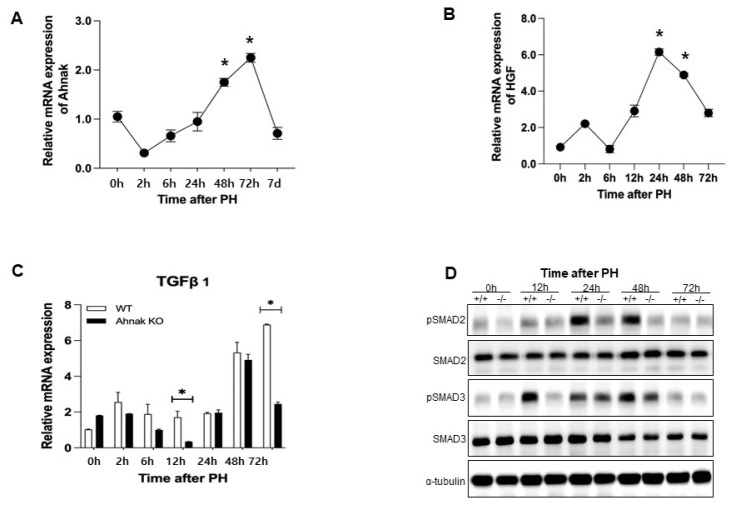
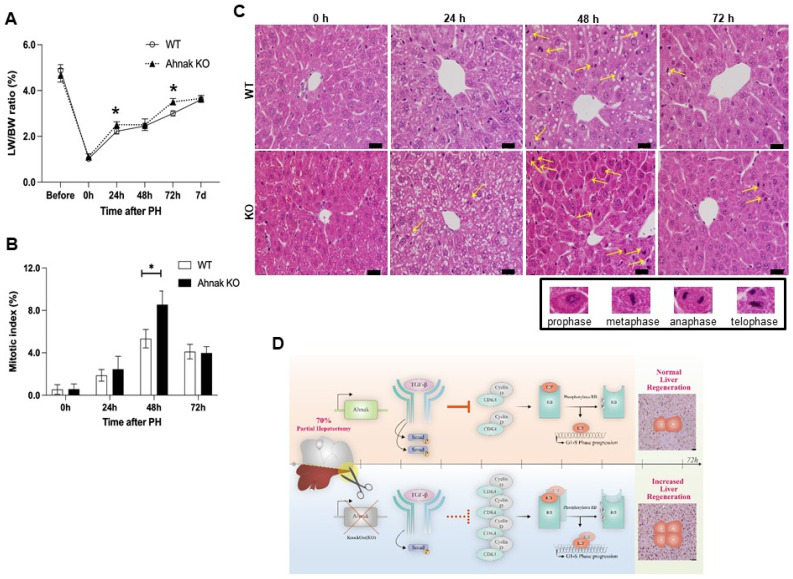
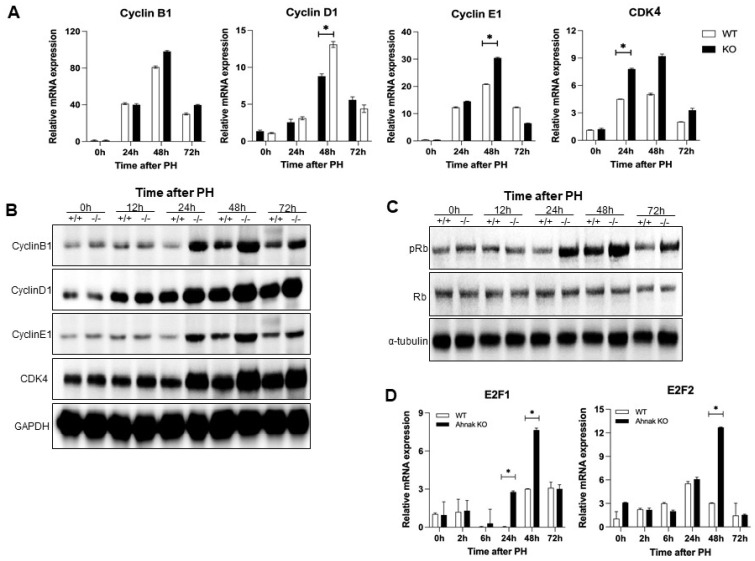
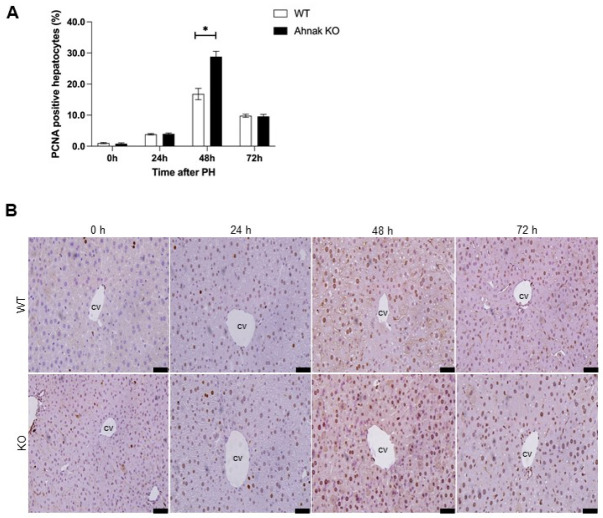
Ahnak, a large protein first identified as an inhibitor of TGF-β signaling in human neuroblastoma, was recently shown to promote TGF-β in some cancers. The TGF-β signaling pathway regulates cell growth, various biological functions, and cancer growth and metastasis. In this study, we used Ahnak knockout (KO) mice that underwent a 70% partial hepatectomy (PH) to investigate the function of Ahnak in TGF-β signaling during liver regeneration. At the indicated time points after PH, we analyzed the mRNA and protein expression of the TGF -β/Smad signaling pathway and cell cycle-related factors, evaluated the cell cycle through proliferating cell nuclear antigen (PCNA) immunostaining, analyzed the mitotic index by hematoxylin and eosin staining. We also measured the ratio of liver tissue weight to body weight. Activation of TGF-β signaling was confirmed by analyzing the levels of phospho-Smad 2 and 3 in the liver at the indicated time points after PH and was lower in Ahnak KO mice than in WT mice. The expression levels of cyclin B1, D1, and E1; proteins in the Rb/E2F transcriptional pathway, which regulates the cell cycle; and the numbers of PCNA-positive cells were increased in Ahnak KO mice and showed tendencies opposite that of TGF-β expression. During postoperative regeneration, the liver weight to body weight ratio tended to increase faster in Ahnak KO mice. However, 7 days after PH, both groups of mice showed similar rates of regeneration, following which their active regeneration stopped. Analysis of hepatocytes undergoing mitosis showed that there were more mitotic cells in Ahnak KO mice, consistent with the weight ratio. Our findings suggest that Ahnak enhances TGF-β signaling during postoperative liver regeneration, resulting in cell cycle disruption; this highlights a novel role of Ahnak in liver regeneration. These results provide new insight into liver regeneration and potential treatment targets for liver diseases that require surgical treatment. [BMB Reports 2022; 55(8): 401-406].
Ahnak,一种最初在人类神经母细胞瘤中被鉴定为 TGF-β 信号抑制剂的大型蛋白质,最近被证明在某些癌症中促进 TGF-β。TGF-β 信号通路调节细胞生长、各种生物学功能以及癌症的生长和转移。在这项研究中,我们使用接受 70%部分肝切除术(PH)的 Ahnak 敲除(KO)小鼠来研究 Ahnak 在 TGF-β 信号在肝再生过程中的功能。在 PH 后指定的时间点,我们分析了 TGF-β/Smad 信号通路和细胞周期相关因子的 mRNA 和蛋白表达,通过增殖细胞核抗原(PCNA)免疫染色评估细胞周期,通过苏木精和伊红染色分析有丝分裂指数。我们还测量了肝组织重量与体重的比值。通过分析 PH 后指定时间点肝中磷酸化 Smad2 和 3 的水平来确认 TGF-β 信号的激活,并且在 Ahnak KO 小鼠中比在 WT 小鼠中低。细胞周期调节转录途径中的细胞周期蛋白 B1、D1 和 E1 水平;Rb/E2F 转录途径中的蛋白;和 PCNA 阳性细胞的数量在 Ahnak KO 小鼠中增加,并表现出与 TGF-β 表达相反的趋势。在术后再生过程中,Ahnak KO 小鼠的肝重与体重比倾向于更快增加。然而,在 PH 后 7 天,两组小鼠的再生率相似,此后它们的活跃再生停止。对有丝分裂的肝细胞进行分析表明,Ahnak KO 小鼠中有更多的有丝分裂细胞,与体重比一致。我们的研究结果表明,Ahnak 在术后肝再生过程中增强 TGF-β 信号,导致细胞周期紊乱;这凸显了 Ahnak 在肝再生中的新作用。这些结果为肝再生提供了新的见解,并为需要手术治疗的肝脏疾病提供了潜在的治疗靶点。[BMB 报告 2022;55(8):401-406]。