Instituto de Biología y Genética Molecular, Consejo Superior de Investigaciones Científicas (CSIC), 47003 Valladolid, Spain.
Centro de Investigación Biomédica en Red de Diabetes y Enfermedades Metabólicas Asociadas (CIBERDEM), Instituto de Salud Carlos III, 28029 Madrid, Spain.
Cells. 2022 Jul 8;11(14):2146. doi: 10.3390/cells11142146.
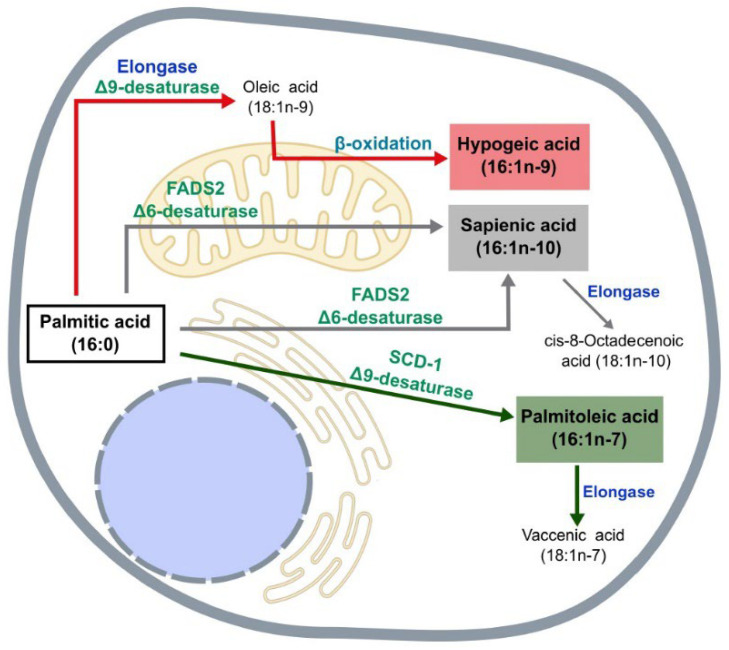
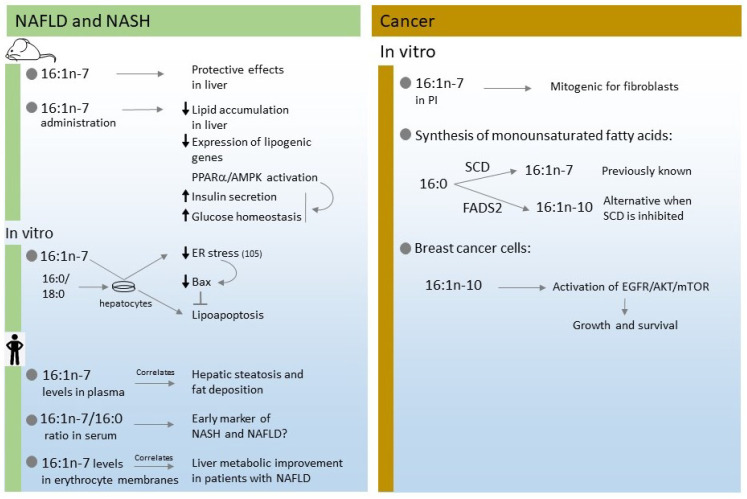
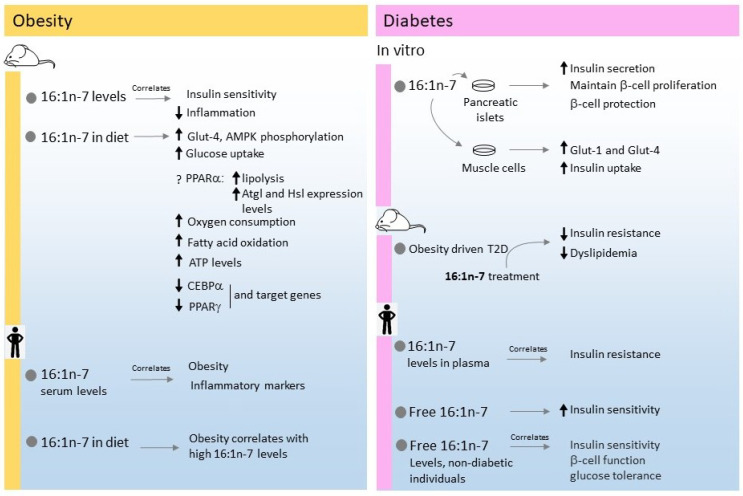
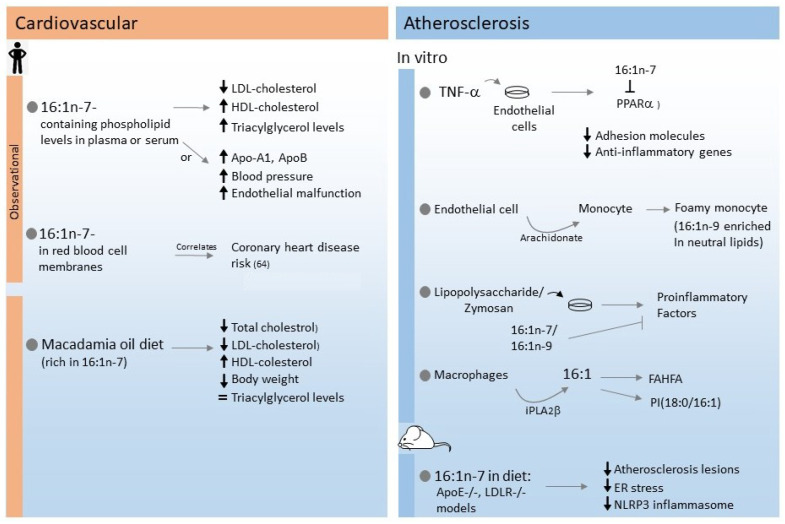
In the last few years, the monounsaturated hexadecenoic fatty acids are being increasingly considered as biomarkers of health with key functions in physiology and pathophysiology. Palmitoleic acid (16:1n-7) and sapienic acid (16:1n-10) are synthesized from palmitic acid by the action of stearoyl-CoA desaturase-1 and fatty acid desaturase 2, respectively. A third positional isomer, hypogeic acid (16:1n-9) is produced from the partial β-oxidation of oleic acid. In this review, we discuss the current knowledge of the effects of palmitoleic acid and, where available, sapienic acid and hypogeic acid, on metabolic diseases such as diabetes, cardiovascular disease, and nonalcoholic fatty liver disease, and cancer. The results have shown diverse effects among studies in cell lines, animal models and humans. Palmitoleic acid was described as a lipokine able to regulate different metabolic processes such as an increase in insulin sensitivity in muscle, β cell proliferation, prevention of endoplasmic reticulum stress and lipogenic activity in white adipocytes. Numerous beneficial effects have been attributed to palmitoleic acid, both in mouse models and in cell lines. However, its role in humans is not fully understood, and is sometimes controversial. Regarding sapienic acid and hypogeic acid, studies on their biological effects are still scarce, but accumulating evidence suggests that they also play important roles in metabolic regulation. The multiplicity of effects reported for palmitoleic acid and the compartmentalized manner in which they often occur, may suggest the overlapping actions of multiple isomers being present at the same or neighboring locations.
在过去的几年中,单不饱和十六碳烯酸作为健康的生物标志物,在生理学和病理生理学中具有关键作用,越来越受到关注。棕榈油酸(16:1n-7)和芝麻酸(16:1n-10)分别由硬脂酰辅酶 A 去饱和酶-1 和脂肪酸去饱和酶 2 从棕榈酸合成。第三种位置异构体 hypogeic 酸(16:1n-9)是从油酸的部分β-氧化产生的。在这篇综述中,我们讨论了棕榈油酸以及在可用情况下芝麻酸和 hypogeic 酸对代谢疾病(如糖尿病、心血管疾病和非酒精性脂肪肝疾病以及癌症)的影响的现有知识。结果表明,在细胞系、动物模型和人类中的研究结果存在差异。棕榈油酸被描述为一种能够调节不同代谢过程的脂素,例如增加肌肉中的胰岛素敏感性、β 细胞增殖、预防内质网应激和白色脂肪细胞中的脂肪生成活性。已经有许多有益的作用归因于棕榈油酸,无论是在小鼠模型还是在细胞系中。然而,其在人类中的作用尚未完全了解,有时甚至存在争议。关于芝麻酸和 hypogeic 酸,它们的生物学效应的研究仍然很少,但越来越多的证据表明它们在代谢调节中也起着重要作用。棕榈油酸报告的多种作用以及它们通常发生的隔室化方式,可能表明存在于同一或相邻位置的多种异构体的重叠作用。