Sun Qinying, Wei Xiangzhen, Wang Zhonglin, Zhu Yan, Zhao Weiying, Dong Yuchao
Department of Respiratory and Critical Care Medicine, Changhai Hospital, The First Affiliated Hospital of Naval Medical University (Second Military Medical University), Shanghai 200001, China.
Medical College, Shaoxing University, Shaoxing 311201, China.
Cancers (Basel). 2022 Jul 6;14(14):3294. doi: 10.3390/cancers14143294.
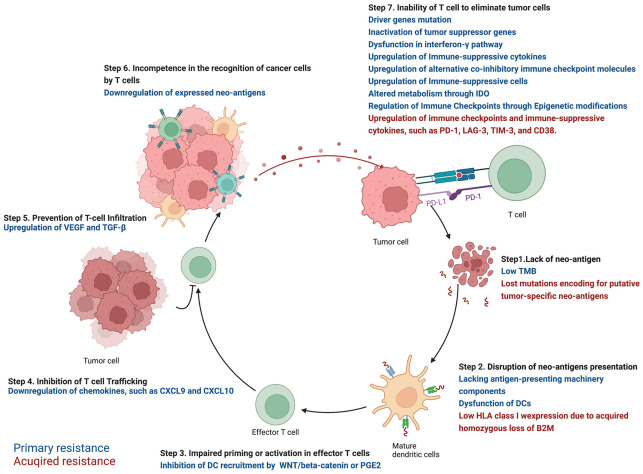
Immune checkpoint inhibitors have emerged as the treatment landscape of advanced non-small cell lung cancer (NSCLC) in recent years. However, approximately 80% of NSCLC patients do not benefit from ICIs due to primary resistance (no initial response) or acquired resistance (tumor relapse after an initial response). In this review, we highlight the mechanisms of primary and secondary resistance. Furthermore, we provide a future direction of the potential predictive biomarkers and the tumor microenvironmental landscape and suggest treatment strategies to overcome these mechanisms.
近年来,免疫检查点抑制剂已成为晚期非小细胞肺癌(NSCLC)的治疗手段。然而,约80%的NSCLC患者由于原发性耐药(无初始反应)或获得性耐药(初始反应后肿瘤复发)而无法从免疫检查点抑制剂中获益。在本综述中,我们重点介绍了原发性和继发性耐药的机制。此外,我们提供了潜在预测生物标志物和肿瘤微环境格局的未来方向,并提出了克服这些机制的治疗策略。