Jagtap Sandeep, Trollman Hana, Trollman Frank, Garcia-Garcia Guillermo, Parra-López Carlos, Duong Linh, Martindale Wayne, Munekata Paulo E S, Lorenzo Jose M, Hdaifeh Ammar, Hassoun Abdo, Salonitis Konstantinos, Afy-Shararah Mohamed
Sustainable Manufacturing Systems Centre, School of Aerospace, Transport & Manufacturing, Cranfield University, Cranfield MK43 0AL, UK.
Department of Work, Employment, Management and Organisations, School of Business, The University of Leicester, University Road, Leicester LE1 7RH, UK.
Foods. 2022 Jul 14;11(14):2098. doi: 10.3390/foods11142098.
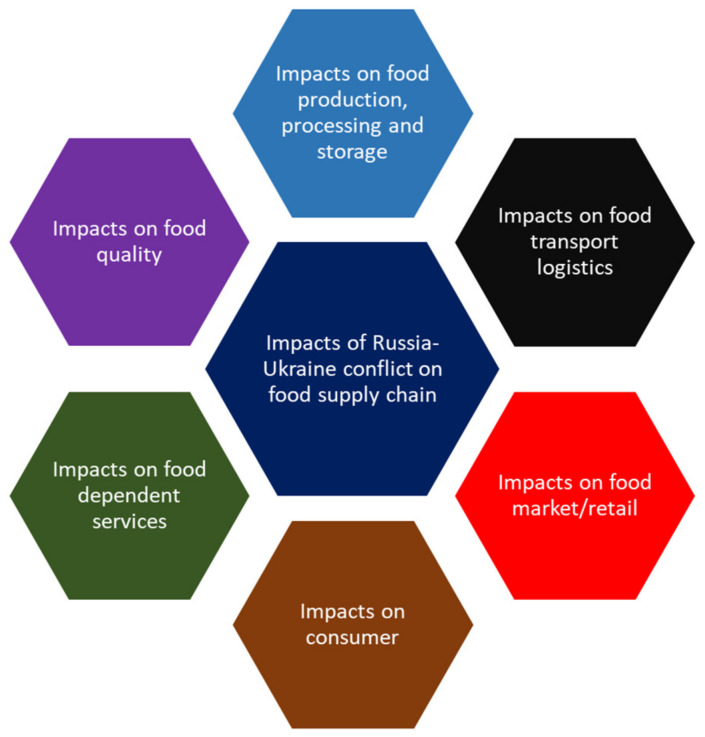
Food is one of the most traded goods, and the conflict in Ukraine, one of the European breadbaskets, has triggered a significant additional disruption in the global food supply chains after the COVID-19 impact. The disruption to food output, supply chains, availability, and affordability could have a long-standing impact. As a result, the availability and supply of a wide range of food raw materials and finished food products are under threat, and global markets have seen recent increases in food prices. Furthermore, the Russian-Ukrainian conflict has adversely affected food supply chains, with significant effects on production, sourcing, manufacturing, processing, logistics, and significant shifts in demand between nations reliant on imports from Ukraine. This paper aims to analyze the impacts of the conflict between Russia and Ukraine on the effectiveness and responsiveness of the global food supply chains. A PRISMA (Preferred Reporting Items for Systematic Reviews and Meta-Analyses) approach, including grey literature, was deployed to investigate six key areas of the food supply chains that would be impacted most due to the ongoing war. Findings include solutions and strategies to mitigate supply chain impacts such as alternative food raw materials, suppliers and supply chain partners supported by technological innovations to ensure food safety and quality in warlike situations.
粮食是交易最为频繁的商品之一,乌克兰作为欧洲的粮仓之一,其内部冲突在新冠疫情的影响之上,又给全球粮食供应链带来了严重的额外干扰。粮食产量、供应链、供应情况以及可承受价格受到的干扰可能会产生长期影响。因此,各类粮食原材料和制成品的供应及可得性受到威胁,近期全球市场粮食价格上涨。此外,俄乌冲突对粮食供应链产生了不利影响,对生产、采购、制造、加工、物流造成重大影响,依赖从乌克兰进口的国家之间的需求也发生了显著变化。本文旨在分析俄乌冲突对全球粮食供应链的有效性和响应能力的影响。采用PRISMA(系统评价和荟萃分析的首选报告项目)方法,包括灰色文献,对粮食供应链中因当前战争而受影响最大的六个关键领域进行调查。研究结果包括减轻供应链影响的解决方案和策略,如替代粮食原材料、供应商以及由技术创新支持的供应链合作伙伴,以确保在战争状态下的食品安全和质量。