Budd Maggi A, Gater David R, Channell Isabella
Spinal Cord Injury/Disease Service, VA Boston Healthcare System, Boston, MA 02130, USA.
Department of Psychiatry, Harvard Medical School, Boston, MA 02115, USA.
J Pers Med. 2022 Jul 20;12(7):1178. doi: 10.3390/jpm12071178.
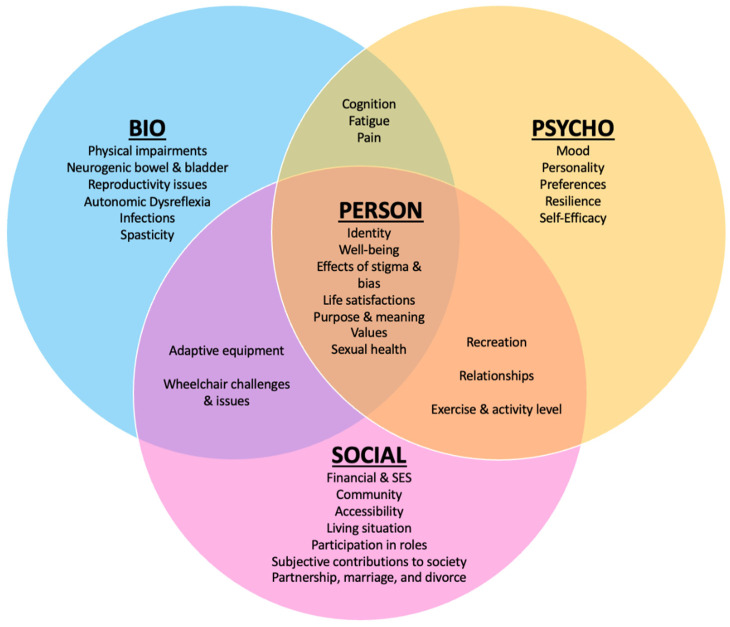
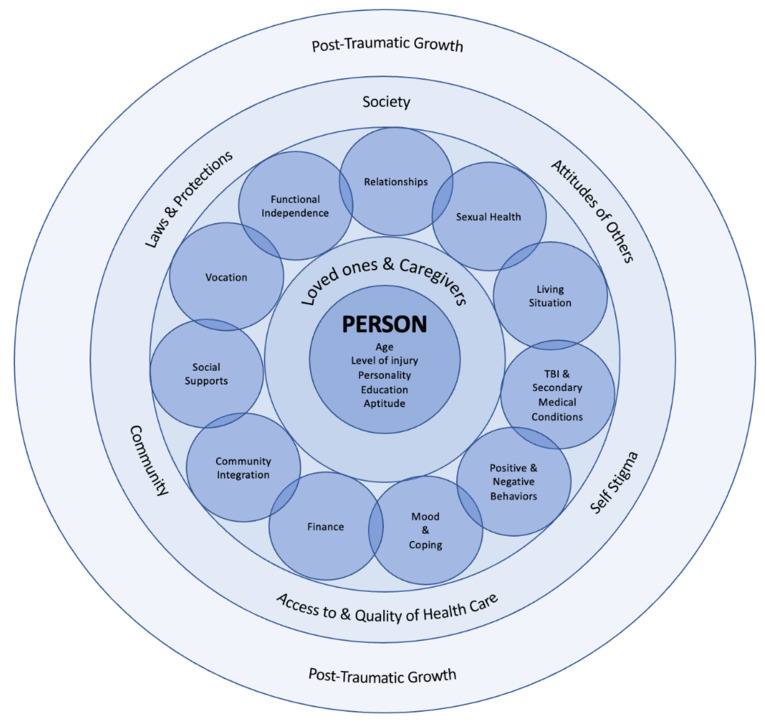
Consequences of a spinal cord injury (SCI) entail much more than damage to the spinal cord. The lives of people with SCI, along with those around them, experience profound long-lasting changes in nearly every life domain. SCI is a physical (biological) injury that is inextricably combined with various psychological and social consequences. The objective of this review is to present psychosocial challenges following SCI through the biopsychosocial model, beginning with acknowledgement of the larger societal effects of ableism and stigma before addressing the many unique psychosocial aspects of living with SCI. Included in this review are qualitative studies and systematic reviews on current psychosocial outcomes and consequences. This paper attempts to structure this information by dividing it into the following sections: relationships and family; changes in finances and employment; issues related to the person's living situation; community reintegration; factors associated with mood and coping (e.g., depression, anxiety, substance use, and PTSD); self-harm behaviors (ranging from nonadherence to suicide); effects of traumatic brain injury; considerations regarding sexual health; aging with SCI; and concludes with a brief discussion about post-traumatic growth. Cultivating an understanding of the unique and interrelated psychosocial consequences of people living with SCI may help mitigate the psychosocial aftermath and serve as a reminder to providers to maintain a person-centered approach to care.
脊髓损伤(SCI)的后果远不止于脊髓损伤本身。脊髓损伤患者及其周围人的生活在几乎每个生活领域都经历了深刻而持久的变化。脊髓损伤是一种身体(生物学)损伤,与各种心理和社会后果紧密相连。本综述的目的是通过生物心理社会模型呈现脊髓损伤后的心理社会挑战,首先承认能力主义和污名化对社会的更大影响,然后再探讨脊髓损伤患者生活中许多独特的心理社会方面。本综述包括关于当前心理社会结果和后果的定性研究和系统评价。本文试图通过将这些信息分为以下几个部分来进行组织:人际关系与家庭;财务和就业变化;与个人生活状况相关的问题;重新融入社区;与情绪和应对相关的因素(如抑郁、焦虑、物质使用和创伤后应激障碍);自我伤害行为(从不依从到自杀);创伤性脑损伤的影响;性健康方面的考虑;脊髓损伤后的衰老;最后简要讨论创伤后成长。了解脊髓损伤患者独特且相互关联的心理社会后果,可能有助于减轻心理社会后遗症,并提醒医疗服务提供者保持以患者为中心的护理方法。