Shen Yu-An, Wu John A
Department of Materials Science and Engineering, Feng Chia University, Taichung 407, Taiwan.
School of Materials Engineering, Purdue University, West Lafayette, IN 47907, USA.
Materials (Basel). 2022 Jul 21;15(14):5086. doi: 10.3390/ma15145086.
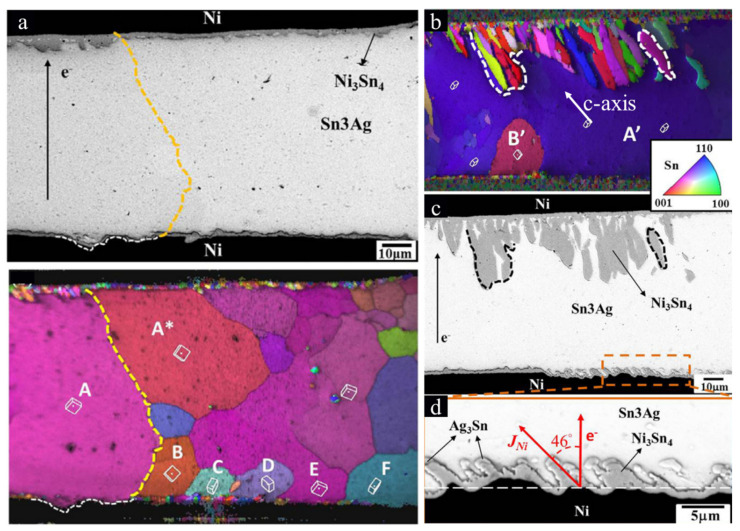
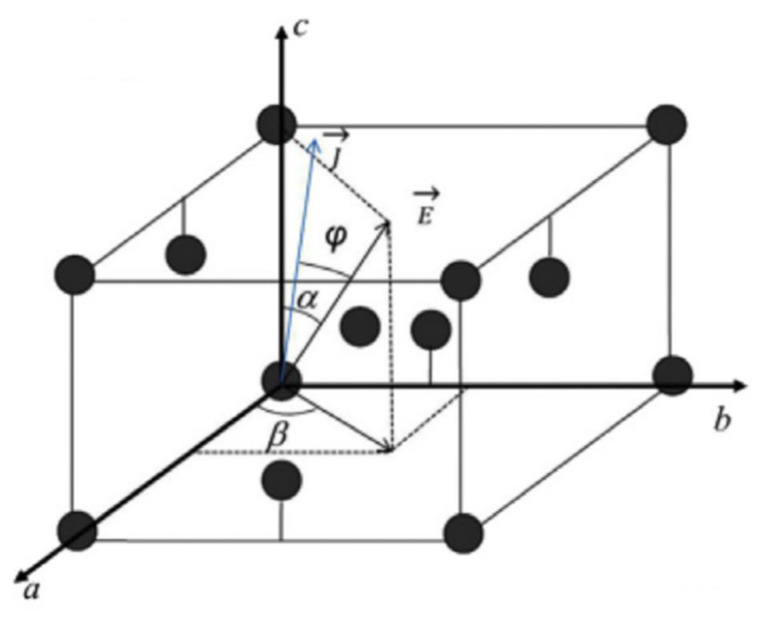
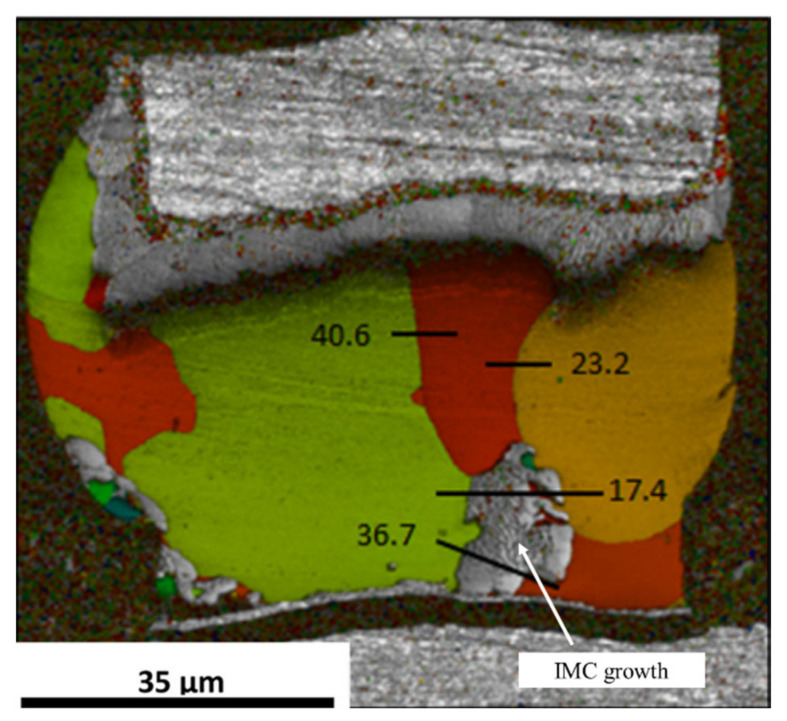
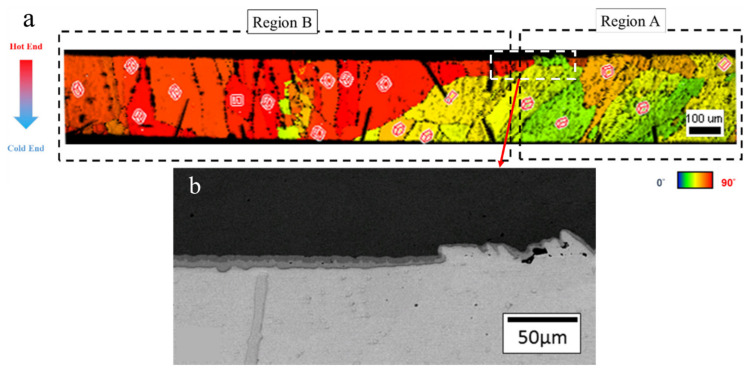
Sn-rich solder joints in three-dimensional integrated circuits and their reliability issues, such as the electromigration (EM), thermomigration (TM), and thermomechanical fatigue (TMF), have drawn attention related to their use in electronic packaging. The Sn grain orientation is recognized as playing an important role in reliability issues due to its anisotropic diffusivity, mechanical properties, and coefficient of thermal expansion. This study reviews the effects of the Sn grain orientation on the EM, TM, and TMF in Sn-rich solder joints. The findings indicate that in spite of the failure modes dominated by the Sn grain orientation, the size and shape of the solder joint, as well as the Sn microstructures, such as the cycling twining boundary (CTB), single crystals, and misorientations of the Sn grain boundary, should be considered in more detail. In addition, we show that two methods, involving a strong magnetic field and seed crystal layers, can control the Sn grain orientations during the solidification of Sn-rich solder joints.
三维集成电路中富含锡的焊点及其可靠性问题,如电迁移(EM)、热迁移(TM)和热机械疲劳(TMF),已因其在电子封装中的应用而受到关注。由于其各向异性扩散率、机械性能和热膨胀系数,锡晶粒取向被认为在可靠性问题中起着重要作用。本研究综述了锡晶粒取向对富含锡焊点中的电迁移、热迁移和热机械疲劳的影响。研究结果表明,尽管失效模式由锡晶粒取向主导,但焊点的尺寸和形状,以及锡微观结构,如循环孪晶界(CTB)、单晶和锡晶界的取向差,应更详细地加以考虑。此外,我们表明,两种方法,即强磁场和籽晶层,可在富含锡焊点凝固过程中控制锡晶粒取向。