Krambrich Janina, Bringeland Emelie, Hesson Jenny C, Hoffman Tove, Lundkvist Åke, Lindahl Johanna F, Ling Jiaxin
Department of Medical Biochemistry and Microbiology, Zoonosis Science Center, Uppsala University, P.O. Box 582, 751 23 Uppsala, Sweden.
Department of Biosciences, International Livestock Research Institute, P.O. Box 30709, Nairobi 00100, Kenya.
Microorganisms. 2022 Jul 18;10(7):1445. doi: 10.3390/microorganisms10071445.
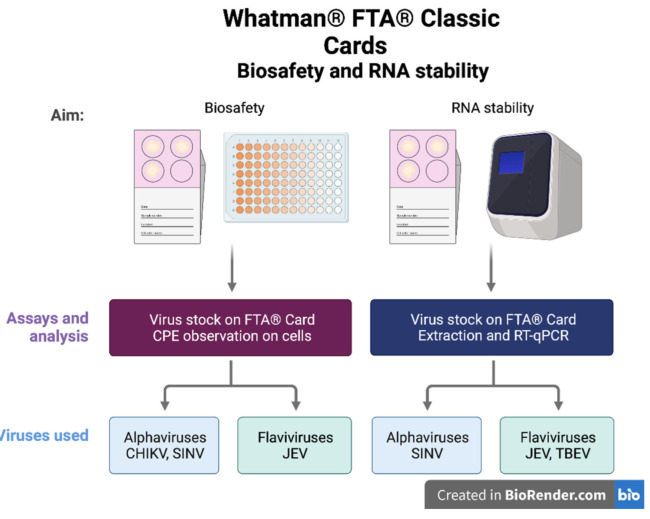
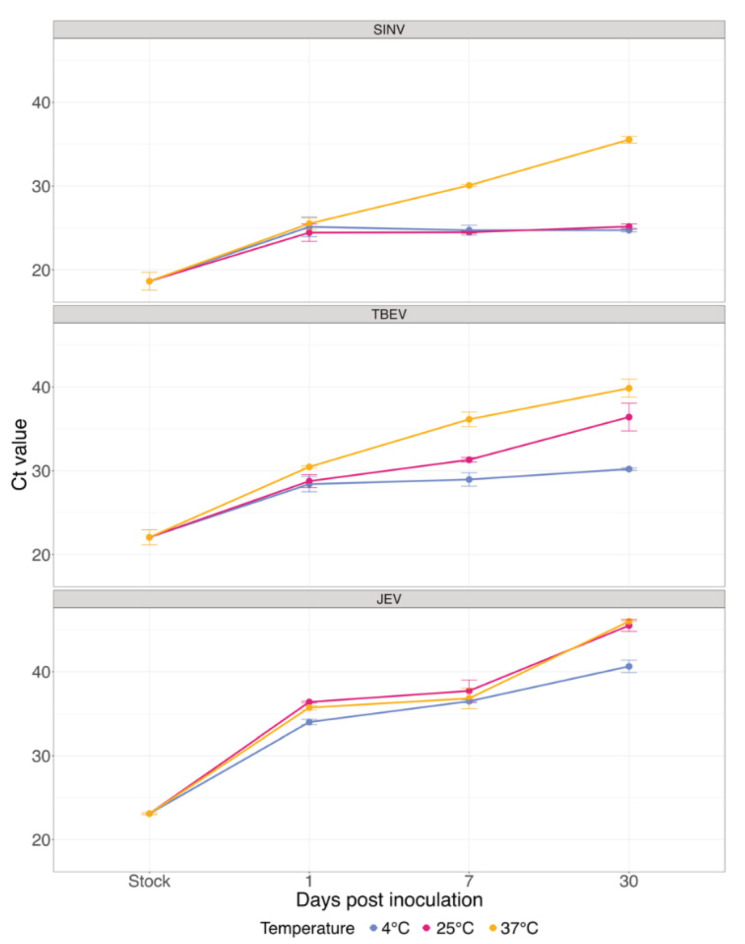
Infections caused by arthropod-borne RNA viruses are overrepresented among emerging infectious diseases. Effective methods for collecting, storing, and transporting clinical or biological specimens are needed worldwide for disease surveillance. However, many tropical regions where these diseases are endemic lack analytical facilities and possibility of continuous cold chains, which presents challenges from both a biosafety and material preservation perspective. Whatman FTA Classic Cards may serve as an effective and safe option for transporting hazardous samples at room temperature, particularly for RNA viruses classified as biosafety level (BSL) 2 and 3 pathogens, from sampling sites to laboratories. In this study, we investigated the biosafety and perseverance of representative alpha- and flaviviruses stored on FTA cards. To evaluate the virus inactivation capacity of FTA cards, we used Sindbis virus (SINV), chikungunya virus (CHIKV), and Japanese encephalitis virus (JEV). We inoculated susceptible cells with dilution series of eluates from viral samples stored on the FTA cards and observed for cytopathic effect to evaluate the ability of the cards to inactivate viruses. All tested viruses were inactivated after storage on FTA cards. In addition, we quantified viral RNA of JEV, SINV, and tick-borne encephalitis virus (TBEV) stored on FTA cards at 4 °C, 25 °C, and 37 °C for 30 days using two reverse transcriptase quantitative PCR assays. Viral RNA of SINV stored on FTA cards was not reduced at either 4 °C or 25 °C over a 30-day period, but degraded rapidly at 37 °C. For JEV and TBEV, degradation was observed at all temperatures, with the most rapid degradation occurring at 37 °C. Therefore, the use of FTA cards provides a safe and effective workflow for the collection, storage, and analysis of BSL 2- and 3-virus RNA samples, but there is a risk of false negative results if the cards are stored at higher temperatures for long periods of time. Conscious usage of the cards can be useful in disease surveillance and research, especially in tropical areas where transportation and cold chains are problematic.
节肢动物传播的RNA病毒引起的感染在新发传染病中占比过高。全球都需要有效的方法来采集、储存和运输临床或生物标本以进行疾病监测。然而,这些疾病流行的许多热带地区缺乏分析设施且无法维持连续冷链,这从生物安全和材料保存的角度都带来了挑战。Whatman FTA经典卡片可能是在室温下运输危险样本的一种有效且安全的选择,特别是对于被归类为生物安全水平(BSL)2和3病原体的RNA病毒,从采样点运输到实验室。在本研究中,我们调查了储存在FTA卡片上的代表性α病毒和黄病毒的生物安全性和持久性。为了评估FTA卡片的病毒灭活能力,我们使用了辛德毕斯病毒(SINV)、基孔肯雅病毒(CHIKV)和日本脑炎病毒(JEV)。我们用储存在FTA卡片上的病毒样本洗脱液的稀释系列接种易感细胞,并观察细胞病变效应以评估卡片灭活病毒的能力。所有测试病毒在储存在FTA卡片上后均被灭活。此外,我们使用两种逆转录定量PCR测定法,对储存在FTA卡片上于4℃、25℃和37℃保存30天的JEV、SINV和蜱传脑炎病毒(TBEV)的病毒RNA进行了定量。储存在FTA卡片上的SINV病毒RNA在4℃或25℃下30天内未减少,但在37℃下迅速降解。对于JEV和TBEV,在所有温度下均观察到降解,在37℃下降解最快。因此,使用FTA卡片为收集、储存和分析BSL 2和3病毒RNA样本提供了一种安全有效的工作流程,但如果卡片在较高温度下长时间储存,存在假阴性结果的风险。在疾病监测和研究中,尤其是在运输和冷链存在问题的热带地区,谨慎使用这些卡片可能会很有用。