Mennini Francesco Saverio, Silenzi Andrea, Marcellusi Andrea, Conversano Michele, Siddu Andrea, Rezza Giovanni
Economic Evaluation and HTA (EEHTA CEIS), Department of Economics and Finance, Faculty of Economics, University of Rome "Tor Vergata", Via Columbia 2, 00133 Rome, Italy.
Institute for Leadership and Management in Health, Kingston University, River House, 53-57 High Street, Kingston upon Thames, London Surrey KT1 1LQ, UK.
Vaccines (Basel). 2022 Jul 16;10(7):1133. doi: 10.3390/vaccines10071133.
Italy was the first European country to introduce universal vaccination of adolescents, for both males and females, against Human Papilloma Virus (HPV) starting in 2017 with the NIP 2017-2019's release. However, vaccine coverage rates (VCRs) among adolescents have shown a precarious take-off since the NIP's release, and this situation worsened due to the impact of the COVID-19 pandemic in 2020. The aim of this work is to estimate the epidemiological and economic impact of drops in VCRs due to the pandemic on those generations that missed the vaccination appointment and to discuss alternative scenarios in light of the national data.
Through an analysis of the official ministerial HPV vaccination reports, a model was developed to estimate the number of 12-year-old males and females who were not vaccinated against HPV during the period 2017-2021. Based on previously published models that estimate the incidence and the economic impact of HPV-related diseases in Italy, a new model was developed to estimate the impact of the aggregated HPV VCRs achieved in Italy between 2017 and 2021.
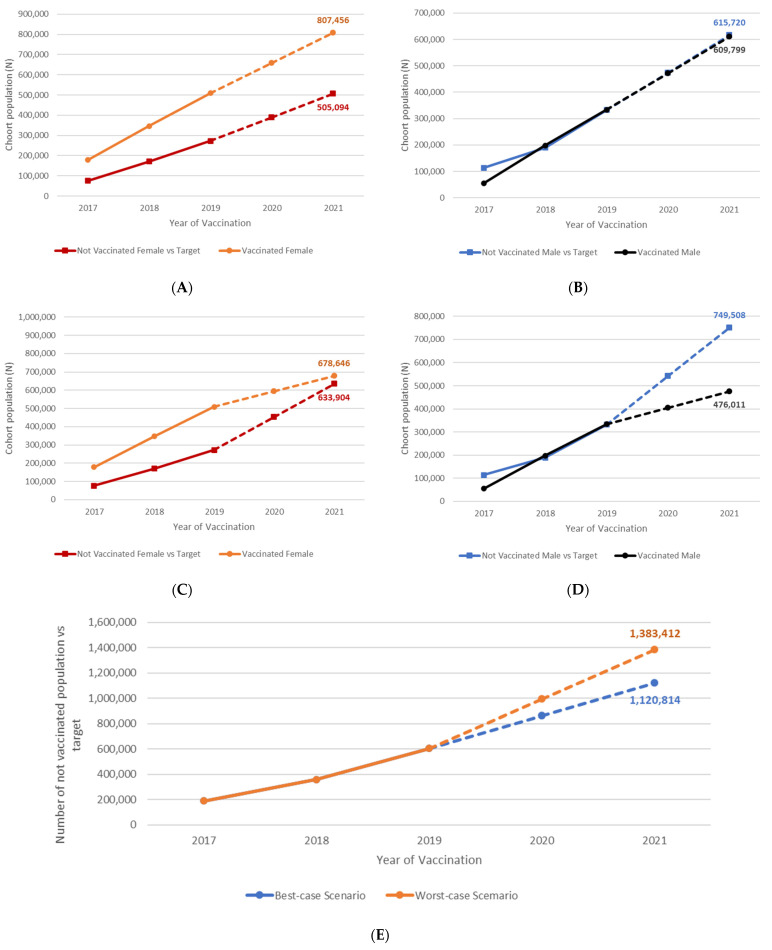
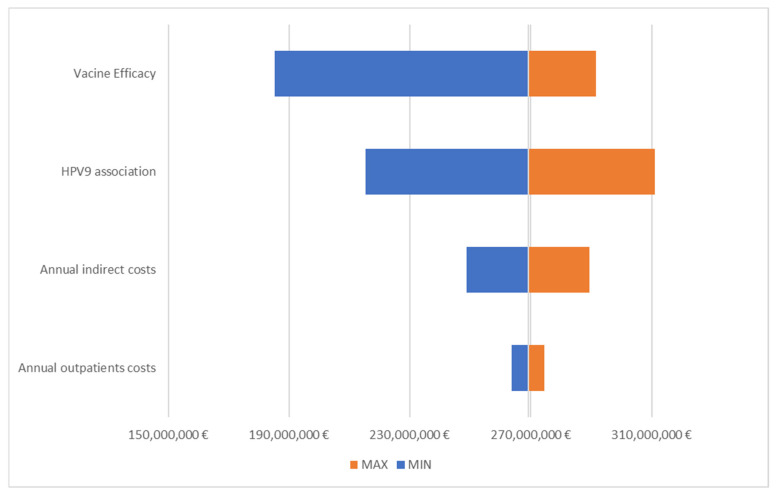
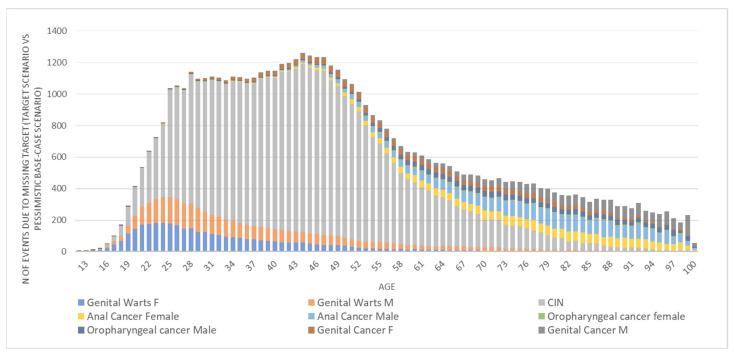
Overall, in 2021, 723,375 girls and 1,011,906 boys born between 2005 and 2009 were not vaccinated against HPV in Italy (42% and 52% of these cohorts, respectively). As compared with the 95% target provided by the Italian NIP, between 505,000 and 634,000 girls will not be protected against a large number of HPV-related diseases. For boys, the number of the unvaccinated population compared to the applicable target is over 615,000 in the 'best case scenario' and over 749,000 in the 'worst case scenario'. Overall, between 1.1 and 1.3 million young adolescents born between 2005 and 2009 will not be protected against HPV-related diseases over their lifetime with expected lifetime costs of non-vaccination that will be over EUR 905 million. If the 95% optimal VCRs were achieved, the model estimates a cost reduction equal to EUR 529 million, the net of the costs incurred to implement the vaccination program.
Suboptimal vaccination coverage represents a missed opportunity, not only because of the increased burden of HPV-related diseases, but also in terms of economic loss. Thus, reaching national HPV immunization goals is a public health priority.
意大利是首个在欧洲国家推行青少年(无论男女)人乳头瘤病毒(HPV)普遍接种的国家,自2017年《2017 - 2019年国家免疫计划》发布起开始实施。然而,自该计划发布以来,青少年中的疫苗接种覆盖率(VCR)呈现出不稳定的增长态势,并且由于2020年新冠疫情的影响,这种情况进一步恶化。这项工作的目的是评估因疫情导致的VCR下降对那些错过接种预约的人群所产生的流行病学和经济影响,并根据国家数据讨论替代方案。
通过分析官方卫生部的HPV疫苗接种报告,开发了一个模型来估计2017 - 2021年期间未接种HPV疫苗的12岁男性和女性的数量。基于先前发表的估计意大利HPV相关疾病发病率和经济影响的模型,开发了一个新模型来估计2017年至2021年期间意大利总体HPV疫苗接种覆盖率所产生的影响。
总体而言,2021年,意大利2005年至2009年出生的723,375名女孩和1,011,906名男孩未接种HPV疫苗(分别占这些队列的42%和52%)。与意大利国家免疫计划规定的95%的目标相比,将有505,000至634,000名女孩无法预防大量HPV相关疾病。对于男孩来说,与适用目标相比,未接种疫苗的人数在“最佳情况”下超过615,000人,在“最坏情况”下超过749,000人。总体而言,2005年至2009年出生的110万至130万青少年在其一生中将无法预防HPV相关疾病,未接种疫苗的预期终身成本将超过9.05亿欧元。如果达到95%的最佳疫苗接种覆盖率,该模型估计成本降低额为5.29亿欧元,这是实施疫苗接种计划所产生成本的净额。
次优的疫苗接种覆盖率意味着错失机会,不仅因为HPV相关疾病负担增加,还在经济损失方面。因此,实现国家HPV免疫目标是公共卫生的优先事项。