Chen Tong, Liu Yu, Wu Shiquan, Long Siyu, Feng Ling, Lu Wenqian, Chen Wenya, Hong Guoai, Zhou Li, Wang Fang, Luo Yuechan, Zou Hequn, Liu Weihua
Department of Nephrology, South China Hospital of Shenzhen University, Shenzhen, China.
Guangdong Key Laboratory for Biomedical Measurements and Ultrasound Imaging, National Regional Key Technology Engineering Laboratory for Medical Ultrasound School of Biomedical Engineering, Shenzhen University Medical School, Shenzhen, China.
Front Endocrinol (Lausanne). 2024 Dec 4;15:1381060. doi: 10.3389/fendo.2024.1381060. eCollection 2024.
Retinol binding protein 4 (RBP4), as a novel adipokine, has been proven to be highly related to insulin resistance, obesity, diabetes, hypertension, hyperuricemia and other metabolic diseases, which are all risk factors for chronic kidney disease (CKD). However, there is a lack of sufficient studies to explore the relationship between RBP4 and CKD, and no reports have described the predictive value of RBP4 for CKD. This study was designed to clarify the relationship between RBP4 and CKD and its potential predictive value.
Our team has conducted a large-scale cross-sectional survey that contained 2117 individuals on the southern coast of China. Correlation test, logistic regression analysis were used to evaluate the association between RBP4 and CKD. Receiver operating characteristic (ROC) were used to evaluate the optimal cut-off and predictive value of RBP4 for predicting CKD.
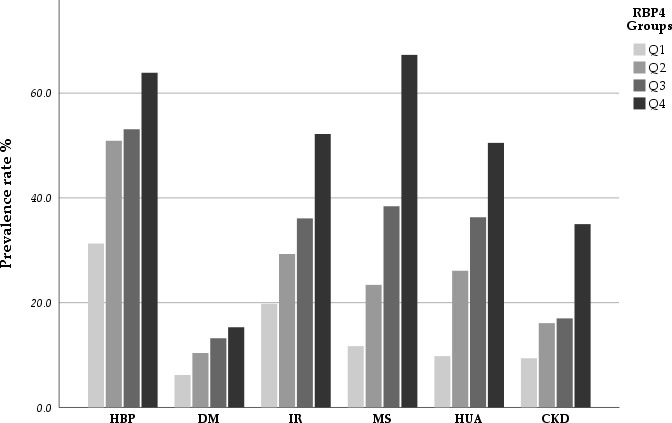
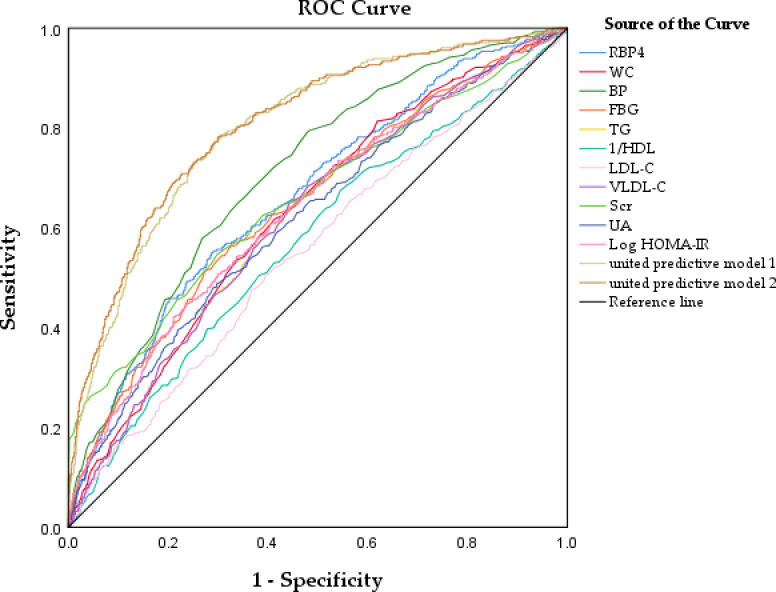
By using the quartile grouping method, the population was divided into four groups according to the RBP4 level. As the RBP4 level increased, the prevalence of CKD also gradually increased among different groups. RBP4 was also correlated with various metabolic risk factors, such as blood glucose, blood lipids, blood pressure, waist circumference, uric acid, and with kidney function indicators such as creatinine, urine protein. Logistic regression analysis found that after adjusting for confounders, RBP4 remained significantly associated with CKD, independent of metabolic risk factors. ROC analysis showed that RBP4 as a single index, AUC (0.666) was superior to Scr, FBG, Log HOMA-IR, WC, TG, VLDL-C, UA, HDL-C, LDL-C, and that combining RBP4 indicator and other common risk factors of CKD can improve the accuracy for predicting CKD.
This study found that the RBP4 was strongly correlated with CKD, RBP4 may become a valuable marker and have strong power for predicting CKD.
视黄醇结合蛋白4(RBP4)作为一种新型脂肪因子,已被证明与胰岛素抵抗、肥胖、糖尿病、高血压、高尿酸血症及其他代谢性疾病高度相关,而这些疾病均为慢性肾脏病(CKD)的危险因素。然而,目前缺乏足够的研究来探讨RBP4与CKD之间的关系,也没有报道描述RBP4对CKD的预测价值。本研究旨在阐明RBP4与CKD之间的关系及其潜在的预测价值。
我们团队在中国南部沿海地区对2117名个体进行了大规模横断面调查。采用相关性检验、逻辑回归分析评估RBP4与CKD之间的关联。采用受试者工作特征(ROC)曲线评估RBP4预测CKD的最佳截断值和预测价值。
采用四分位数分组法,根据RBP4水平将人群分为四组。随着RBP4水平升高,不同组中CKD的患病率也逐渐增加。RBP4还与各种代谢危险因素相关,如血糖、血脂、血压、腰围、尿酸,以及与肾功能指标如肌酐、尿蛋白相关。逻辑回归分析发现,在调整混杂因素后,RBP4仍与CKD显著相关,独立于代谢危险因素。ROC分析显示,RBP4作为单一指标,曲线下面积(AUC,0.666)优于血肌酐(Scr)、空腹血糖(FBG)、稳态模型胰岛素抵抗指数(Log HOMA-IR)、腰围(WC)、甘油三酯(TG)、极低密度脂蛋白胆固醇(VLDL-C)、尿酸(UA)、高密度脂蛋白胆固醇(HDL-C)、低密度脂蛋白胆固醇(LDL-C),并且将RBP4指标与CKD其他常见危险因素相结合可提高预测CKD的准确性。
本研究发现RBP4与CKD密切相关,RBP4可能成为一个有价值的标志物,对预测CKD具有较强的能力。