Papait Andrea, Romoli Jacopo, Stefani Francesca Romana, Chiodelli Paola, Montresor Maria Cristina, Agoni Lorenzo, Silini Antonietta Rosa, Parolini Ornella
Department of Life Science and Public Health, Università Cattolica del Sacro Cuore, 00168 Rome, Italy.
Fondazione Policlinico Universitario "Agostino Gemelli" IRCCS, 00168 Rome, Italy.
Cancers (Basel). 2022 Jul 22;14(15):3570. doi: 10.3390/cancers14153570.
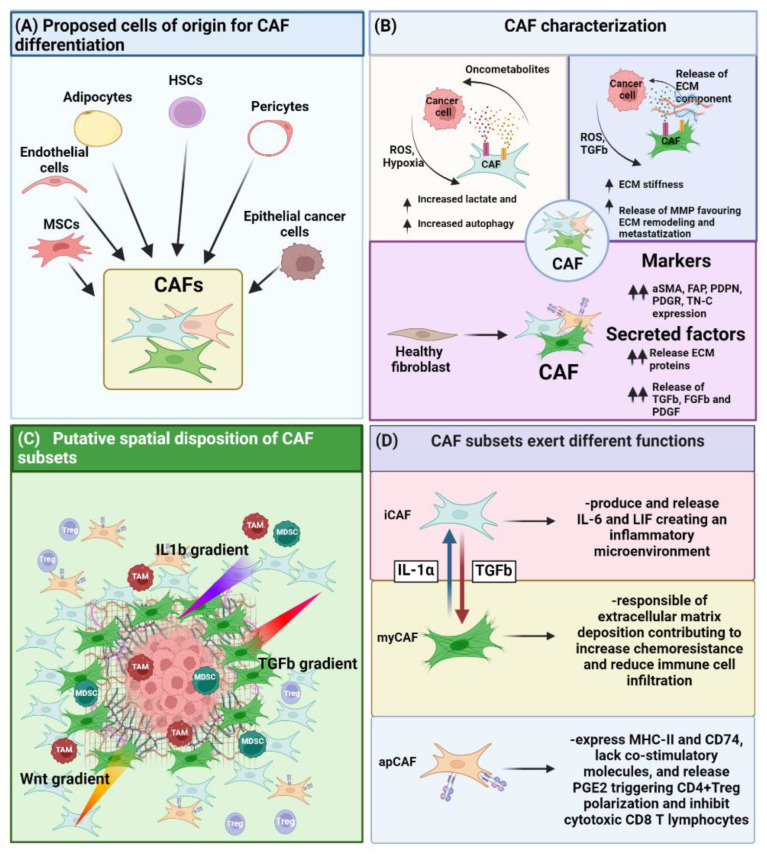
The tumor microenvironment (TME) is comprised of different cellular components, such as immune and stromal cells, which co-operate in unison to promote tumor progression and metastasis. In the last decade, there has been an increasing focus on one specific component of the TME, the stromal component, often referred to as Cancer-Associated Fibroblasts (CAF). CAF modulate the immune response and alter the composition of the extracellular matrix with a decisive impact on the response to immunotherapies and conventional chemotherapy. The most recent publications based on single-cell analysis have underlined CAF heterogeneity and the unique plasticity that strongly impact the TME. In this review, we focus not only on the characterization of CAF based on the most recent findings, but also on their impact on the immune system. We also discuss clinical trials and preclinical studies where targeting CAF revealed controversial results. Therefore, future efforts should focus on understanding the functional properties of individual subtypes of CAF, taking into consideration the peculiarities of each pathological context.
肿瘤微环境(TME)由不同的细胞成分组成,如免疫细胞和基质细胞,它们协同作用以促进肿瘤进展和转移。在过去十年中,人们越来越关注TME的一个特定成分,即基质成分,通常称为癌症相关成纤维细胞(CAF)。CAF调节免疫反应并改变细胞外基质的组成,对免疫治疗和传统化疗的反应具有决定性影响。基于单细胞分析的最新出版物强调了CAF的异质性和独特的可塑性,这对TME有强烈影响。在本综述中,我们不仅关注基于最新发现的CAF特征,还关注它们对免疫系统的影响。我们还讨论了针对CAF的临床试验和临床前研究,这些研究结果存在争议。因此,未来的努力应集中在了解CAF各个亚型的功能特性,同时考虑到每种病理背景的特殊性。