Posadas-Sánchez Rosalinda, Vargas-Alarcón Gilberto, Cardenas Andres, Texcalac-Sangrador José Luis, Osorio-Yáñez Citlalli, Sanchez-Guerra Marco
Instituto Nacional de Cardiología Ignacio Chávez, Mexico City 14080, Mexico.
Division of Environmental Health Sciences, School of Public Health, University of California, Berkeley, CA 94720, USA.
Biology (Basel). 2022 Jul 27;11(8):1122. doi: 10.3390/biology11081122.
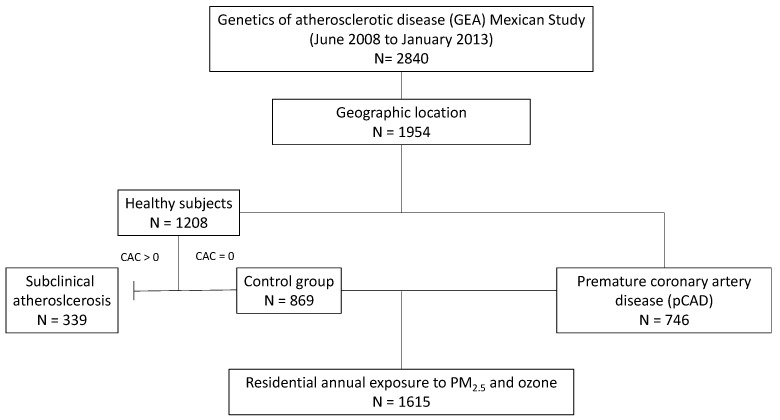
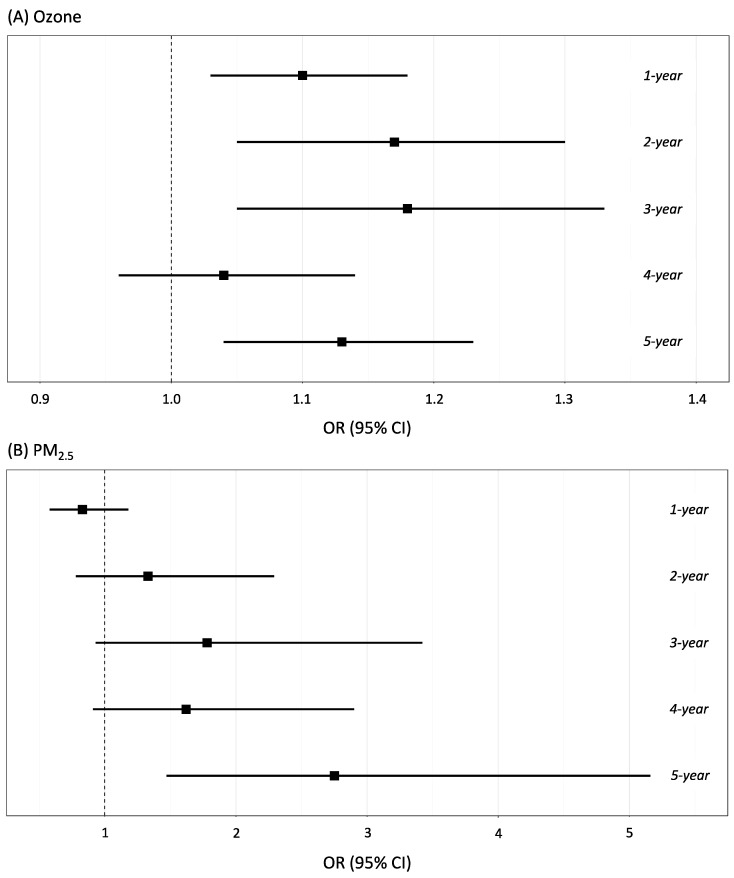
(1) Background: Epidemiological studies have identified associations between fine particulate matter (PM2.5) and ozone exposure with cardiovascular disease; however, studies linking ambient air pollution and premature coronary artery disease (pCAD) in Latin America are non-existing. (2) Methods: Our study was a case−control analysis nested in the Genetics of Atherosclerotic Disease (GEA) Mexican study. We included 1615 participants (869 controls and 746 patients with pCAD), recruited at the Instituto Nacional de Cardiología Ignacio Chávez from June 2008 to January 2013. We defined pCAD as history of myocardial infarction, angioplasty, revascularization surgery or coronary stenosis > 50% diagnosed before age 55 in men and age 65 in women. Controls were healthy individuals without personal or family history of pCAD and with coronary artery calcification equal to zero. Hourly measurements of ozone and PM2.5 from the Atmospheric Monitoring System in Mexico City (SIMAT in Spanish; Sistema de Monitero Atmosférico de la Ciudad de México) were used to calculate annual exposure to ozone and PM2.5 in the study participants. (3) Results: Each ppb increase in ozone at 1-year, 2-year, 3-year and 5-year averages was significantly associated with increased odds (OR = 1.10; 95% CI: 1.03−1.18; OR = 1.17; 95% CI: 1.05−1.30; OR = 1.18; 95% CI: 1.05−1.33, and OR = 1.13; 95% CI: 1.04−1.23, respectively) of pCAD. We observed higher risk of pCAD for each 5 µg/m3 increase only for the 5-year average of PM2.5 exposure (OR = 2.75; 95% CI: 1.47−5.16), compared to controls. (4) Conclusions: Ozone exposure at different time points and PM2.5 exposure at 5 years were associated with increased odds of pCAD. Our results highlight the importance of reducing long-term exposure to ambient air pollution levels to reduce the burden of cardiovascular disease in Mexico City and other metropolitan areas.
(1) 背景:流行病学研究已确定细颗粒物(PM2.5)和臭氧暴露与心血管疾病之间存在关联;然而,拉丁美洲关于环境空气污染与早发性冠状动脉疾病(pCAD)之间联系的研究尚不存在。(2) 方法:我们的研究是嵌套于墨西哥动脉粥样硬化疾病遗传学(GEA)研究中的病例对照分析。我们纳入了2008年6月至2013年1月在伊格纳西奥·查韦斯国家心脏病学研究所招募的1615名参与者(869名对照者和746名pCAD患者)。我们将pCAD定义为男性在55岁之前、女性在65岁之前被诊断出的心肌梗死、血管成形术、血运重建手术史或冠状动脉狭窄>50%。对照者为无pCAD个人或家族史且冠状动脉钙化等于零的健康个体。利用墨西哥城大气监测系统(西班牙语为SIMAT;Sistema de Monitero Atmosférico de la Ciudad de México)对臭氧和PM2.5的每小时测量数据来计算研究参与者的臭氧和PM2.5年度暴露量。(3) 结果:在1年、2年、3年和5年平均值时,臭氧每增加1 ppb,与pCAD的患病几率增加显著相关(OR = 1.10;95% CI:1.03 - 1.18;OR = 1.17;95% CI:1.05 - 1.30;OR = 1.18;95% CI:1.05 - 1.33,以及OR = 1.13;95% CI:1.04 - 1.23)。与对照者相比,仅在PM2.5暴露的5年平均值时,每增加5 µg/m3,我们观察到pCAD风险更高(OR = 2.75;95% CI:1.47 - 5.16)。(4) 结论:不同时间点的臭氧暴露和5年的PM2.5暴露与pCAD的患病几率增加相关。我们的结果凸显了降低长期环境空气污染暴露水平对于减轻墨西哥城及其他大都市心血管疾病负担的重要性。