Subedi Deepak, Phuyal Parshuram, Bhandari Suman, Kandel Milan, Shah Shambhu, Rawal Gaurav, Karki Surendra, Dhakal Santosh
Paklihawa Campus, Institute of Agriculture and Animal Science (IAAS), Tribhuvan University, Siddharthanagar 32900, Nepal.
National Avian Disease Investigation Laboratory, Bharatpur 44200, Nepal.
Infect Dis Rep. 2022 Jul 18;14(4):525-536. doi: 10.3390/idr14040056.
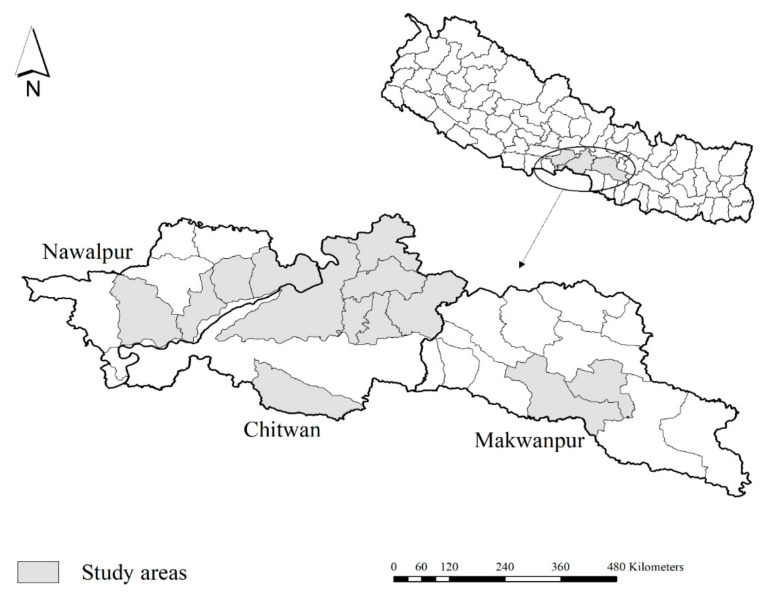
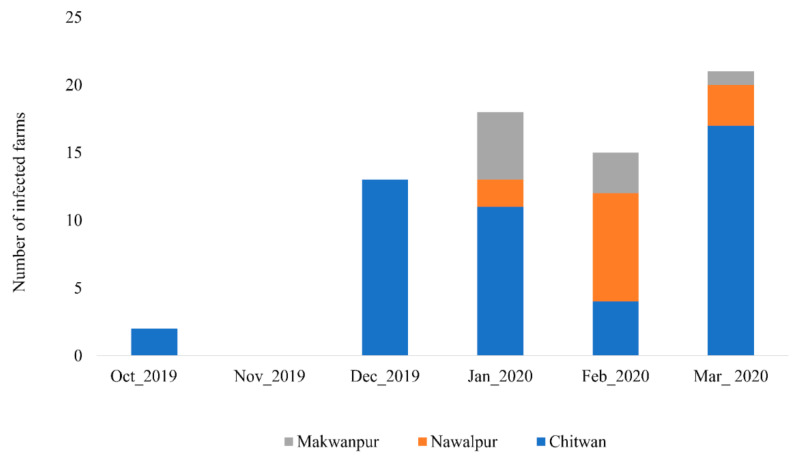
Low pathogenic avian influenza (LPAI) of subtype H9 outbreaks have been frequently occurring in major commercial hubs of Nepal including Chitwan, a central lowland area, causing substantial economic losses to the farmers. However, the risk factors associated with these outbreaks have been poorly understood, and hence, this case-control study was conducted in Chitwan, Nawalpur, and Makawanpur districts of Nepal from October 2019 to March 2020. A total of 102 farms were selected in which 51 were case farms, and 51 were controls. Case farms were avian influenza (AI)-subtype-H9-confirmed farms through polymerase chain reaction (PCR) assays on poultry samples. Control farms included farms that were AI-negative in the antigen test brought to the National Avian Disease Investigation Laboratory, Chitwan, for diagnosis during the study period. Each farm was visited to collect information using a semi-structured questionnaire. A total of 25 variables representing farm characteristics and biosecurity measures were considered as potential risk factors. The final multivariable model showed that distance of less than 0.5 km from the main road (OR = 4.04, 95% CI = 1.20-13.56, = 0.023), distance of less than 1 km from a nearest infected farm (OR = 76.42, 95% CI = 7.17-814.06, = 0.0003), and wild birds coming around the farm (OR = 6.12, 95% CI = 1.99-18.79, = 0.0015) were risk factors for avian influenza type H9, whereas using apron or separate cloth inside the shed (OR = 0.109, 95% CI = 0.020-0.577, = 0.0092) was shown to reduce the risk of farms being positive for AI subtype H9. These findings suggest that due consideration should be given to site selection while establishing the farms and the importance of implementing appropriate biosecurity measures, such as using separate cloth inside the shed and preventing the entry of wild birds inside the farm to reduce the potential risk of introduction of avian influenza type H9 to their poultry farms.
H9亚型低致病性禽流感(LPAI)疫情在尼泊尔的主要商业中心频繁发生,包括中部低地地区的奇旺,给养殖户造成了巨大经济损失。然而,人们对这些疫情的相关风险因素了解甚少,因此,于2019年10月至2020年3月在尼泊尔的奇旺、纳瓦尔普尔和马卡万布尔地区开展了这项病例对照研究。总共选取了102个养殖场,其中51个为病例养殖场,51个为对照养殖场。病例养殖场是通过对家禽样本进行聚合酶链反应(PCR)检测确诊为H9亚型禽流感(AI)的养殖场。对照养殖场包括在研究期间送往奇旺国家禽病调查实验室进行诊断的抗原检测呈AI阴性的养殖场。每个养殖场都通过半结构化问卷进行走访以收集信息。总共25个代表养殖场特征和生物安全措施的变量被视为潜在风险因素。最终的多变量模型显示,距离主干道小于0.5公里(比值比[OR]=4.04,95%置信区间[CI]=1.20 - 13.56,P = 0.023)、距离最近的感染养殖场小于1公里(OR = 76.42,95% CI = 7.17 - 814.06,P = 0.0003)以及养殖场周围有野生鸟类出没(OR = 6.12,95% CI = 1.99 - 18.79,P = 0.0015)是H9型禽流感的风险因素,而在鸡舍内使用围裙或单独的布料(OR = 0.109,95% CI = 0.020 - 0.577,P = 0.0092)可降低养殖场H9亚型AI呈阳性的风险。这些发现表明,在建设养殖场时应充分考虑选址问题,以及实施适当生物安全措施的重要性,例如在鸡舍内使用单独的布料并防止野生鸟类进入养殖场,以降低H9型禽流感传入其家禽养殖场的潜在风险。