Briola Chiara
The Ralph Veterinary Referral Centre, Fourth Avenue Globe Business Park, Marlow SL71YG, UK.
Vet Sci. 2022 Jul 23;9(8):378. doi: 10.3390/vetsci9080378.
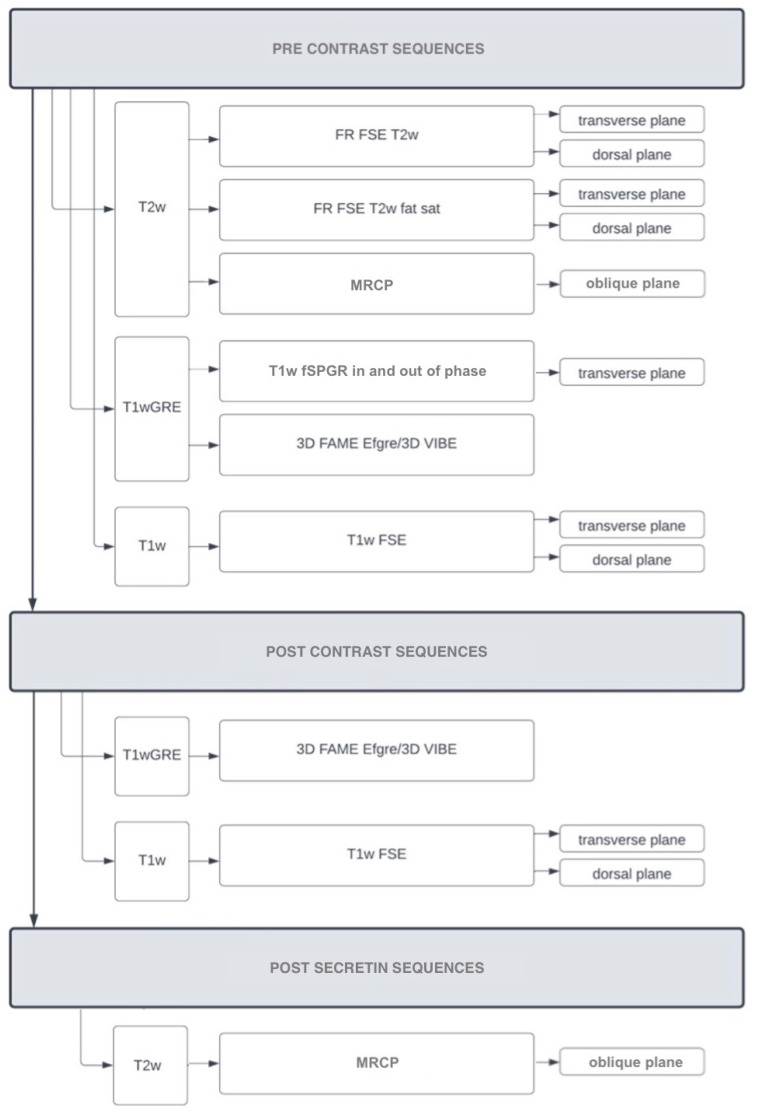
Magnetic resonance imaging (MRI) and MR cholangiopancreatography (MRCP) have emerged as non-invasive diagnostic techniques for the diagnosis of pancreatic and pancreatic duct disorders in humans. The number of studies focused on MR and MRCP for pancreatic disease in small animals is very limited. MR has been described for the evaluation of insulinoma in dogs and to investigate pancreatitis in cats. The studies were based on a standard protocol with T2 weighted (w) fast recovery fast spin-echo (FRFSE) with and without fat suppression, T1w FSE pre-contrast and T1w FSE post-contrast with and without fat suppression. MRCP after secretin stimulation has been described in cats to assess the pancreatic ductal system, taking advantage of pulse sequences heavily T2w as rapid acquisition with rapid enhancement (RARE), fast-recovery fast spin-echo (FRFSE) sequences and single-shot fast spin-echo (SSFSE) sequences. In addition to the standard protocol, fast spoiled gradient recalled echo pulse sequences (fSPGR) and volume interpolated 3D gradient-echo T1w pulse sequences pre and post-contrast have also been used in cats, reaching the goal of assessing the biliary tree and the pancreatic duct with the same sequence and in multiple planes. Despite the small amount of data, the results show potential, and the most recent technical innovations, in particular, focused on diffusion MRI and fast acquisition, further support the need for continued evaluation of MRI as an effective instrument for the investigation of pancreatic disease.
磁共振成像(MRI)和磁共振胰胆管造影(MRCP)已成为诊断人类胰腺和胰管疾病的非侵入性诊断技术。针对小动物胰腺疾病的磁共振成像和磁共振胰胆管造影研究数量非常有限。已有关于利用磁共振成像评估犬胰岛素瘤和研究猫胰腺炎的报道。这些研究基于标准方案,采用有或无脂肪抑制的T2加权(w)快速恢复快速自旋回波(FRFSE)序列、T1加权快速自旋回波序列造影前及造影后有或无脂肪抑制序列。已有关于在猫身上进行促胰液素刺激后磁共振胰胆管造影以评估胰管系统的报道,利用重T2加权脉冲序列如快速采集快速增强(RARE)序列、快速恢复快速自旋回波(FRFSE)序列和单次激发快速自旋回波(SSFSE)序列。除了标准方案外,快速扰相梯度回波脉冲序列(fSPGR)以及造影前后的容积内插三维梯度回波T1加权脉冲序列也已用于猫,实现了用同一序列在多个平面评估胆管树和胰管的目的。尽管数据量较少,但结果显示出潜力,尤其是最近的技术创新,特别是聚焦于扩散磁共振成像和快速采集技术,进一步支持了继续评估磁共振成像作为研究胰腺疾病有效手段的必要性。