Division of Hematology and Oncology, Department of Internal Medicine, University of Michigan, Ann Arbor, Michigan, USA.
Center for Cancer Biostatistics, University of Michigan School of Public Health, Ann Arbor, Michigan, USA.
Cancer. 2022 Oct 1;128(19):3523-3530. doi: 10.1002/cncr.34394. Epub 2022 Jul 27.
Gemcitabine and cisplatin has limited benefit as treatment for advanced biliary tract cancer (BTC). The addition of an anti-programmed death receptor (PD-1)/PD-ligand (L1) antibody to either systemic chemotherapy or anti-cytotoxic T-lymphocyte-associated protein 4 (CTLA4) antibody has shown benefit in multiple solid tumors.
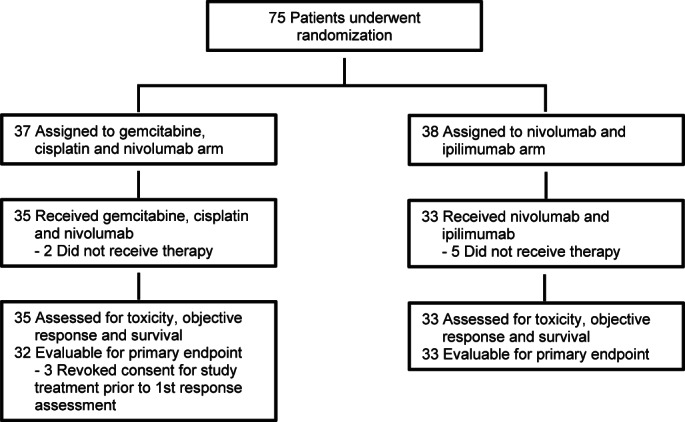
In this phase 2 trial, patients 18 years or older with advanced BTC without prior systemic therapy and Eastern Cooperative Oncology Group Performance Status 0-1 were randomized across six academic centers. Patients in Arm A received nivolumab (360 mg) on day 1 along with gemcitabine and cisplatin on days 1 and 8 every 3 weeks for 6 months followed by nivolumab (240 mg) every 2 weeks. Patients in Arm B received nivolumab (240 mg) every 2 weeks and ipilimumab (1 mg/kg) every 6 weeks.
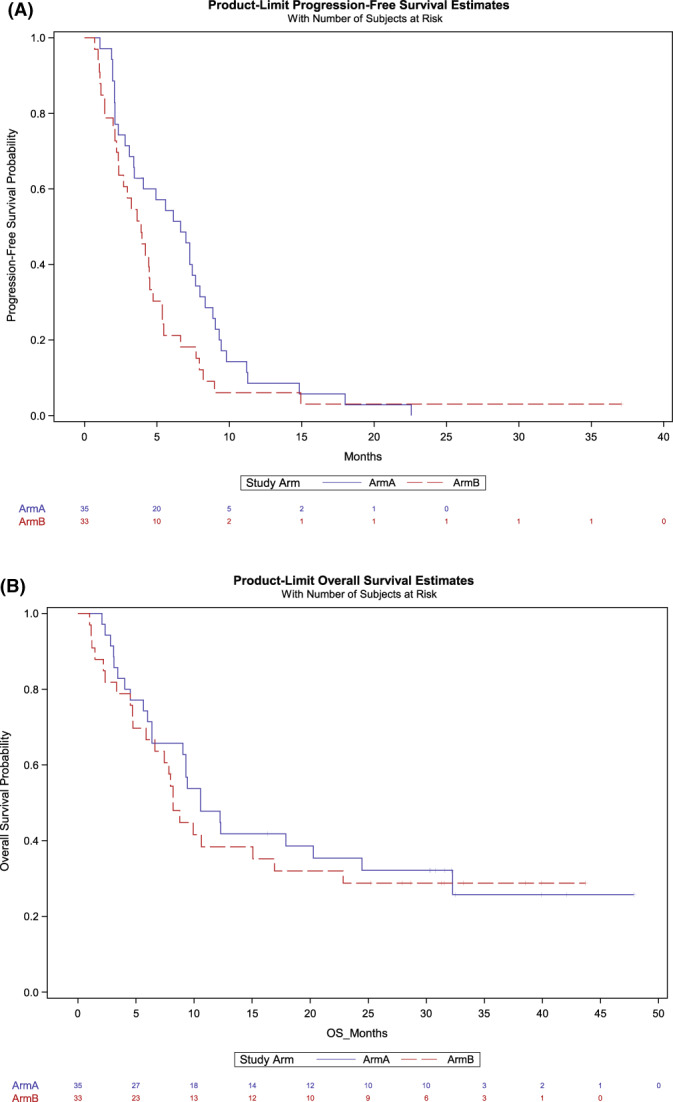
Of 75 randomized patients, 68 received therapy (Arm A = 35, Arm B = 33); 51.5% women with a median age of 62.5 years. The observed primary outcome of 6-month progression-free survival (PFS) rates in the evaluable population was 59.4% in Arm A and 21.2% in Arm B. The median PFS and overall survival (OS) in Arm A were 6.6 and 10.6 months, and in Arm B 3.9 and 8.2 months, respectively, in patients who received any treatment. The most common treatment-related grade 3 or higher hematologic adverse event was neutropenia in 34.3% (Arm A) and nonhematologic adverse events were fatigue (8.6% Arm A) and elevated transaminases (9.1% Arm B).
The addition of nivolumab to chemotherapy or ipilimumab did not improve 6-month PFS. Although median OS was less than 12 months in both arms, the high OS rate at 2 years in Arm A suggests benefit in a small cohort of patients.
吉西他滨和顺铂作为晚期胆管癌(BTC)的治疗方法获益有限。在多种实体肿瘤中,抗程序性死亡受体(PD-1)/PD-配体(L1)抗体联合系统化疗或抗细胞毒性 T 淋巴细胞相关蛋白 4(CTLA4)抗体显示出获益。
在这项 2 期试验中,在没有接受系统治疗且东部肿瘤协作组体能状态为 0-1 的 6 个学术中心,入组了年龄在 18 岁及以上的晚期 BTC 患者。Arm A 组患者在第 1 天接受纳武利尤单抗(360mg),第 1 天和第 8 天接受吉西他滨和顺铂,每 3 周为 1 个周期,持续 6 个月,随后每 2 周接受纳武利尤单抗(240mg)治疗。Arm B 组患者每 2 周接受纳武利尤单抗(240mg)和每 6 周接受伊匹单抗(1mg/kg)治疗。
75 例随机患者中,68 例接受了治疗(Arm A=35 例,Arm B=33 例);51.5%为女性,中位年龄为 62.5 岁。在可评估人群中,观察到的 6 个月无进展生存期(PFS)主要终点结果为 Arm A 组为 59.4%,Arm B 组为 21.2%。Arm A 和 Arm B 组患者接受任何治疗后的中位 PFS 和总生存期(OS)分别为 6.6 个月和 10.6 个月,以及 3.9 个月和 8.2 个月。最常见的治疗相关 3 级或以上血液学不良事件为中性粒细胞减少症(34.3%,Arm A),非血液学不良事件为疲劳(8.6%,Arm A)和转氨酶升高(9.1%,Arm B)。
纳武利尤单抗联合化疗或伊匹单抗并未改善 6 个月 PFS。尽管两组的中位 OS 均不到 12 个月,但 Arm A 组 2 年时的高 OS 率表明对一小部分患者有获益。