Department of Primary Care and Public Health, Imperial College London, London, UK
School of Public Health, Imperial College London, London, UK.
Thorax. 2023 Jul;78(7):706-712. doi: 10.1136/thoraxjnl-2021-217858. Epub 2022 Jul 27.
We examine differences in posthospitalisation outcomes, and health system resource use, for patients hospitalised with COVID-19 during the UK's first pandemic wave in 2020, and influenza during 2018 and 2019.
This retrospective cohort study used routinely collected primary and secondary care data. Outcomes, measured for 90 days follow-up after discharge were length of stay in hospital, mortality, emergency readmission and primary care activity.
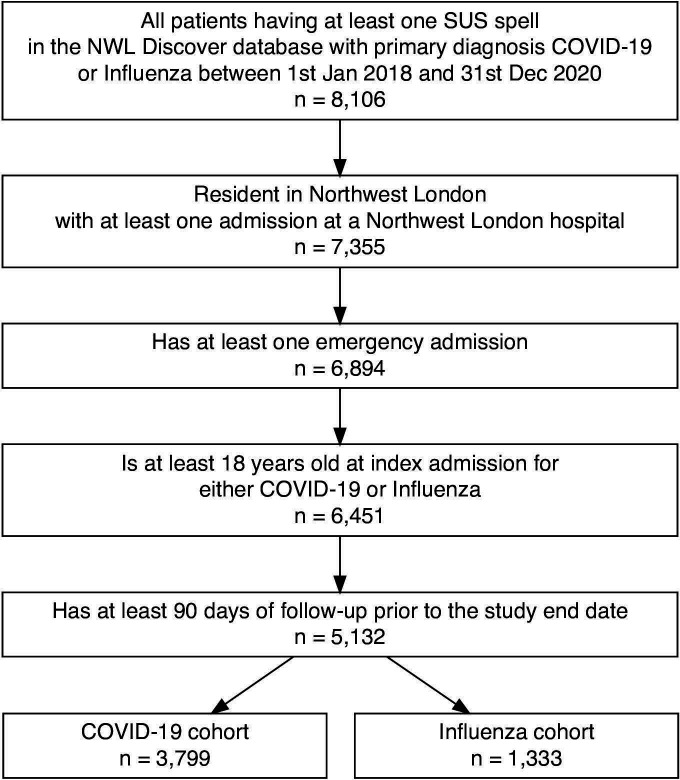
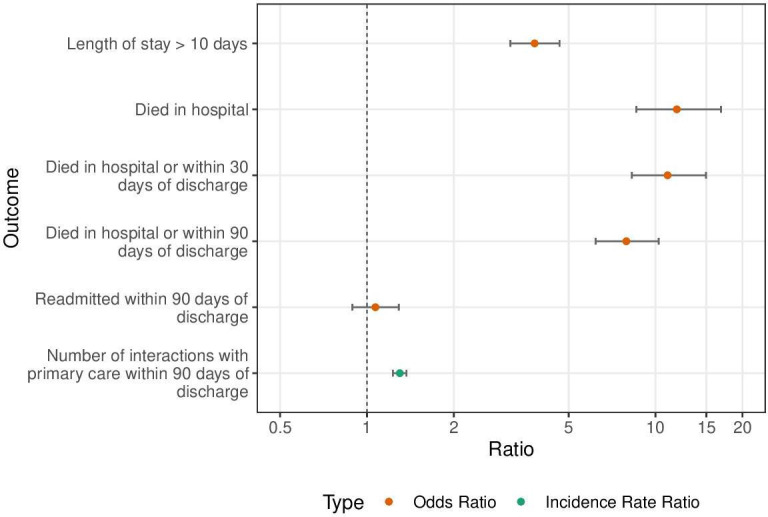
The study included 5132 patients admitted to hospital as an emergency, with COVID-19 and influenza cohorts comprising 3799 and 1333 patients respectively. Patients in the COVID-19 cohort were more likely to stay in hospital longer than 10 days (OR 3.91, 95% CI 3.14 to 4.65); and more likely to die in hospital (OR 11.85, 95% CI 8.58 to 16.86) and within 90 days of discharge (OR 7.92, 95% CI 6.20 to 10.25). For those who survived, rates of emergency readmission within 90 days were comparable between COVID-19 and influenza cohorts (OR 1.07, 95% CI 0.89 to 1.29), while primary care activity was greater among the COVID-19 cohort (incidence rate ratio 1.30, 95% CI 1.23 to 1.37).
Patients admitted for COVID-19 were more likely to die, more likely to stay in hospital for over 10 days and interact more with primary care after discharge, than patients admitted for influenza. However, readmission rates were similar for both groups. These findings, while situated in the context of the first wave of COVID-19, with the associated pressures on the health system, can inform health service planning for subsequent waves of COVID-19, and show that patients with COVID-19 interact more with healthcare services as well as having poorer outcomes than those with influenza.
我们研究了 2020 年英国第一波大流行期间因 COVID-19 住院的患者和 2018 年和 2019 年流感住院患者的住院后结局差异,以及卫生系统资源使用情况。
这是一项回顾性队列研究,使用了常规收集的初级和二级保健数据。出院后 90 天随访的结局包括住院时间、死亡率、急诊再入院和初级保健活动。
该研究纳入了 5132 名因急诊住院的患者,COVID-19 组和流感组分别有 3799 名和 1333 名患者。COVID-19 组的患者住院时间超过 10 天的可能性更大(OR3.91,95%CI3.14 至 4.65);在医院内死亡的可能性更高(OR11.85,95%CI8.58 至 16.86)和出院后 90 天内死亡的可能性更高(OR7.92,95%CI6.20 至 10.25)。对于存活的患者,COVID-19 组和流感组在 90 天内急诊再入院的发生率相似(OR1.07,95%CI0.89 至 1.29),而 COVID-19 组的初级保健活动更多(发病率比 1.30,95%CI1.23 至 1.37)。
与因流感住院的患者相比,因 COVID-19 住院的患者更有可能死亡,更有可能住院超过 10 天,出院后与初级保健的互动更多。然而,两组的再入院率相似。这些发现虽然是在 COVID-19 第一波大流行的背景下,以及随之而来的卫生系统压力下得出的,但可以为随后的 COVID-19 波次的卫生服务规划提供信息,并表明 COVID-19 患者与医疗保健服务的互动更多,且结局比流感患者更差。