Department of Hand, Plastic and Reconstructive Surgery, BG Trauma Center, Eberhard-Karls University Tuebingen, Schnarrenbergstr. 95, 72076, Tuebingen, Germany.
Department of Pediatric Surgery, University Hospital of General and Visceral Surgery Freiburg, Hugstetter Straße 55, 79106, Freiburg, Germany.
J Orthop Traumatol. 2022 Jul 27;23(1):35. doi: 10.1186/s10195-022-00654-7.
The success of digit replantation is mainly based on survival rates. The functional outcome as well as the recovery of sensibility are essential parameters for judging the outcome after digit replantation but have been poorly assessed in previous studies.
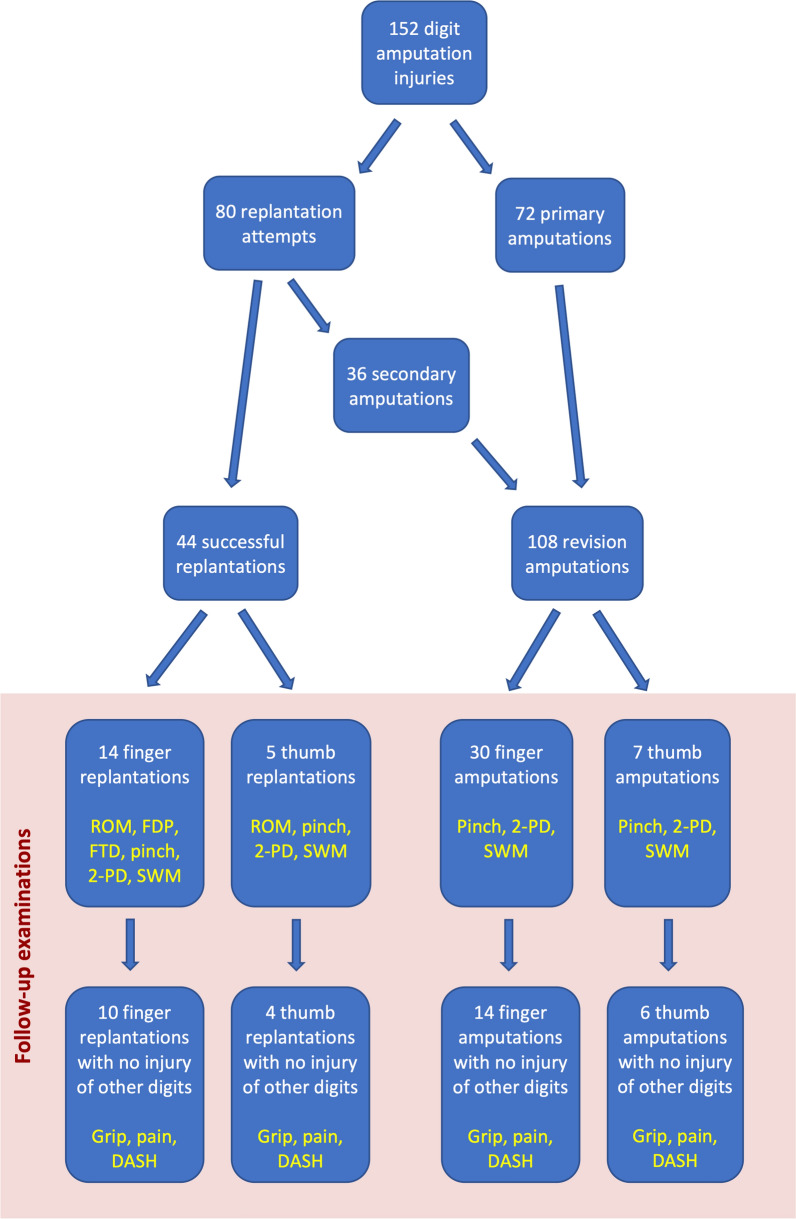
Forty-eight patients with 56 complete traumatic digit amputations occurring between 2008 and 2013 returned for a follow-up examination, the earliest being 6 months postoperatively. Each patient's range of motion, fingertip-to-table distance, fingertip-to-palm distance, grip and pinch strengths, static two-point discrimination (2-PD), and Semmes-Weinstein monofilament (SWM) test level were assessed in order to compare functional outcome and recovery of sensibility between successful replantation (n = 19) and primary or secondary amputation (n = 37). Subjective assessments of the pain level and function of the upper extremity were performed using the numerical rating scale and the DASH score, respectively.
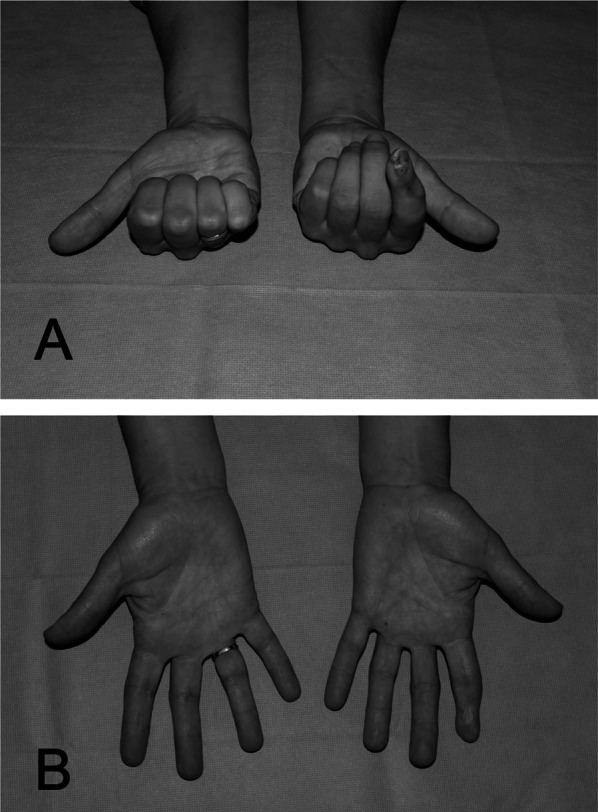
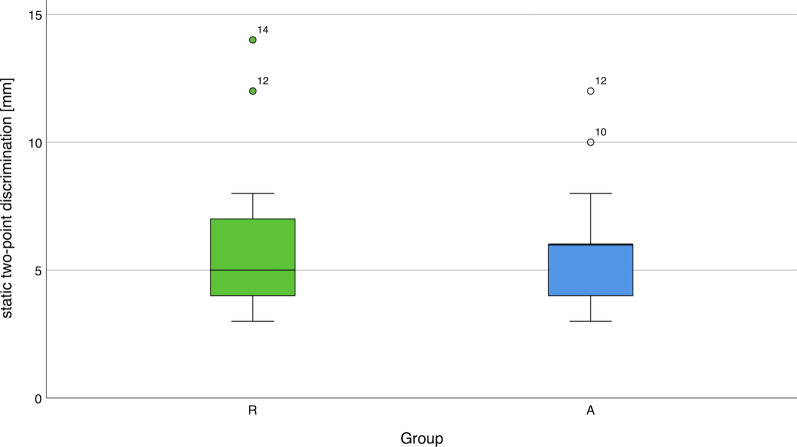
Replanted digits achieved 58% of the median total range of motion of the corresponding uninjured digits. Grip and pinch strength were not significantly different after thumb or finger replantation or amputation. Recovery of sensibility was excellent after replantation, with a median static 2-PD of 5 mm and a reduction of pressure sensibility of two levels of the SWM test compared to the contralateral side. After amputation, the median static 2-PD was also very good, with a median value of 6 mm and a reduction of pressure sensibility of only one level according to the SWM test. There was significantly less pain after replantation at rest (p = 0.012) and under strain (p = 0.012) compared to patients after amputation. No significant differences were observed in the DASH score between the two groups.
Comparable functional results and sensory recovery but significantly less pain at rest and under strain can be expected after digit replantation when compared to digit amputation.
IV.
断指再植的成功主要取决于成活率。功能结果和感觉恢复是判断断指再植后结果的重要参数,但在以前的研究中评估较差。
2008 年至 2013 年间共有 48 例 56 例完全创伤性断指患者接受随访检查,最早为术后 6 个月。评估每个患者的关节活动度、指尖到桌面的距离、指尖到手掌的距离、握力和捏力强度、静态两点辨别觉(2-PD)和 Semmes-Weinstein 单丝(SWM)测试水平,以比较成功再植(n=19)与初次或二次截肢(n=37)之间的功能结果和感觉恢复。使用数字评分量表和 DASH 评分分别对疼痛水平和上肢功能进行主观评估。
再植手指的总活动度中位数达到相应未受伤手指的 58%。拇指或手指再植或截肢后,握力和捏力无明显差异。再植后感觉恢复良好,静态 2-PD 中位数为 5mm,与对侧相比,SWM 测试压力感觉降低两个级别。截肢后,静态 2-PD 也非常好,中位数为 6mm,SWM 测试压力感觉仅降低一个级别。与截肢患者相比,再植患者在休息时(p=0.012)和在压力下(p=0.012)的疼痛明显减轻。两组间 DASH 评分无显著差异。
与断指截肢相比,断指再植后可获得相当的功能结果和感觉恢复,但休息和压力下的疼痛明显减轻。
IV。