Ayobami Olufunmilayo O, Goldring Steven R, Goldring Mary B, Wright Timothy M, van der Meulen Marjolein C H
Meinig School of Biomedical Engineering, Cornell University, Ithaca, NY, United States of America.
Research Division, Hospital for Special Surgery, New York, NY, United States of America.
Bone Rep. 2022 Jul 19;17:101602. doi: 10.1016/j.bonr.2022.101602. eCollection 2022 Dec.
Clinical evidence suggests that abnormal mechanical forces play a major role in the initiation and progression of osteoarthritis (OA). However, few studies have examined the mechanical environment that leads to disease. Thus, using a mouse tibial loading model, we quantified the cartilage contact stresses and examined the effects of altering tissue material properties on joint stresses during loading.
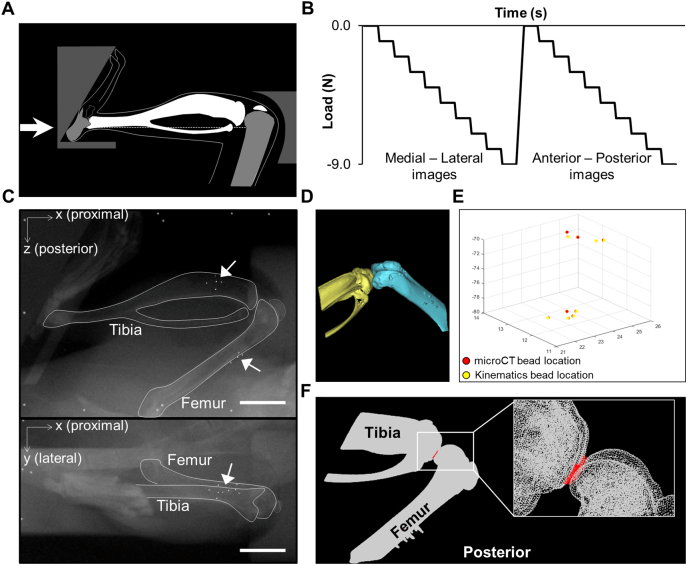
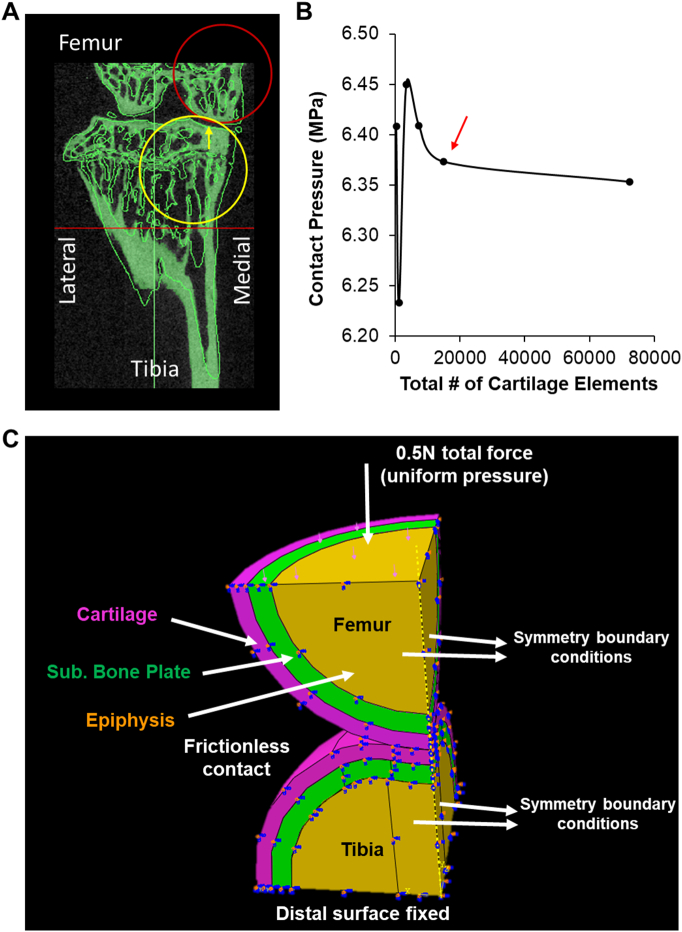
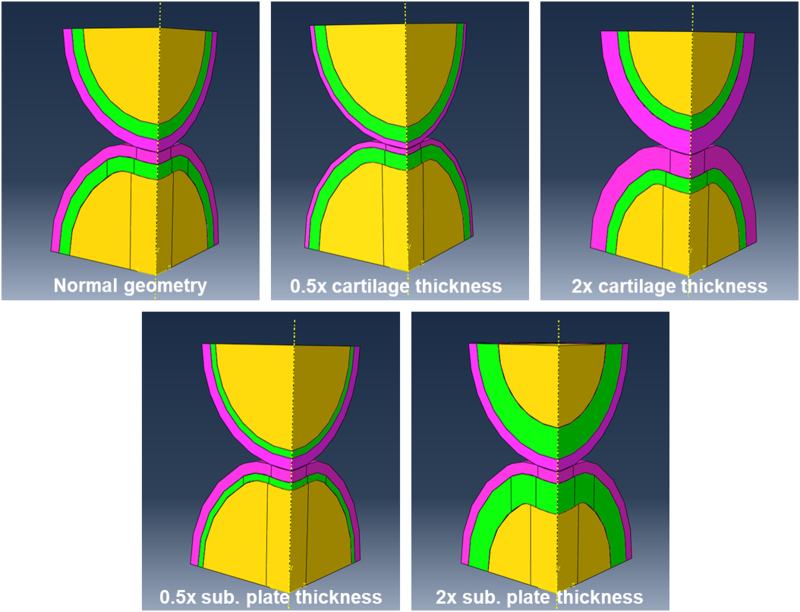
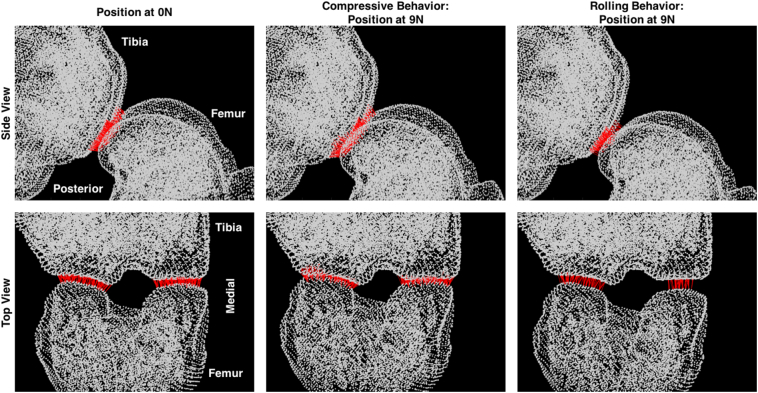
Using a discrete element model (DEA) in conjunction with joint kinematics data from a murine knee joint compression model, the magnitude and distribution of contact stresses in the tibial cartilage during joint loading were quantified at levels ranging from 0 to 9 N in 1 N increments. In addition, a simplified finite element (FEA) contact model was developed to simulate the knee joint, and parametric analyses were conducted to investigate the effects of altering bone and cartilage material properties on joint stresses during compressive loading.
As loading increased, the peak contact pressures were sufficient to induce fibrillations on the cartilage surfaces. The computed areas of peak contact pressures correlated with experimentally defined areas of highest cartilage damage. Only alterations in cartilage properties and geometry caused large changes in cartilage contact pressures. However, changes in both bone and cartilage material properties resulted in significant changes in stresses induced in the bone during compressive loading.
The level of mechanical stress induced by compressive tibial loading directly correlated with areas of biological change observed in the mouse knee joint. These results, taken together with the parametric analyses, are the first to demonstrate both experimentally and computationally that the tibial loading model is a useful preclinical platform with which to predict and study the effects of modulating bone and/or cartilage properties on attenuating OA progression. Given the direct correlation between computational modeling and experimental results, the effects of tissue-modifying treatments may be predicted prior to experimentation, allowing for novel therapeutics to be developed.
临床证据表明,异常机械力在骨关节炎(OA)的发生和发展中起主要作用。然而,很少有研究探讨导致该疾病的机械环境。因此,我们使用小鼠胫骨加载模型,量化了软骨接触应力,并研究了改变组织材料特性对加载过程中关节应力的影响。
结合小鼠膝关节压缩模型的关节运动学数据,使用离散元模型(DEA),以1N的增量,在0至9N的水平上量化关节加载过程中胫骨软骨接触应力的大小和分布。此外,还开发了一个简化的有限元(FEA)接触模型来模拟膝关节,并进行参数分析,以研究改变骨和软骨材料特性对压缩加载过程中关节应力的影响。
随着加载增加,峰值接触压力足以在软骨表面诱发原纤维形成。计算得到的峰值接触压力区域与实验确定的软骨损伤最严重区域相关。只有软骨特性和几何形状的改变会导致软骨接触压力的大幅变化。然而,骨和软骨材料特性的改变都会导致压缩加载过程中骨内诱导应力的显著变化。
胫骨压缩加载诱导的机械应力水平与小鼠膝关节中观察到的生物学变化区域直接相关。这些结果与参数分析一起,首次通过实验和计算证明,胫骨加载模型是一个有用的临床前平台,可用于预测和研究调节骨和/或软骨特性对减缓OA进展的影响。鉴于计算建模与实验结果之间的直接相关性,可以在实验前预测组织修饰治疗的效果,从而开发新的治疗方法。