Discipline of Orthopaedics and Trauma, The University of Adelaide , Adelaide, South Australia 5005, Australia.
Bone Res. 2016 Sep 20;4:16028. doi: 10.1038/boneres.2016.28. eCollection 2016.
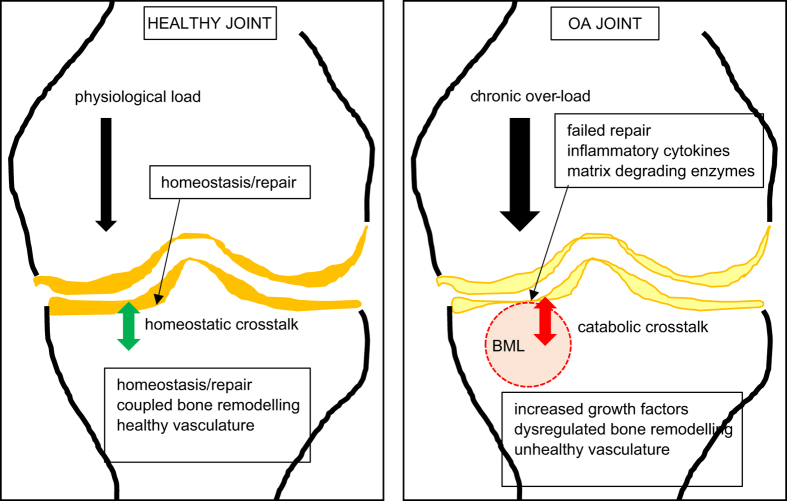
Although cartilage degradation is the characteristic feature of osteoarthritis (OA), it is now recognized that the whole joint is involved in the progression of OA. In particular, the interaction (crosstalk) between cartilage and subchondral bone is thought to be a central feature of this process. The interface between articular cartilage and bone of articulating long bones is a unique zone, which comprises articular cartilage, below which is the calcified cartilage sitting on and intercalated into the subchondral bone plate. Below the subchondral plate is the trabecular bone at the end of the respective long bones. In OA, there are well-described progressive destructive changes in the articular cartilage, which parallel characteristic changes in the underlying bone. This review examines the evidence that biochemical and biomechanical signaling between these tissue compartments is important in OA disease progression and asks whether such signaling might provide possibilities for therapeutic intervention to halt or slow disease development.
虽然软骨降解是骨关节炎 (OA) 的特征,但现在人们认识到整个关节都参与了 OA 的进展。特别是,软骨和软骨下骨之间的相互作用(串扰)被认为是这一过程的核心特征。在关节长骨的关节软骨和骨之间的界面是一个独特的区域,它包括关节软骨,其下是钙化软骨,位于并插入软骨下骨板中。软骨下板下方是相应长骨末端的骨小梁。在 OA 中,关节软骨有明确的进行性破坏性变化,与下面的骨的特征性变化平行。这篇综述探讨了这些组织间隙之间生化和生物力学信号在 OA 疾病进展中的重要性,并询问这种信号是否可能为治疗干预提供可能性,以阻止或减缓疾病的发展。