Xu Xuefen, Schmidt Thomas L, Liang Jiaxin, Ridland Peter M, Chung Jessica, Yang Qiong, Jasper Moshe E, Umina Paul A, Liu Wanxue, Hoffmann Ary A
Bio21 Institute, School of BioSciences The University of Melbourne Parkville Victoria Australia.
Cesar Australia Brunswick Victoria Australia.
Evol Appl. 2022 Jun 28;15(7):1129-1140. doi: 10.1111/eva.13430. eCollection 2022 Jul.
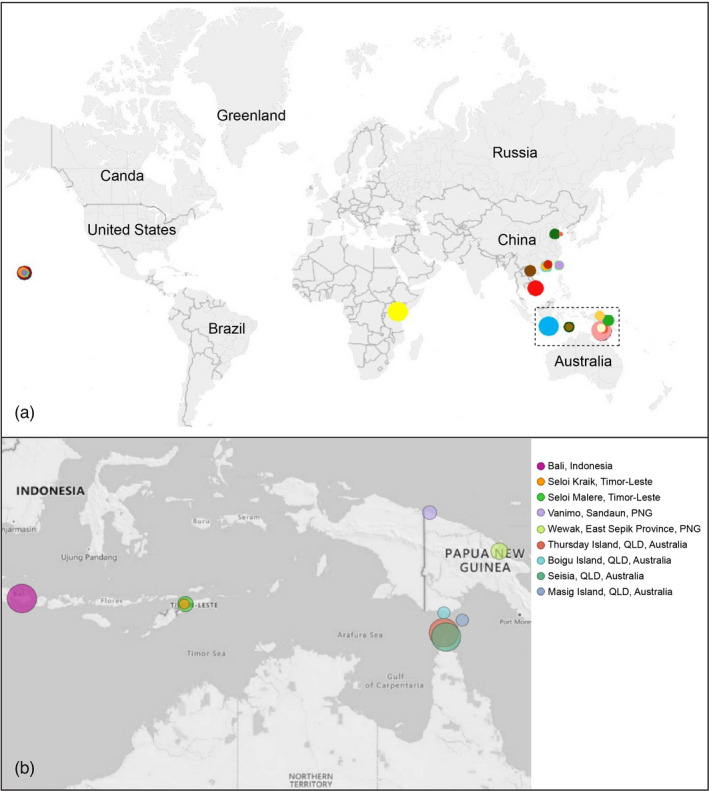
, the vegetable leafminer, is an important agricultural pest originally from the Americas, which has now colonized all continents except Antarctica. In 2015, arrived on the Australian mainland and established on the Cape York Peninsula in the northeast of the country near the Torres Strait, which provides a possible pathway for pests to enter Australia and evade biosecurity efforts. Here, we assessed genetic variation in based on genome-wide single nucleotide polymorphisms (SNPs) generated by double digest restriction-site-associated DNA sequencing (ddRAD-seq), aiming to uncover the potential origin(s) of this pest in Australia and contribute to reconstructing its global invasion history. Our fineRADstructure results and principal component analysis suggest Australian mainland populations were genetically close to populations from the Torres Strait, whereas populations from Asia, Africa, and Papua New Guinea (PNG) were more distantly related. Hawaiian populations were genetically distinct from all other populations of included in our study. Admixture analyses further revealed that from the Torres Strait may have genetic variation originating from multiple sources including Indonesia and PNG, and which has now spread to the Australian mainland. The lineages from Asia and Africa appear closely related. Isolation-by-distance (IBD) was found at a broad global scale, but not within small regions, suggesting that human-mediated factors likely contribute to the local spread of this pest. Overall, our findings suggest that an exotic pest invaded Australia through the Indo-Papuan conduit, highlighting the importance of biosecurity programs aimed at restricting the movement of pests and diseases through this corridor.
斑潜蝇是一种原产于美洲的重要农业害虫,现已在除南极洲以外的各大洲定殖。2015年,斑潜蝇抵达澳大利亚大陆并在该国东北部靠近托雷斯海峡的约克角半岛定殖,这为害虫进入澳大利亚并规避生物安全措施提供了一条可能的途径。在此,我们基于双酶切限制性位点关联DNA测序(ddRAD-seq)产生的全基因组单核苷酸多态性(SNP)评估了斑潜蝇的遗传变异,旨在揭示该害虫在澳大利亚的潜在起源,并有助于重建其全球入侵历史。我们的fineRADstructure结果和主成分分析表明,澳大利亚大陆种群在基因上与来自托雷斯海峡的种群接近,而来自亚洲、非洲和巴布亚新几内亚(PNG)的种群关系较远。夏威夷种群在基因上与我们研究中纳入的所有其他斑潜蝇种群不同。混合分析进一步表明,来自托雷斯海峡的斑潜蝇可能具有源自包括印度尼西亚和巴布亚新几内亚在内的多个来源的遗传变异,并且现已传播到澳大利亚大陆。来自亚洲和非洲的斑潜蝇谱系似乎关系密切。在广泛的全球尺度上发现了距离隔离(IBD),但在小区域内未发现,这表明人为介导的因素可能促成了这种害虫的局部传播。总体而言,我们的研究结果表明,一种外来斑潜蝇害虫通过印度 - 巴布亚通道入侵了澳大利亚,凸显了旨在限制病虫害通过这条走廊移动的生物安全计划的重要性。