Department of Psychology, University of California, Los Angeles, CA, USA.
Department of Psychiatry and Biobehavioral Sciences, University of California, Los Angeles, CA, USA.
JNCI Cancer Spectr. 2022 Jul 1;6(4). doi: 10.1093/jncics/pkac052.
Inflammation contributes to poor behavioral, functional, and clinical outcomes in cancer survivors. We examined whether standard cancer treatments-radiation and chemotherapy-led to acute and persistent changes in circulating markers of inflammation in breast cancer patients.
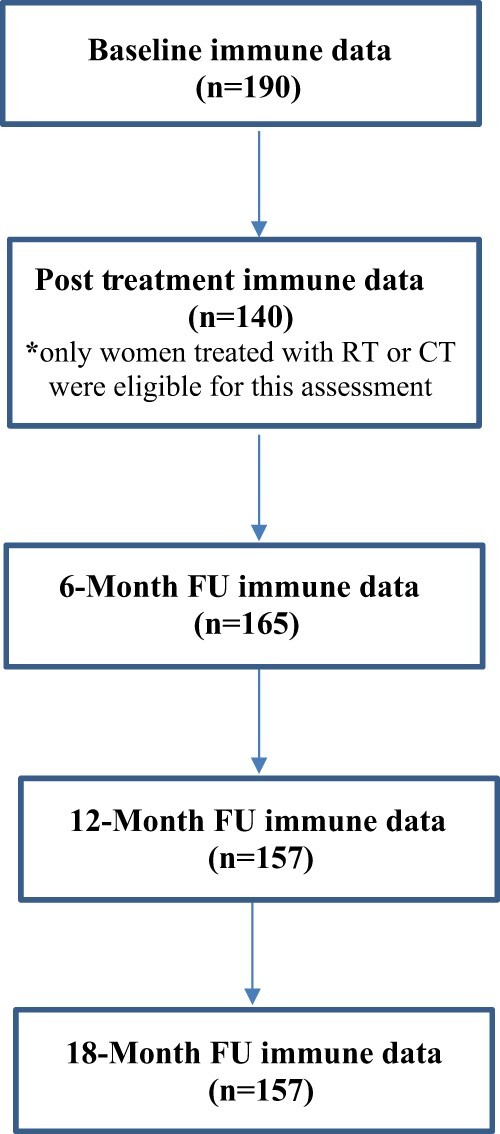
A total of 192 women diagnosed with early stage breast cancer provided blood samples before and after completion of radiation and/or chemotherapy and at 6-, 12-, and 18-month posttreatment follow-ups. Samples were assayed for circulating inflammatory markers, including tumor necrosis factor-α (TNF-α) and interleukin (IL)-6, downstream markers of their activity (soluble TNF receptor type II [sTNF-RII], C reactive protein), and other inflammatory mediators (IL-8, interferon-γ [IFN-γ]). Analyses evaluated within-group changes in inflammatory markers in 4 treatment groups: no radiation or chemotherapy (n = 39), radiation only (n = 77), chemotherapy only (n = 18), and chemotherapy with radiation (n = 58).
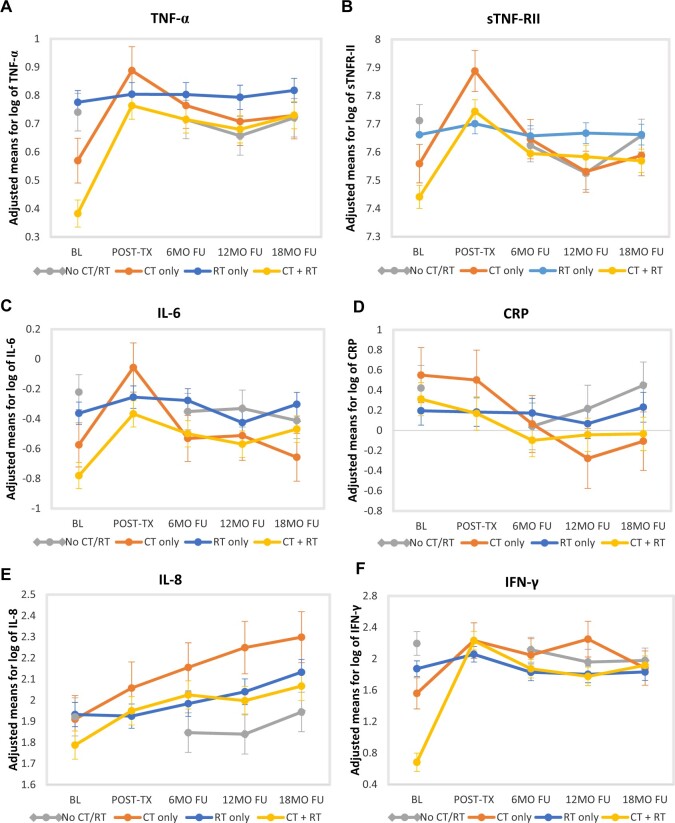
Patients treated with chemotherapy showed statistically significant increases in circulating concentrations of TNF-α, sTNF-RII, IL-6, and IFN-γ from pre- to posttreatment, with parameter estimates in standard deviation units ranging from 0.55 to 1.20. Those who received chemotherapy with radiation also showed statistically significant increases in IL-8 over this period. Statistically significant increases in TNF-α, sTNF-RII, IL-6, IFN-γ, and IL-8 persisted at 6, 12, and 18 months posttreatment among patients treated with chemotherapy and radiation (all P < .05). Patients treated with radiation only showed a statistically significant increase in IL-8 at 18 months posttreatment; no increases in any markers were observed in patients treated with surgery only.
Chemotherapy is associated with acute increases in systemic inflammation that persist for months after treatment completion in patients who also receive radiation therapy. These increases may contribute to common behavioral symptoms and other comorbidities in cancer survivors.
炎症会导致癌症幸存者的行为、功能和临床结局恶化。我们研究了标准的癌症治疗方法——放疗和化疗是否会导致乳腺癌患者循环炎症标志物出现急性和持续性变化。
192 名被诊断患有早期乳腺癌的女性在放疗和/或化疗完成前后以及治疗后 6、12 和 18 个月时提供了血液样本。样本检测了循环炎症标志物,包括肿瘤坏死因子-α(TNF-α)和白细胞介素(IL)-6,以及其活性的下游标志物(可溶性 TNF 受体 II 型[sTNF-RII]、C 反应蛋白)和其他炎症介质(IL-8、干扰素-γ[IFN-γ])。分析评估了 4 个治疗组中炎症标志物的组内变化:无放疗或化疗(n=39)、仅放疗(n=77)、仅化疗(n=18)和放疗联合化疗(n=58)。
接受化疗的患者在治疗前后,TNF-α、sTNF-RII、IL-6 和 IFN-γ的循环浓度呈统计学显著升高,标准偏差单位的参数估计值范围为 0.55 至 1.20。接受化疗联合放疗的患者在此期间 IL-8 也呈统计学显著升高。在接受化疗和放疗的患者中,在治疗后 6、12 和 18 个月时,TNF-α、sTNF-RII、IL-6、IFN-γ 和 IL-8 的升高持续存在(均 P<0.05)。仅接受放疗的患者在治疗后 18 个月时 IL-8 呈统计学显著升高;仅接受手术治疗的患者中未观察到任何标志物增加。
化疗会导致接受放疗的患者在治疗完成后数月内出现全身炎症的急性增加。这些增加可能导致癌症幸存者出现常见的行为症状和其他合并症。