Centre for Safe Medication Practice and Research, Department of Pharmacology and Pharmacy, The University of Hong Kong, Hong Kong Special Administration Region (SAR), China.
Laboratory of Data Discovery for Health, Hong Kong Science and Technology Park, Hong Kong SAR, China.
JAMA Netw Open. 2022 Jul 1;5(7):e2224163. doi: 10.1001/jamanetworkopen.2022.24163.
Evidence for improved clinical outcomes with long-acting injectable antipsychotics (LAIAs) vs oral antipsychotics (OAs) is limited in Asian populations and special patient groups, including older people (>65 years), people with substance use, and early initiators of LAIAs.
To compare the risk of disease relapse, health care use, and adverse events associated with the use of LAIAs vs OAs among people in Hong Kong with schizophrenia.
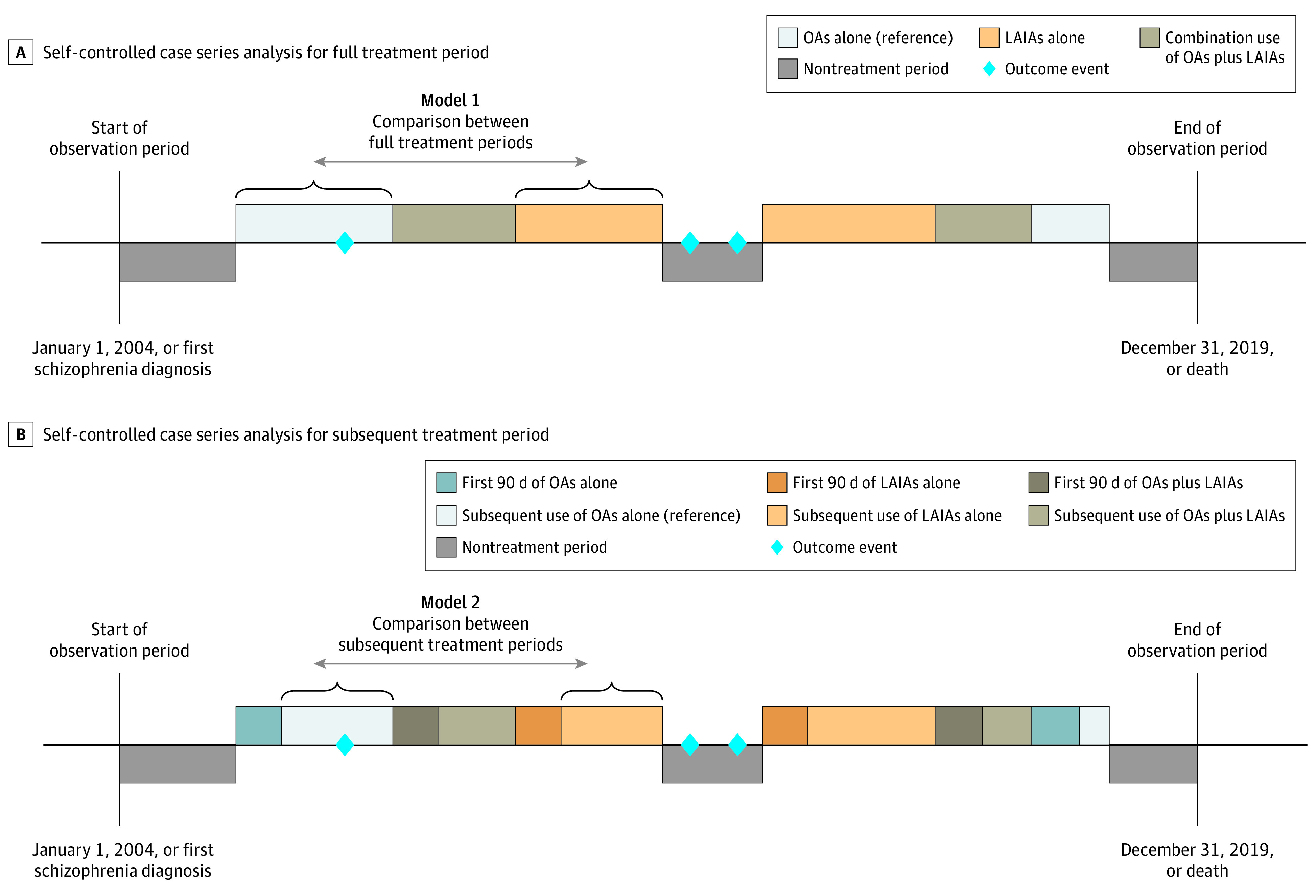
DESIGN, SETTING, AND PARTICIPANTS: In this self-controlled case series study, individuals with a diagnosis of schizophrenia who were prescribed LAIAs and OAs between January 1, 2004, and December 31, 2019, were identified from the Clinical Database Analysis and Reporting System of the Hong Kong Hospital Authority. Data analysis was conducted from May to August in 2021.
Use of LAIAs vs OAs.
Risk of disease relapse (hospitalizations for psychiatric disorders, hospitalizations for schizophrenia, and suicide attempts), health care use (all-cause emergency department visits and hospitalizations), and adverse events (hospitalizations for somatic disorders, hospitalizations for cardiovascular diseases, and extrapyramidal symptoms) between the period in which patients were treated with LAIAs and the period in which patients were treated with OAs were compared using Poisson regression.
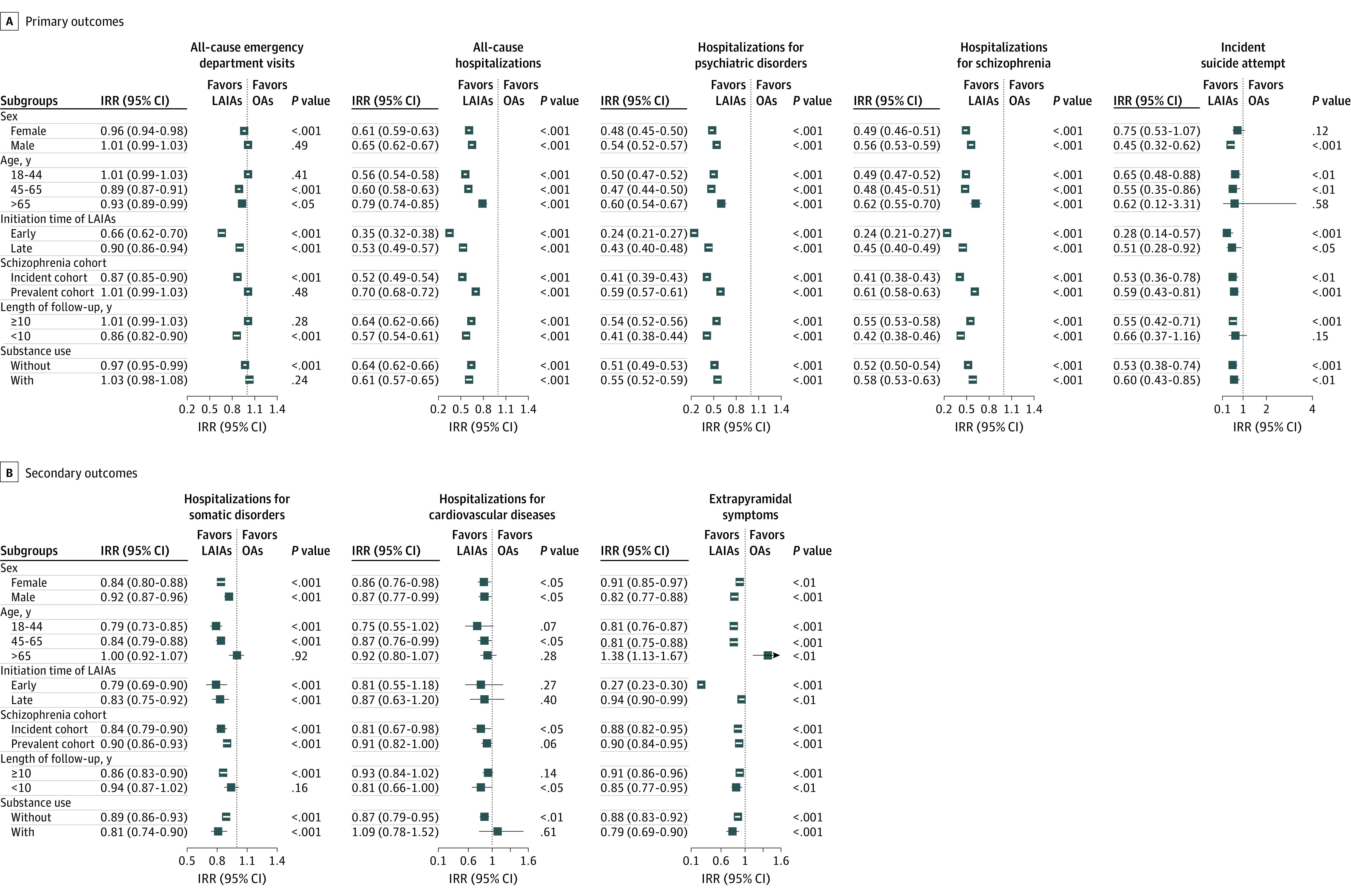
Of the 70 396 individuals with schizophrenia (37 200 women [52.8%]; mean [SD] age, 44.2 [15.8] years), 23 719 (33.7%) were prescribed both LAIAs and OAs. Compared with OAs, LAIAs were associated with a lower risk of hospitalizations for any cause (n = 20 973; incidence rate ratio [IRR], 0.63 [95% CI, 0.61-0.65]), hospitalizations for psychiatric disorders (n = 19 283; IRR, 0.52 [95% CI, 0.50-0.53]), hospitalizations for schizophrenia (n = 18 385; IRR, 0.53 [95% CI, 0.51-0.55]), and incident suicide attempts (n = 1453; IRR, 0.56 [95% CI, 0.44-0.71]). During full treatment with LAIAs, there was a reduction in hospitalizations for somatic disorders (n = 15 396; IRR, 0.88 [95% CI, 0.85-0.91]), hospitalizations for cardiovascular diseases (n = 3710; IRR, 0.88 [95% CI, 0.81-0.96]), and extrapyramidal symptoms (n = 22 182; IRR, 0.86 [95% CI, 0.82-0.91]) compared with full treatment with OAs. No significant difference was found for emergency department visits. Similar associations were observed during the subsequent treatment periods (beyond 90 days) and among older people and those with substance use, except for an increased risk of extrapyramidal symptoms among older people when initiating LAIAs (first 90 days). Compared with late initiators, early LAIA initiators had a greater reduction in these outcome events.
This self-controlled case series study of people in Hong Kong with schizophrenia suggests that LAIAs were associated with a lower risk of disease relapse and hospitalization than OAs, without an increased risk of adverse events. Clinicians should more broadly consider the long-term use of LAIAs for Chinese people with schizophrenia, especially early in the course of illness.
在亚洲人群和特殊患者群体中,包括老年人(>65 岁)、物质使用人群和长效抗精神病药(LAIAs)的早期使用者,长效注射抗精神病药(LAIAs)与口服抗精神病药(OAs)相比,改善临床结局的证据有限。
比较香港精神分裂症患者使用 LAIAs 与 OAs 的疾病复发风险、医疗保健使用情况和不良事件。
设计、地点和参与者:在这项自身对照病例系列研究中,从香港医院管理局的临床数据库分析和报告系统中确定了 2004 年 1 月 1 日至 2019 年 12 月 31 日期间被诊断为精神分裂症并开处 LAIAs 和 OAs 的个体。数据分析于 2021 年 5 月至 8 月进行。
使用 LAIAs 与 OAs。
与 OAs 相比,LAIAs 治疗期间和 OAs 治疗期间的疾病复发风险(精神障碍住院、精神分裂症住院和自杀企图)、医疗保健使用(所有原因急诊就诊和住院)和不良事件(躯体疾病住院、心血管疾病住院和锥体外系症状)通过泊松回归进行比较。
在 70396 名精神分裂症患者中(37200 名女性[52.8%];平均[标准差]年龄为 44.2[15.8]岁),23719 名(33.7%)同时开具了 LAIAs 和 OAs。与 OAs 相比,LAIAs 与任何原因的住院风险降低相关(n=20973;发病率比[IRR],0.63[95%CI,0.61-0.65])、精神病住院(n=19283;IRR,0.52[95%CI,0.50-0.53])、精神分裂症住院(n=18385;IRR,0.53[95%CI,0.51-0.55])和自杀企图发生率(n=1453;IRR,0.56[95%CI,0.44-0.71])。在接受 LAIAs 全程治疗期间,与接受 OAs 全程治疗相比,躯体疾病住院(n=15396;IRR,0.88[95%CI,0.85-0.91])、心血管疾病住院(n=3710;IRR,0.88[95%CI,0.81-0.96])和锥体外系症状(n=22182;IRR,0.86[95%CI,0.82-0.91])减少。急诊就诊无显著差异。在随后的治疗期间(90 天后)和在老年人和物质使用人群中观察到类似的关联,除了在开始使用 LAIAs 时老年人的锥体外系症状风险增加(前 90 天)。与晚期开始者相比,早期 LAIAs 开始者这些结局事件的减少幅度更大。
这项针对香港精神分裂症患者的自身对照病例系列研究表明,与 OAs 相比,LAIAs 与疾病复发和住院风险降低相关,而不良事件风险增加。临床医生应更广泛地考虑为中国精神分裂症患者长期使用 LAIAs,尤其是在疾病早期。