Department of Community Psychiatry, Bali Psychiatric Center, Ministry of Health and Welfare, New Taipei City, Taiwan.
Department of Nursing, Mackay Medical College, New Taipei City, Taiwan.
JAMA Netw Open. 2021 May 3;4(5):e218810. doi: 10.1001/jamanetworkopen.2021.8810.
Schizophrenia is generally considered to be among the most severe psychiatric disorders because of the excessive mortality associated with it. Research to find means to reduce this excessive mortality is warranted.
To investigate associations of long-acting injectable antipsychotics (LAIs) with all-cause, natural-cause, and suicide mortality risks as well as the impacts of early use of LAIs in patients with newly diagnosed schizophrenia.
DESIGN, SETTING, AND PARTICIPANTS: This cohort study used data from the Taiwan National Health Insurance Research Database to construct a population-based cohort of patients with schizophrenia who received oral antipsychotics (OAPs) from January 1, 2002, to December 31, 2017. Within this cohort, the LAI group was defined as patients who switched to LAIs and were prescribed LAIs at least 4 times within 1 year. The LAI group was propensity matched 1:1 to patients who continued receiving OAPs of the same compounds. All patients were followed up until switching the antipsychotic administration route, death, or the end of the study (December 31, 2018), whichever occurred first. Data analysis was performed from January 2002 to December 2018.
All-cause mortality, natural-cause mortality, suicide mortality, and suicide attempts.
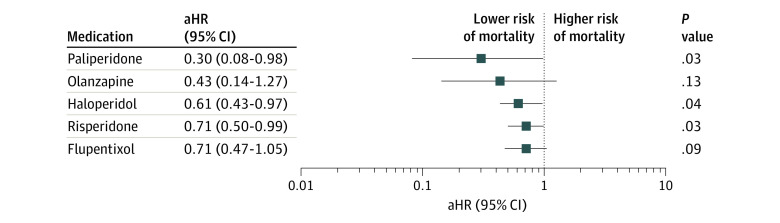
In total, 2614 patients who switched to LAIs (median [interquartile range] {IQR} age, 30 [23-39] years) and 2614 who received OAPs (median [IQR] age, 30 [23-39] years) were included (1333 male patients [51.0%] in each group). During the 16-year follow-up period (median [IQR] follow-up of 14 [10-17] years), patients who switched to LAIs had lower risks of all-cause mortality (adjusted hazard ratio [aHR], 0.66; 95% CI, 0.54-0.81), natural-cause mortality (aHR, 0.63; 95% CI, 0.52-0.76), and suicide attempts (incidence rate ratio, 0.72; 95% CI, 0.55-0.93) compared with patients who received the corresponding OAPs. A 47% lower suicide mortality risk (aHR, 0.53; 95% CI, 0.30-0.92) was observed in patients who switched to LAIs within the first 2 years of OAP initiation.
These findings suggest that LAI use in patients with newly diagnosed schizophrenia is associated with decreased all-cause mortality and suicide risk. Furthermore, early treatment with LAIs within the first 2 years of OAP initiation was associated with a decrease in suicide mortality risk. Thus, LAI use in the early stage of treatment should be actively considered for patients with newly diagnosed schizophrenia.
精神分裂症通常被认为是最严重的精神障碍之一,因为它与过高的死亡率有关。有必要研究寻找降低这种过高死亡率的方法。
调查长效注射型抗精神病药(LAIs)与全因、自然原因和自杀死亡率的相关性,以及在新诊断为精神分裂症的患者中早期使用 LAIs 的影响。
设计、设置和参与者:这项队列研究使用了来自台湾全民健康保险研究数据库的数据,构建了一个基于人群的精神分裂症患者队列,这些患者在 2002 年 1 月 1 日至 2017 年 12 月 31 日期间接受了口服抗精神病药(OAPs)治疗。在这个队列中,LAI 组被定义为至少在 1 年内 4 次转换为 LAI 并被处方 LAI 的患者。LAI 组以 1:1 的比例与继续接受相同化合物 OAP 治疗的患者进行倾向匹配。所有患者均随访至转换抗精神病药物给药途径、死亡或研究结束(2018 年 12 月 31 日),以先发生者为准。数据分析于 2002 年 1 月至 2018 年 12 月进行。
全因死亡率、自然原因死亡率、自杀死亡率和自杀企图。
共有 2614 名转换为 LAI(中位数[四分位数间距]年龄为 30[23-39]岁)和 2614 名接受 OAP 治疗的患者(中位数[四分位数间距]年龄为 30[23-39]岁)纳入研究(每组各有 1333 名男性患者[51.0%])。在 16 年的随访期间(中位数[四分位数间距]随访时间为 14[10-17]年),与接受相应 OAP 治疗的患者相比,转换为 LAI 的患者全因死亡率(调整后的危险比[aHR],0.66;95%CI,0.54-0.81)、自然原因死亡率(aHR,0.63;95%CI,0.52-0.76)和自杀企图发生率(发生率比,0.72;95%CI,0.55-0.93)较低。与接受 OAP 治疗的患者相比,在 OAP 治疗开始后的前 2 年内转换为 LAI 的患者自杀死亡率风险降低了 47%(aHR,0.53;95%CI,0.30-0.92)。
这些发现表明,在新诊断为精神分裂症的患者中使用 LAI 与降低全因死亡率和自杀风险相关。此外,在 OAP 治疗开始后的前 2 年内早期使用 LAI 与自杀死亡率降低相关。因此,应积极考虑在新诊断的精神分裂症患者的早期阶段使用 LAI。