Institute of Clinical Chemistry and Laboratory Medicine, Medical Centre -University of Freiburg, Freiburg im Breisgau, Germany.
Faculty of Medicine, University of Freiburg, Freiburg im Breisgau, Germany.
PLoS One. 2022 Jul 28;17(7):e0272050. doi: 10.1371/journal.pone.0272050. eCollection 2022.
Information on LDL's dynamic behaviour of LDL (i.e. production rate and fractional catabolic rate) are of interest if pathologies, lipid-lowering strategies or LDL-metabolism itself are investigated. Determination of these rates is costly and elaborate. Here we studied the interrelationship of LDL mass, its composition and other lipoproteins. Based on this data, we deducted information about LDL's dynamic behaviour.
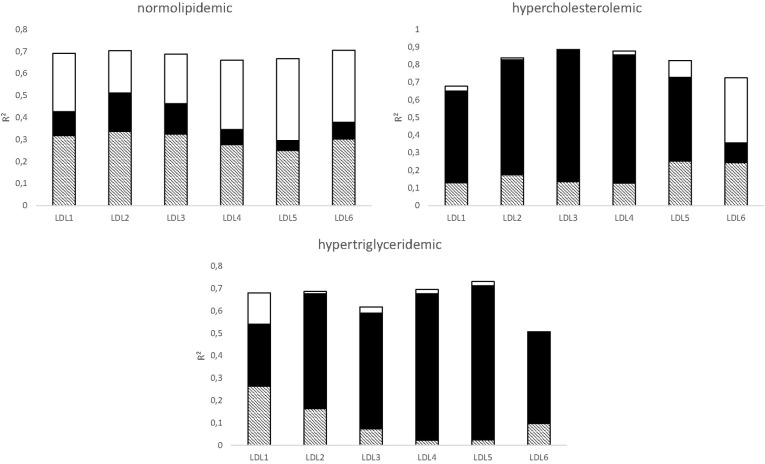
Lipoprotein profiles of n = 236 participants are evaluated. Plasma was separated by sequential ultracentrifugation into VLDL, IDL, LDL and HDL. Additionally, LDL and HDL were separated into subfractions. Stepwise multiple linear regressions were used to study LDL's ApoB mass and lipid composition. Relying on these results and on causation, we constructed a mathematical model to estimate LDL's retention time.
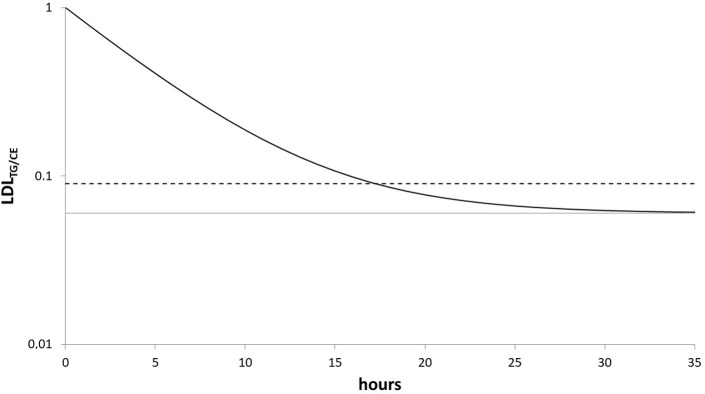
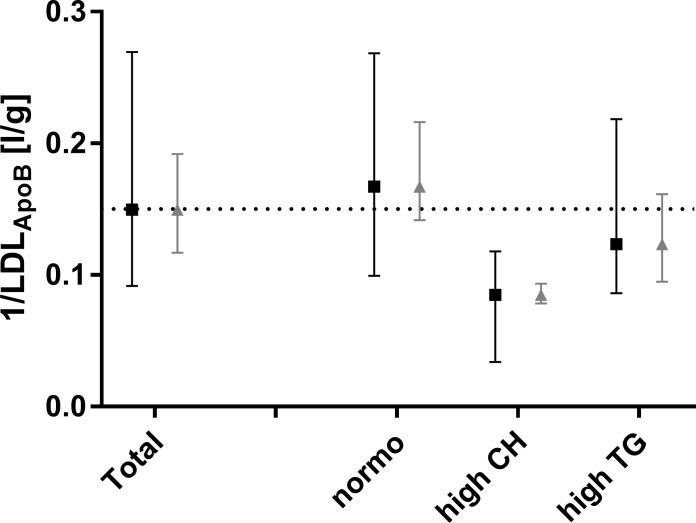
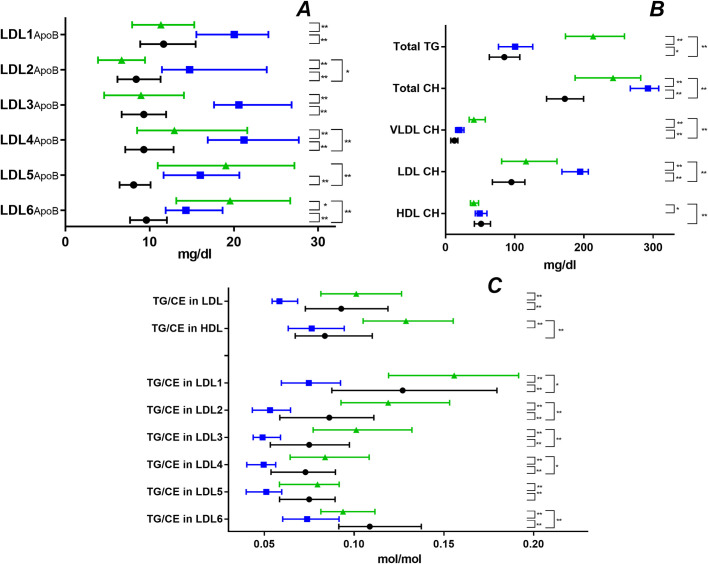
The ApoB mass in LDL correlated best among all measured parameters (including corresponding lipid compositions but using no LDL-associated parameters) with the cholesterol ester content in IDL. TG/CE ratios in LDL's subfractions were strongly correlated with the corresponding ratios in IDL and HDL. The constructed mathematical model links the TG/CE ratio of LDL and HDL to LDL's ApoB concentration and enables a good estimate of LDL's retention time in plasma.
Relying on our statistic evaluations, we assume that i) the production of nascent LDL via IDL as well as ii) LDL's prolonged retention are mapped by the TG/CE ratio in LDL subfractions. HDL's TG/CE ratio is associated with the change in LDL's TG/CE ratio during its retention in plasma. Our mathematical model uses this information and enables-by relying on causation- a good estimation of LDL's retention time.
如果要研究病理学、降脂策略或 LDL 代谢本身,了解 LDL 的动态行为(即产生率和分数代谢率)的信息将很有意义。这些速率的确定既昂贵又复杂。在这里,我们研究了 LDL 质量与其组成和其他脂蛋白之间的相互关系。基于这些数据,我们推导出有关 LDL 动态行为的信息。
评估了 236 名参与者的脂蛋白谱。通过连续超速离心将血浆分离成 VLDL、IDL、LDL 和 HDL。此外,还将 LDL 和 HDL 分离成亚组分。使用逐步多元线性回归研究 LDL 的 ApoB 质量和脂质组成。根据这些结果和因果关系,我们构建了一个数学模型来估计 LDL 的保留时间。
在所有测量的参数中(包括相应的脂质组成,但不使用 LDL 相关参数),LDL 的 ApoB 质量与 IDL 中的胆固醇酯含量相关性最佳。LDL 亚组分中的 TG/CE 比值与 IDL 和 HDL 中的相应比值密切相关。构建的数学模型将 LDL 和 HDL 的 TG/CE 比值与 LDL 的 ApoB 浓度联系起来,可以很好地估计 LDL 在血浆中的保留时间。
基于我们的统计评估,我们假设 i)通过 IDL 产生新生 LDL 以及 ii)LDL 的延长保留由 LDL 亚组分中的 TG/CE 比值来映射。HDL 的 TG/CE 比值与 LDL 在血浆中保留期间 TG/CE 比值的变化相关。我们的数学模型利用了这一信息,并通过因果关系实现了对 LDL 保留时间的良好估计。