ICMR- National Institute of Epidemiology, Chennai, Tamil Nadu, India.
World Health Organization, Country Office for India, New Delhi, India.
BMJ Open. 2022 Jul 28;12(7):e060197. doi: 10.1136/bmjopen-2021-060197.
We verified subnational (state/union territory (UT)/district) claims of achievements in reducing tuberculosis (TB) incidence in 2020 compared with 2015, in India.
A community-based survey, analysis of programme data and anti-TB drug sales and utilisation data.
National TB Elimination Program and private TB treatment settings in 73 districts that had filed a claim to the Central TB Division of India for progress towards TB-free status.
Each district was divided into survey units (SU) and one village/ward was randomly selected from each SU. All household members in the selected village were interviewed. Sputum from participants with a history of anti-TB therapy (ATT), those currently experiencing chest symptoms or on ATT were tested using Xpert/Rif/TrueNat. The survey continued until 30 cases were identified in a district.
We calculated a direct estimate of TB incidence based on incident cases identified in the survey. We calculated an under-reporting factor by matching these cases within the TB notification system. The TB notification adjusted for this factor was the estimate by the indirect method. We also calculated TB incidence from drug sale data in the private sector and drug utilisation data in the public sector. We compared the three estimates of TB incidence in 2020 with TB incidence in 2015.
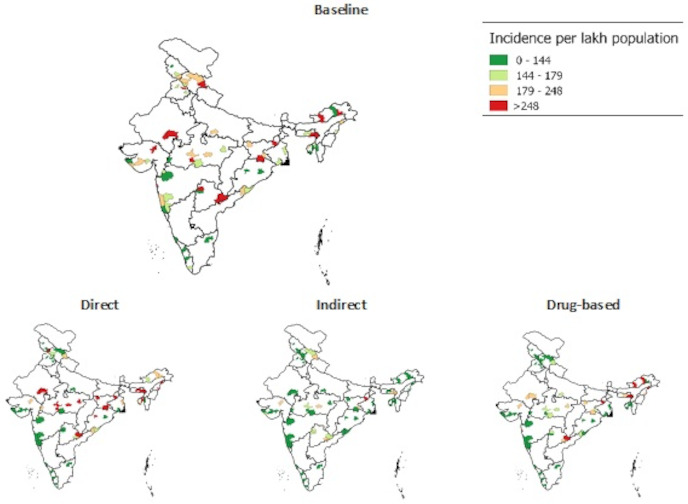
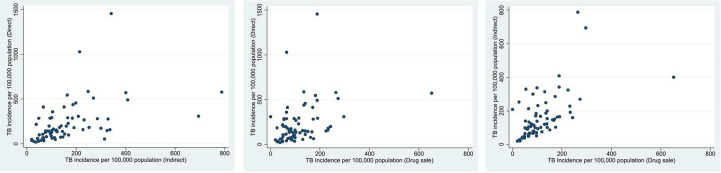
The estimated direct incidence ranged from 19 (Purba Medinipur, West Bengal) to 1457 (Jaintia Hills, Meghalaya) per 100 000 population. Indirect estimates of incidence ranged between 19 (Diu, Dadra and Nagar Haveli) and 788 (Dumka, Jharkhand) per 100 000 population. The incidence using drug sale data ranged from 19 per 100 000 population in Diu, Dadra and Nagar Haveli to 651 per 100 000 population in Centenary, Maharashtra.
TB incidence in 1 state, 2 UTs and 35 districts had declined by at least 20% since 2015. Two districts in India were declared TB free in 2020.
我们验证了印度在 2020 年相对于 2015 年在降低结核病(TB)发病率方面的次国家级(邦/联邦属地(UT)/地区)成就声明。
一项基于社区的调查、对国家结核病消除计划和私营结核病治疗机构的方案数据、抗结核药物销售和利用数据的分析。
在向印度中央结核病司声称结核病发病率下降至少 20%的 73 个地区的结核病治疗机构和私营结核病治疗机构。
每个地区都被划分为调查单位(SU),每个 SU 随机选择一个村庄/病房。从选中的村庄中随机抽取所有家庭成员进行访谈。对有抗结核治疗史(ATT)的参与者、目前有胸部症状或正在接受 ATT 的参与者进行 Xpert/Rif/TrueNat 检测。调查继续进行,直到在一个地区确定了 30 个病例。
我们根据调查中发现的新发病例计算了结核病发病率的直接估计值。我们通过在结核病报告系统中匹配这些病例来计算漏报率。通过该因素调整后的结核病报告发病率是间接法的估计值。我们还从私营部门的药物销售数据和公共部门的药物利用数据中计算了结核病发病率。我们将 2020 年的三种结核病发病率估计值与 2015 年的发病率进行了比较。
1 个邦、2 个 UT 和 35 个地区的发病率至少下降了 20%。2020 年,印度有两个地区被宣布为结核病发病率为零。