Institute for Systems and Robotics, Instituto Superior Técnico, Universidade de Lisboa, Lisbon, Portugal.
Singapore Management University, Singapore, Singapore.
J Neuroeng Rehabil. 2022 Jul 28;19(1):83. doi: 10.1186/s12984-022-01053-z.
The increasing demands concerning stroke rehabilitation and in-home exercise promotion grew the need for affordable and accessible assistive systems to promote patients' compliance in therapy. These assistive systems require quantitative methods to assess patients' quality of movement and provide feedback on their performance. However, state-of-the-art quantitative assessment approaches require expensive motion-capture devices, which might be a barrier to the development of low-cost systems.
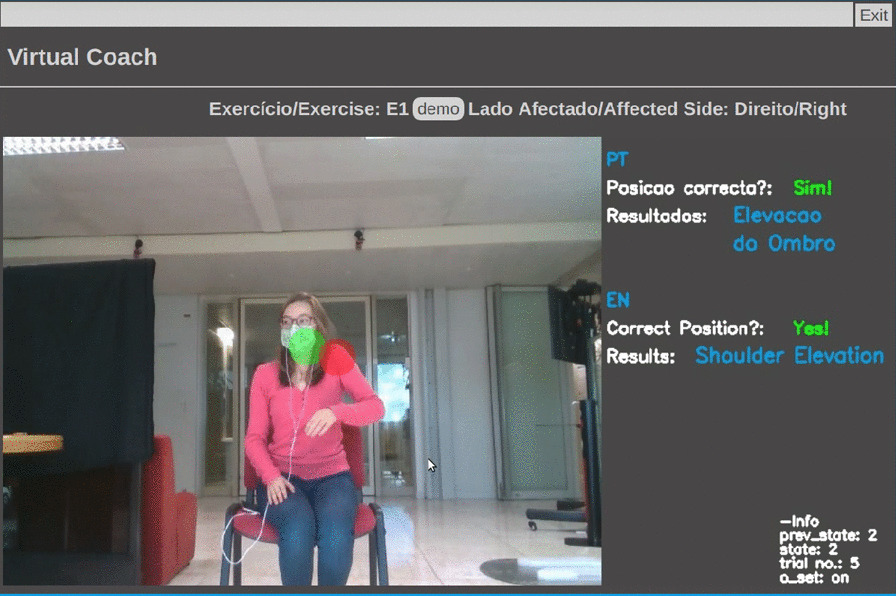
In this work, we develop a low-cost virtual coach (VC) that requires only a laptop with a webcam to monitor three upper extremity rehabilitation exercises and provide real-time visual and audio feedback on compensatory motion patterns exclusively from image 2D positional data analysis. To assess compensation patterns quantitatively, we propose a Rule-based (RB) and a Neural Network (NN) based approaches. Using the dataset of 15 post-stroke patients, we evaluated these methods with Leave-One-Subject-Out (LOSO) and Leave-One-Exercise-Out (LOEO) cross-validation and the [Formula: see text] score that measures the accuracy (geometric mean of precision and recall) of a model to assess compensation motions. In addition, we conducted a pilot study with seven volunteers to evaluate system performance and usability.
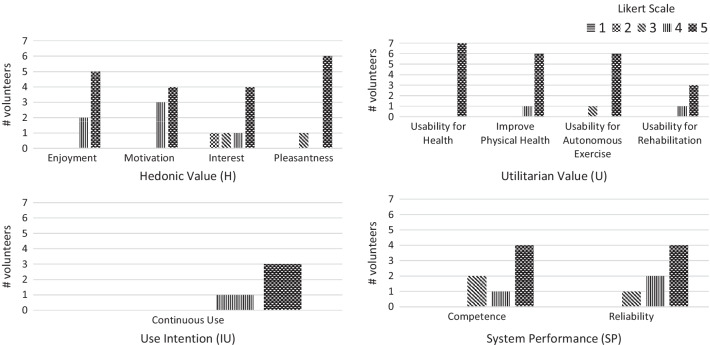
For exercise 1, the RB approach assessed four compensation patterns with a [Formula: see text] score of [Formula: see text]. For exercises 2 and 3, the NN-based approach achieved a [Formula: see text] score of [Formula: see text] and [Formula: see text], respectively. Concerning the user study, they found that the system is enjoyable (hedonic value of 4.54/5) and relevant (utilitarian value of 4.86/5) for rehabilitation administration. Additionally, volunteers' enjoyment and interest (Hedonic value perception) were correlated with their perceived VC performance ([Formula: see text]).
The VC performs analysis on 2D videos from a built-in webcam of a laptop and accurately identifies compensatory movement patterns to provide corrective feedback. In addition, we discuss some findings concerning system performance and usability.
随着对中风康复和家庭运动促进的需求不断增加,需要经济实惠且易于使用的辅助系统来提高患者对治疗的依从性。这些辅助系统需要定量方法来评估患者的运动质量,并为其提供有关运动表现的反馈。然而,最先进的定量评估方法需要昂贵的运动捕捉设备,这可能成为开发低成本系统的障碍。
在这项工作中,我们开发了一种低成本的虚拟教练 (VC),仅需使用带有网络摄像头的笔记本电脑即可监控三种上肢康复运动,并仅通过二维图像位置数据分析提供实时视觉和音频反馈补偿运动模式。为了对补偿模式进行定量评估,我们提出了基于规则 (RB) 和神经网络 (NN) 的方法。我们使用 15 名中风患者的数据集,通过留一受试者外 (LOSO) 和留一运动外 (LOEO) 交叉验证以及 [Formula: see text] 评分来评估这些方法,该评分用于衡量模型评估补偿运动的准确性 (精度和召回率的几何平均值)。此外,我们还进行了一项七名志愿者参与的试点研究,以评估系统的性能和可用性。
对于练习 1,RB 方法评估了四个补偿模式,其 [Formula: see text] 得分为 [Formula: see text]。对于练习 2 和 3,基于 NN 的方法分别实现了 [Formula: see text] 得分为 [Formula: see text] 和 [Formula: see text]。关于用户研究,他们发现系统对于康复管理是令人愉快的 (享乐价值为 4.54/5) 和相关的 (实用价值为 4.86/5)。此外,志愿者的享受和兴趣 (享乐价值感知) 与他们对 VC 性能的感知相关 ([Formula: see text])。
VC 可对笔记本电脑内置网络摄像头的二维视频进行分析,并准确识别补偿运动模式,提供纠正反馈。此外,我们还讨论了一些关于系统性能和可用性的发现。