Department of Respiratory Medicine, The Second Hospital of Jilin University, Changchun, China.
Department of Immunology, College of Basic Medical Sciences, Jilin University, Changchun, China.
Front Immunol. 2022 Jul 12;13:921275. doi: 10.3389/fimmu.2022.921275. eCollection 2022.
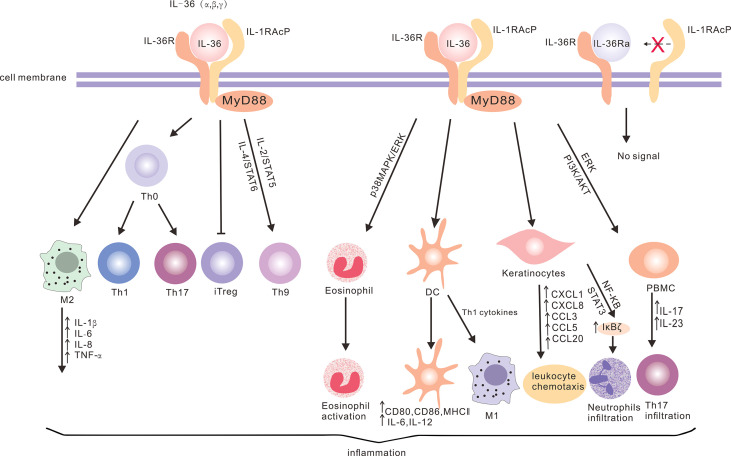
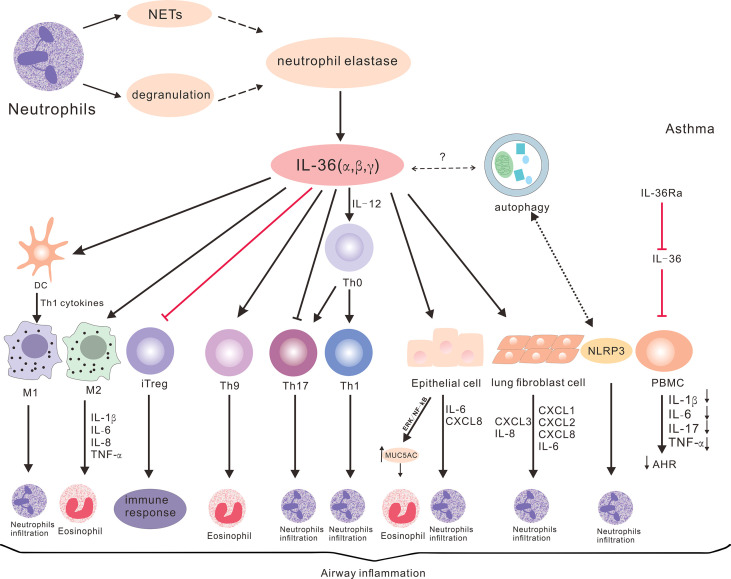
Interleukin (IL)-36 cytokines are members of the IL-1 superfamily, which consists of three agonists (IL-36α, IL-36β and IL-36γ) and an IL-36 receptor antagonist (IL-36Ra). IL-36 cytokines are crucial for immune and inflammatory responses. Abnormal levels of IL-36 cytokine expression are involved in the pathogenesis of inflammation, autoimmunity, allergy and cancer. The present study provides a summary of recent reports on IL-36 cytokines that participate in the pathogenesis of inflammatory diseases, and the potential mechanisms underlying their roles in asthma. Abnormal levels of IL-36 cytokines are associated with the pathogenesis of different types of asthma through the regulation of the functions of different types of cells. Considering the important role of IL-36 cytokines in asthma, these may become a potential therapeutic target for asthma treatment. However, existing evidence is insufficient to fully elucidate the specific mechanism underlying the action of IL-36 cytokines during the pathological process of asthma. The possible mechanisms and functions of IL-36 cytokines in different types of asthma require further studies.
白细胞介素 (IL)-36 细胞因子是 IL-1 超家族的成员,该超家族由三种激动剂(IL-36α、IL-36β 和 IL-36γ)和一种 IL-36 受体拮抗剂(IL-36Ra)组成。IL-36 细胞因子对于免疫和炎症反应至关重要。IL-36 细胞因子表达水平异常与炎症、自身免疫、过敏和癌症的发病机制有关。本研究总结了近年来关于参与炎症性疾病发病机制的 IL-36 细胞因子的研究报告,并探讨了其在哮喘发病机制中的潜在作用机制。通过调节不同类型细胞的功能,异常的 IL-36 细胞因子水平与不同类型哮喘的发病机制有关。鉴于 IL-36 细胞因子在哮喘中的重要作用,它们可能成为哮喘治疗的潜在治疗靶点。然而,目前的证据还不足以充分阐明 IL-36 细胞因子在哮喘病理过程中作用的确切机制。IL-36 细胞因子在不同类型哮喘中的可能机制和功能需要进一步研究。